At least 20 years after the Moody Awori prison reforms were praised as a turning point in the country’s correctional facilities, National Treasury austerity measures are quietly undoing them.
In a rare moment, Correctional Services Principal Secretary Dr Salome Beacco broke ranks and blamed the National Treasury’s continued budget rationalisation, which she says has hit correctional facilities hard.
Dr. Salome Beacco, the Principal Secretary State Department for Correctional Services.
Photo credit: File | Nation
This comes as a report by Auditor-General Nancy Gathungu on the accounts of the State Department for Correctional Services for the 2024/25 fiscal period exposed a sorry state of affairs in the country’s correctional facilities, diminishing the transformative reforms started by former Vice President Moody Awori.
The reforms sought to shift life in correctional facilities from a punitive culture to a rehabilitative one through improvements in food rations, living conditions, and infrastructure.
However, during a meeting of the National Assembly Committee on Public Accounts (PAC), Dr Beacco blamed the deteriorating conditions in the facilities—including overcrowding, poor food, and collapsing infrastructure—directly on constant budget cuts.
“Rationalisation of our budget by the National Treasury has really affected our State Department… so we are left to utilise what we have, which is not enough,” said Dr Beacco.
The State Department for Correctional Services is charged with promoting policies to reform the penal justice system. This includes developing administrative policies for institutions and facilities for incarcerated minors and probation services.
A large portion of the allocation to the State Department goes toward personnel emoluments and medical cover for prison warders, leaving little for development, as rationalised by the National Assembly.
For instance, the budget allocation to the State Department in the current fiscal year—2025/26—is Sh38.15 billion, compared to Sh34.39 billion in the 2024/25 period, according to Controller of Budget (CoB) Dr Margaret Nyakang’o in her February 2026 budget implementation report for the national government.
The Controller of Budget, Margaret Nyakang'o.
Photo credit: File | Nation
Of the budget allocated in the last financial year, Sh1 billion was set aside for improving conditions in correctional facilities. However, Dr Beacco told PAC that the amount was reduced by Sh300 million, making it difficult for the State Department to implement reforms.
“The Justice and Legal Affairs Committee has allocated us Sh1 billion to improve our prisons in the next financial year,” she said, after Lugari MP Nabii Nabwera sought to know whether the Moody Awori modernisation reforms had stalled.
“Moody Awori is my voter and he keeps asking why what he started has been ignored,” said Dr Wilberforce Oundo, whose Funyula constituency Mr Awori represented in the 10th Parliament.
According to Mathioya MP Edwin Mugo, correctional facilities are among the most neglected institutions, yet “we have seen senior political figures landing there.”
Turkana Central MP Joseph Namuar added, “I was talking to someone who had completed his jail term, and he told me that prisons are some of the most horrible places.”
The audit notes that some correctional facilities still have asbestos roofing. Some of the prison staff, including warders and senior officers, live in condemned housing units.
Overcrowding in inmate wards, lack of perimeter walls, absence of ceilings in wards housing capital offenders, lack of CCTV cameras, leaking roofs, and poor-quality food infested by rodents have made life in the country’s correctional facilities increasingly harsh for both inmates and staff.
The audit is based on verification exercises conducted in July and August 2025, covering 23 correctional facilities across the country.
The poor living conditions for both prison officers and inmates are contrary to the Occupational Safety and Health Act of 2007.
Entrance to Kodiaga Main Prison in this picture taken on July 25, 2017.
Photo credit: File | Nation Media Group
Section 6(1) of the Act states that every occupier shall ensure the safety, health, and welfare at work of all persons working in their workplace.
“In the circumstances, the State Department for Correctional Services is in breach of the law, and service delivery in correctional facilities may be impaired due to the poor condition of buildings and infrastructure,” the audit reads.
For instance, at Nanyuki Main Prison, wards meant for capital offenders have no ceilings, which the audit describes as a serious security threat.
“Ordinary wards and Ward Six require a complete plastering overhaul, and all wards need flooring and toilet repairs. Staff houses require ceilings, floor repairs, and repainting,” the audit notes.
It further states that the inmates’ kitchen requires a roofing overhaul. “The roofing of the capital mixed block needs renovation to enhance security, while the perimeter wall for the main prison, expanded women’s prison, and watchtowers should be improved.”
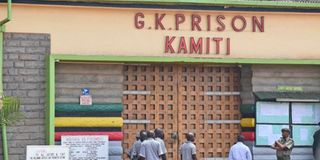
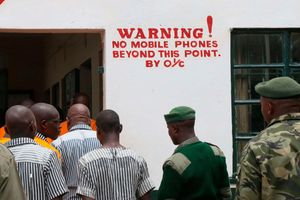
Inmates and correctional officers at Kamiti Maximum Security Prison.
Photo credit: File | Nation Media Group
At Meru Main Prison, the audit reveals that 10 wards require new roofs, timberwork, and iron sheets. It also notes that five wards require toilet basin replacements, 90 staff houses need refurbishment, and the guard room, dispensary, and welfare office require new roofing and repainting.
Additionally, the administration block, documentation office, special store (armoury), general office, Officer-in-Charge office, and deputy OIC office all require roofing and repainting.
At Nairobi Medium Prison, the situation is similar.
There is inadequate office accommodation for staff, with only three office rooms serving the officer in charge, general office, and accounts office.
The prisoners’ ward floors are dilapidated, with rough surfaces, potholes, and dirty marks on the walls, while some sections of the roof leak during rainfall.
The facility has no generator backup in case of prolonged power outages and no CCTV cameras to monitor activities within the prison.
The kitchen used to prepare meals for inmates is in a dilapidated state, with a poor drainage system and stagnant dirty water.
“The floor has potholes, which make it impossible to clean thoroughly, exposing inmates to health hazards and potential disease outbreaks,” the audit warns. This could further increase government treatment costs, it adds.