Geoffrey (not his real name) has been in Nakuru Main Prison for eight months. He was imprisoned in 2025 after being found guilty of defilement, and is serving a 20-year sentence. His first eight months behind bars have been a nightmare, he says. When he arrived, he found the prison severely overcrowded. For the past eight months, almost 200 inmates have shared a single toilet. They take turns to use the facility, but due to the extreme overcrowding, they are sometimes forced to relieve themselves in their cells, which endangers their health.
The living conditions are inhumane — even lying down is a luxury. Some inmates have contracted diseases due to poor sanitation, and some have even died. Geoffrey has been left with a frail body, hollow cheeks and sunken eyes. For many inmates at Nakuru Main Prison and Nakuru Women's Prison, enduring these conditions is a daily struggle.
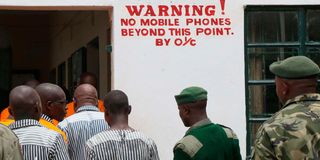
Inmates are escorted into Nakuru Main Prison on April 20, 2026.
Photo credit: Boniface Mwangi | Nation
The Nation has learnt that Nakuru G.K. Prison, which houses Nakuru Main Prison (for men) and Nakuru Women's Prison, has been grappling with a severe overcrowding crisis that has left inmates and remandees suffering. According to the authorities, Nakuru Main Prison was originally built to hold 800 people, but it now has 1,864 inmates and remandees. Boaz Leitich, the deputy officer-in-charge, said that the facility is approximately 200 per cent over capacity. One ward that is designed to accommodate around 50 prisoners is currently housing over 150.
In total, the two facilities at the Nakuru G.K Prison hold over 2,000 people. These individuals represent just a fraction of the 17,663 inmates held in Rift Valley region prisons, comprising 11,570 convicted individuals and 6,093 remandees, against a certified capacity of only 13,382.
The facilities have been struggling with sanitation and health issues, primarily due to a high number of remandees and a significant backlog of court cases.
Inmates are escorted into Nakuru Main Prison on April 20, 2026.
Photo credit: Boniface Mwangi | Nation
The Nation has established that of the people in these facilities, more than 900 are remandees who have yet to be convicted. A Nakuru Women's Prison officer revealed that many of these individuals are awaiting trial because they cannot afford bail.
On Monday, the National Assembly's Constitutional Implementation Oversight Committee (CIOC) visited the two facilities and witnessed the crisis first-hand. During the visit, the committee witnessed the harsh reality of severe overcrowding, with hundreds of inmates forced to share limited cells and toilets. The MPs expressed dismay at the state of the facilities and pledged to push for legislative reforms and additional funding to improve conditions. The committee's chairman, Charles Ngina (who is also the Mwingi North MP), questioned how more than 150 men could be expected to share a single toilet.
During the inspection, the MPs found that the correctional facilities have been struggling due to chronic underfunding. Key issues raised included how overcrowding has severely strained sanitation systems, inmate healthcare and overall security. At the women’s correctional facility, the MPs found that 13 children were living in general prison wards with their mothers, with no steady supply of nappies or sanitary towels. Furthermore, the facility lacks a perimeter wall, creating significant security risks and facilitating the smuggling of contraband.
The committee was also briefed on the difficulties inmates encounter when trying to access medication and the limited support they receive from the Social Health Insurance Fund (SHIF). It emerged that sick inmates were detained in or rejected by hospitals because they were not paying members, primarily due to the National Treasury's failure to remit premiums.
The committee was also informed that many prison officers are forced to live in insecure areas due to a chronic shortage of official housing.
Prison wardens at the entrance of the Nakuru Main Prison on April 20, 2026.
Photo credit: Boniface Mwangi | Nation
Embakasi Central MP Benjamin Gathiru asked the management to submit a proposal to the Ministry of Housing so that officers could benefit from the Affordable Housing Programme. He noted that significant funds had already been allocated to such initiatives.
The committee promised to hold a joint meeting with the Interior Cabinet Secretary Kipchumba Murkomen and the Attorney-General to discuss legislative gaps, funding and overcrowding. Mr Ngina added that various reforms must be implemented following the visit, as the committee does not want these inspections to be merely a tick-box exercise. The aim is to ensure that all of Kenya’s prisons become centres for rehabilitation, rather than merely places of detention. The lawmakers also called for an urgent review of Cap 90 of the colonial-era Prisons Act, as it no longer conforms to modern standards. A few weeks ago, the government launched a legal aid centre at Nakuru GK Prison to expand access to justice and help inmates fast-track their cases, reducing backlogs.