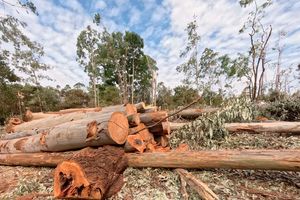
In 1990, Kenyans woke up to the shocking news that Karura Forest, Nairobi’s last great green forest, was being carved up by powerful elites. Bulldozers stood ready, title deeds were issued in backrooms, and plans were underway to clear vast tracts of woodland for luxury housing.
Between 1994 and 1998 alone, more than 500 hectares of Karura’s 1,000 hectares were secretly allocated to private developers. For speculators, it was prime real estate. For conservationists, it was an unforgivable act of vandalism.
Nobel laureate Wangari Maathai, alongside students, activists, and residents, mobilised a campaign of resistance. They planted trees, staged protests, and faced violent crackdowns from security forces. The forest became a frontline in Kenya’s democratic awakening.
Prof Karanja Njoroge, today the Chairperson of Friends of Karura Forest (FKF), was among those on the frontlines. In an exclusive interview, he recalled the turning point:
“It was a battle and we stood up against the grabbers. Due to the change in government and multiparty democracy, most of the grabbers who had title deeds kept off and that is how we were able to secure the forest.”
A section of Kenyans identifying themselves as 'Friends of Karura Forest' hold demonstration over eCitizen rollout on August 29, 2025, at Karura Forest's main entrance.
Photo credit: Wilfred Nyangaresi | Nation Media Group
With a new government in place in 2002, Maathai, then Assistant Minister for Environment and Natural Resources, and Prof Njoroge worked to institutionalise the fight. The State sponsored a joint team of FKF and government representatives to travel to Indonesia to study participatory forest management. The model where communities and government share responsibility would later shape Kenya’s own approach.
But implementation was slow. It was not until 2009 that FKF signed a landmark agreement with the Kenya Forest Service (KFS), formalising joint management of Karura.
“We needed a fence around the forest,” Prof Njoroge said. “As FKF we sought partners and received our first funding of Sh3.7 million from East Africa Breweries Limited. We later raised Sh37 million to complete the fence.”
That fence marked the beginning of Karura’s rebirth. FKF recruited seven scouts, trained by the British Army Training Unit Kenya (Batuk), to patrol the forest and restore it.
“The forest was a den for charcoal burning, chang’aa brewing, and all the bad things,” Njoroge recalled. “Mothers used to threaten children by saying they would take them to Karura if they misbehaved, because it was a terrible place. We collected many bodies there when we began restoration.”
Stranded workers at the Karura Forest, Limuru Road entrance, on August 29, 2025.
Photo credit: Wilfred Nyangaresi | Nation Media Group
In February 2010, the forest was formally opened to the public for the first time. Prof Njoroge remembers the milestone clearly:
“We charged Sh100 for adults and Sh50 for kids. We were very happy since that month we had 345 visitors who came to the forest, and we realised that we could generate income to manage conservation efforts.”
Since then, the community has remained on the frontline of conservation. Most of Karura’s staff are women drawn from the surrounding low-income communities of Githogoro, Huruma, and Gachie. Their work has not only restored the forest but also provided livelihoods where few opportunities previously existed.
“They are all women and they are paid from the fees that we raise from the park. That is how we support the community,” Prof Njoroge says.
Schools, volunteers, and local groups joined FKF in planting indigenous trees, organising clean-ups, and strengthening security. What was once a crime hotspot where 18 bodies were discovered at one point is today a safe public haven.
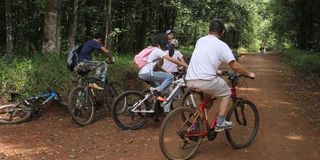
Karura now boasts more than 50 kilometres of walking and cycling trails, caves, waterfalls, picnic sites, and thriving wildlife. The forest covers 1,041 hectares (2,570 acres), divided by Limuru and Kiambu roads. Its restoration has brought back 260 bird species and wildlife ranging from suni and Harvey’s duiker to bush pigs, civets, Syke’s monkeys, porcupines, and honey badgers.
But the battle for Karura never truly ended. In 2019, KFS revealed developers were once again eyeing sections of the land, sparking public outrage. Conservationists warned that vigilance must never wane. A case is also currently before the courts challenging the planned expansion of Kiambu Road, which borders Karura. Conservationists argue that road works could eat into sections of the forest, fragment wildlife habitats, and undo years of painstaking rehabilitation.
The latest threat came on August 29, when FKF accused KFS of staging an abrupt takeover of the forest’s management. At issue is a directive to channel all payments — currently worth about Sh20 million a month, or Sh245 million annually — exclusively through the government’s eCitizen platform.
“We have all the documents, including the Management Agreement and Management Plan. This is a situation where KFS wants to do things their own way without consultation. We will not allow it,” Prof Njoroge said.
FKF insists the change could cripple community-led conservation by starving them of resources to pay staff, maintain trails, and engage neighbouring communities.
“Before our involvement, Karura faced serious insecurity and neglect,” the association said. “If stripped of resources, the forest risks sliding back into the lawless, dangerous state it once was.”