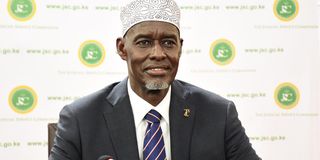
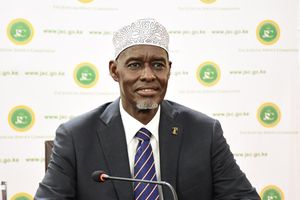
The commission selected Justice Warsame after a competitive interview process that tested candidates on legal depth, constitutional philosophy and leadership within the Judiciary. His long service on the Bench and in judicial administration proved decisive.
Appearing before the panel, Justice Warsame said he would bring more than three decades of legal and judicial experience to the apex court.
“I bring over 32 years of legal experience. I bring jurisprudential leadership. It is the Supreme Court that leads the country in the right direction,” he said.
Justice Warsame: Islamic law is not repugnant to justice
He told commissioners that his experience cuts across criminal law, civil litigation and judicial review, noting that he was the first presiding judge of the Judicial Review Division under the 2010 Constitution.
“I have dealt with all spheres of the law: both criminal and civil judicial review. I am the first presiding judge of the Judicial Review Division under the current Constitution, so I was the first to interpret and interact with the current Constitution,” he said.
“I bring an impeccable record of integrity, which is the hallmark of the leadership of the Judiciary and the Supreme Court. My record in terms of integrity is very clear. I have never, in my life as a judge, come into question where my actions were challenged in terms of integrity,” he said.
His nomination follows a legal career that began after his admission to the Bar in 1994. He trained at the University of Nairobi and the Kenya School of Law before entering private practice, where he built a reputation as a skilled litigator.
Before joining the Bench, he worked at Anjarwalla Abdulhussein & Co. Advocates in 1994, then at Wahome & Co. Advocates between 1995 and 1996, before founding Warsame & Co. Advocates, where he practised from 1996 to 2003. He also served as an acting puisne judge between 2003 and 2004 before his appointment to the High Court in 2004.
At the High Court, he handled commercial, criminal and judicial review matters. During his interview, the JSC said colleagues in the legal profession had credited him with firm case management and sustained efforts to reduce backlog.
His tenure came at a time of mounting criticism over judicial delays, with records showing he prioritised efficiency and strict timelines in resolving disputes.
Justice Warsame later chaired the Community Service and Probation Committee, where he oversaw the release of more than 7,000 petty offenders through non-custodial sentences, easing pressure on the prison system.
His elevation to the Court of Appeal of Kenya in 2012 expanded his judicial footprint. There, he handled complex constitutional and commercial disputes, contributing to key appellate jurisprudence.
Supreme Court interviews day 2: Justice Mohamed Warsame
Beyond the courtroom, he served at the JSC for a decade, from 2013 to 2023, representing judges of the Court of Appeal. He sat on finance and human resource committees, giving him a deeper role in judicial governance and reform.
That experience placed him at the centre of a constitutional dispute over his own reappointment to the commission in 2018, when he was re-elected by Court of Appeal judges to represent them at the JSC.
Former President Uhuru Kenyatta declined to gazette his appointment and instead sought parliamentary vetting. The Law Society of Kenya challenged the move in court.
The High Court barred the National Assembly of Kenya from vetting him, ruling that elected commissioners do not require parliamentary approval. The dispute later reached the Supreme Court, which affirmed that elected and nominated JSC members are not subject to parliamentary vetting and that the President’s role is limited to formal appointment.
The decision clarified the constitutional framework governing judicial appointments and reinforced the independence of the commission.
During the latest interview, commissioners said public feedback on Justice Warsame was largely positive, describing him as straightforward, approachable and respected by court users.
The Law Society of Kenya’s North Rift branch welcomed his nomination, while the Nakuru chapter credited him with measures that helped reduce case backlog and improve access to justice.
“I would describe myself as a person with a golden heart. I can relate with anybody irrespective of status,” he said when asked about the public feedback.
The panel also tested his jurisprudence through past decisions, including a Court of Appeal ruling involving a Muslim family property dispute.
Justice Warsame defended the ruling, arguing that it had been mischaracterised as a matrimonial property matter and insisting that courts must interpret disputes within both constitutional and factual contexts.
“The Supreme Court is not an ordinary court. It must give direction to the country,” he said.
He argued that the apex court should focus on constitutional interpretation rather than routine commercial appeals, adding that the Constitution must be read as a social contract shaped by history and compromise rather than public pressure.
Justice Warsame’s nomination comes at a critical time for the apex court. The vacancy arose after the death of Mohamed Ibrahim in December 2025.
The court has since been operating below its full complement of seven judges, even as it continues to handle presidential election petitions and major constitutional disputes.
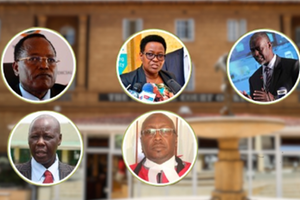
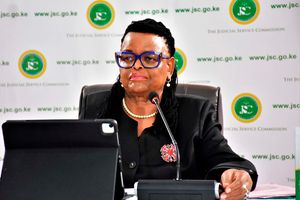
Other candidates interviewed for the position included Court of Appeal judges Francis Tuiyott and Katwa Kigen, High Court judge Joseph Sergon and advocate Anne Makori.