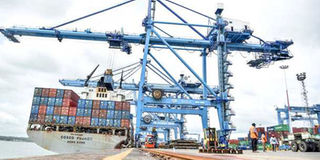
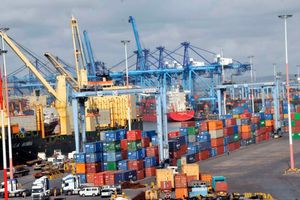
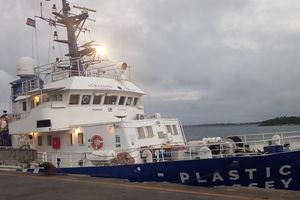
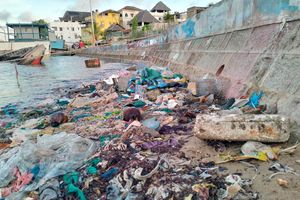
The Mombasa County government has suffered a legal setback in its bid to collect up to $1,500 (Sh193,500) every seven days from ships docking at the Port of Mombasa after the High Court ruled that it had no legal basis to impose the levy.
The court declared unconstitutional a law requiring vessels to pay $2 (Sh258) for every 100 tonnes of gross registered tonnage, subject to a minimum charge of $200 (Sh25,800) and a maximum of $1,500 every seven days.
In a stinging rebuke, the judge found that the county charged ships without showing it provided the waste reception services the levy was meant to fund.
“There is, on this record, no service; and without a service there can be no corresponding benefit in return. The charge is therefore not a valid charge ‘for services’ under Article 209(4),” the court ruled.
The decision deals a blow to the county’s attempt to raise revenue from maritime traffic through an environmental charge, which it defended as an application of the polluter-pays principle.
The court, however, said the levy was imposed simply because a vessel docked, regardless of whether it discharged waste or used any waste reception facility.
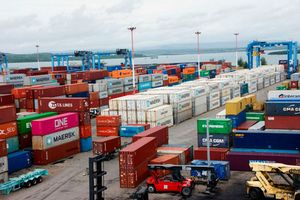
Cargo containers at the Port of Mombasa in September last year.
Photo credit: File | Nation Media Group
It said Section 120 of the County Governments Act, 2012, only permits counties to charge for services they provide. The levy, the judge added, was effectively a charge for docking rather than waste management.
“A charge computed upon gross registered tonnage and levied upon every ship that docks, whether or not it lands so much as a kilogram of refuse, is not, in substance, the price of a waste-reception service; it is an impost upon the act of docking,” the judge said.
The court also found that the county did not operate a certified port waste reception facility and could not rely on the County Governments Act to justify charging for services it did not provide.
Beyond the absence of a service, the judge found that the levy fell outside the categories of taxes counties are constitutionally authorised to impose and lacked authorisation under an Act of Parliament.
The court warned that allowing counties to impose such charges on vessels at a major national port could interfere with economic activities beyond their borders.
A picture of the Mombasa Law Courts| Pool
Photo credit: Pool
“The taxation and other revenue-raising powers of a county shall not be exercised in a way that prejudices national economic policies, economic activities across county boundaries or the national mobility of goods, services, capital or labour,” the court said, citing Article 209(5) of the Constitution.
The judge consequently declared Section 42A of the Mombasa County Solid Waste Management Act, 2021, unconstitutional because the levy was inconsistent with the Constitution and the amendment had been enacted without adequate public participation.
An undated Kenya Ports Authority (KPA) customer notice used to enforce the charge was also quashed. The court said KPA, a national statutory body, needed a lawful instrument, agreement or delegation to collect a county levy.
“Once that provision falls, the notice is left without a lawful foundation, and an instrument that rests upon an unconstitutional provision cannot survive it,” the court ruled.
The case was filed in 2024 by Mombasa resident Ruwaida Hussein, who challenged the levy introduced through the Mombasa County Solid Waste Management (Amendment) Act, 2023.
The law exempted several categories of vessels, including non-commercial government ships, KPA-owned vessels, authorised ferries operating exclusively within the harbour, ships below 500 gross registered tonnes and vessels trading between Kenyan ports.
Ms Hussein argued that the amendment was unconstitutional because it imposed charges without providing corresponding services and was enacted without meaningful public participation.
The Mombasa County Assembly offices.
Photo credit: Brian Wachira I Nation Media Group.
She also challenged its compliance with Kenya’s obligations under the International Convention for the Prevention of Pollution from Ships (MARPOL), arguing that vessels were being charged despite the absence of a certified waste reception facility.
The County Assembly defended the levy as an environmental measure enacted within its legislative mandate. It maintained that the charge implemented the polluter-pays principle and was a fee for services under the County Governments Act.
The County Government said it had conducted public participation, adding that the Shippers Council for East Africa had been consulted and supported the levy. It also said KPA had been appointed to collect the money on its behalf.
However, the court found that the Assembly had failed to produce evidence of public notices, advertisements, hearings, submissions received or publication of the Bill for public comment.
“The onus of establishing reasonable participation lay on the respondents. On the material placed before the court, that onus has not been discharged,” the judge ruled.
The court clarified that it was not necessarily finding that no public participation had taken place, but that the evidence presented did not demonstrate compliance with constitutional requirements. It held that the failure to meet that threshold provided an additional ground for invalidating the amendment.