The Kenya Medical Supplies Authority (Kemsa) has been ordered to pay a software developer $100,000 (Sh13 million) after it was found to have illegally copied his procurement software.
During the course of his engagement between 2006 and 2011 with Deutsche Gesellschaft für Technische Zusammenarbeit (GIZ/GTZ), a development agency based in Germany, developer Frank Frederichs built a public procurement and logistics management system and fronted it to GTZ for use in large-scale procurement operations.
Around the same time, Kemsa, through an agreement involving Crown Agents, GTZ and John Snow Incorporated (JSI), established a specialised procurement agency called the Procurement and Supply Chain Management Consortium (PSCMC).
The consortium was mandated to handle the procurement of medical commodities for HIV/AIDS, TB and malaria programmes funded by the Global Fund. Under this arrangement, PSCMC became the sole procuring agent for all Global Fund-supported medical commodities in Kenya.
To get the job done, the consortium relied on Mr Frederichs’ system to manage procurement processes and generate tender documents. Meanwhile, Kemsa continued to use its own ERP system for other procurements funded by development partners such as USAID and the World Bank.
When the consortium’s engagement came to an end in early June 2011, a taskforce was formed to oversee the transition of Global Fund procurement back to Kemsa’s ERP system.
However, the taskforce recommended that Kemsa continue using the developer's procurement system. That is when he offered to lease it to Kemsa at an annual licence fee of $50,000 (Sh6.4 million).
Kemsa countered with an offer of Sh1.2 million a year, a figure Mr Frederichs rejected. After negotiations fell through, the developer went ahead and registered the software with the Kenya Industrial Property Institute and obtained a certificate.
Meanwhile, Kemsa continued to use the application until 2013, when Mr Frederichs filed a suit at the High Court accusing the State corporation of copyright infringement. He told the court that, despite negotiations falling through, Kemsa continued to use his software in generating tender documents. He further accused Kemsa of making backup copies and decompiling the software programme without seeking his authorisation.
In its defence, Kemsa denied any infringement, asserting that the procurement and logistics system was not the exclusive property of Mr Frederichs, given that it was developed under a consortium in which Kemsa was a part. It further argued that if there was a question over copyright ownership, then it belonged to GTZ and not Mr Frederichs.
The State corporation further argued that upon the collapse of negotiations with Mr Frederichs, staff who had been using the software were trained on the Kemsa ERP procurement module, which it had since been using. Kemsa claims it realised the system was inferior to its ERP module, stating that its own software was a comprehensive, state-of-the-art integrated computer system developed in August 2010 at a cost of Sh267 million.
Kemsa said its system incorporates modules on procurement, warehousing, distribution, customer care, finance, human resources and other support functions, which the procurement system could not do.
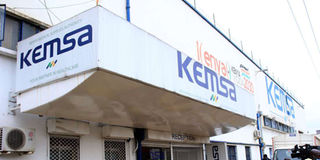
Kemsa offices in Industrial Area, Nairobi.
Photo credit: File | Nation Media Group
The High Court in its judgment, however, poked holes in Kemsa’s argument.
“Mr Frederichs was, at all material times to this suit, the bona fide copyright owner of the said database. It is therefore of little surprise that Kemsa had at one point felt the need to negotiate with Mr Frederichs for its use at the pain of a fee. Kemsa made admissions of discussions between it and Mr Frederichs in respect of the possible lease of the software. Those discussions were without success as the two could not agree on the yearly fees for the lease. The view of this court is that Kemsa had shown an interest in leasing the software...but the two were unable to agree on price.”
“Kemsa, which states that the programme was inferior to its ERP, must have clearly known its usefulness...Why, it must be asked, would it show an interest in a programme which could not match what it already had? It is also not lost that Kemsa was a member of the consortium, which had the benefit of the use of PPROLOG and therefore had an opportunity to interact with the programme.”
In its conclusion, the High Court awarded the software developer $100,000 as general damages, equivalent to two years’ licensing fees based on the amount he had quoted during the failed negotiations of $50,000 per year.
Unhappy with the decision, Kemsa contested it at the Court of Appeal, accusing the High Court judge of awarding excessive damages to Mr Frederichs, arguing that the amount had not been pleaded or prayed for.
However, the Court of Appeal, upon re-evaluating and re-analysing the evidence, upheld the High Court’s determination.
“Having re-evaluated the record of appeal, the fact that Frederichs registered the software in his own name without any objection from GTZ or any other consortium members strongly indicates that all parties recognised him as the rightful owner and not GTZ. On the issue of damages, given that negotiations for a licence were initiated but never concluded due to Kemsa’s refusal to pay and considering the length of unauthorised use, the trial court's award of $100,000 was reasonable. We find this appeal unmeritorious and dismiss it in its entirety.”