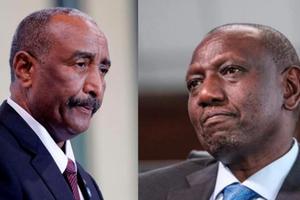
Kenya’s Parliament is under pressure to respond to a diplomatic protest by the Sudanese government, which has directly accused President William Ruto of aiding and abetting unrest in Sudan by allegedly supporting the Rapid Support Forces (RSF), a powerful paramilitary group blamed for war crimes and crimes against humanity.
A senior parliamentary official, who declined to be named due to the sensitivity of the matter, confirmed that the letter, dated March 14, 2025, and authored by Commander Malik Agar, the Vice President of Sudan’s Transitional Sovereign Council (TSC), had been received and was under review.
“The matter is a hot potato and will be dealt with at a higher level,” the official stated. “It will follow the normal government channels through the Ministry of Foreign Affairs, and MPs have been advised against commenting on it.”
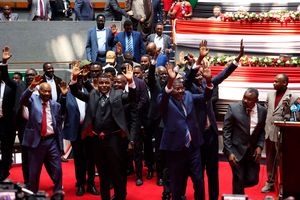
Delegates from Sudan's West Darfur State at the KICC in Nairobi on 18 February 18, 2025, ahead of the planned signing of the Government of Peace and Unity Charter.
Photo credit: Evans Habil | Nation Media Group
In the strongly worded communication, Mr Agar accuses the Kenyan President of allowing RSF leaders to operate from Kenyan soil and even facilitating meetings aimed at establishing a “parallel government” in Sudan, an act the Sudanese government views as a direct threat to its sovereignty and regional stability.
RSF is led by General Mohamed Hamdan Dagalo, alias Hemedti, and has been accused by multiple international organisations, including the United Nations, African Union, Intergovernmental Authority on Development (Igad), and the League of Arab States, of widespread atrocities, including ethnic killings, sexual violence , and forced displacement.
Legitimise rebel entities
The letter urges Kenyan legislators to push back against what it describes as the misuse of Kenya’s territory to legitimise rebel entities. “I trust that your esteemed Parliament will uphold the legacy of Pan-Africanism and will not permit Kenyan territory to be used to legitimise or host entities intent on undermining a neighbouring African state,” Mr Agar wrote.
Sudan’s frustration has already translated into economic retaliation, with Khartoum recently banning key Kenyan exports, particularly tea and coffee , in a move likely to hurt Nairobi’s regional trade revenue. Analysts say the suspension of trade with Sudan, traditionally a reliable market for Kenyan produce, is a warning shot over deeper diplomatic misgivings.
The Sudanese protest letter also referenced a now widely publicised RSF meeting held on February 22, 2025, at the Kenyatta International Convention Centre (KICC) in Nairobi. A second meeting, initially scheduled for mid-April, has been postponed indefinitely following internal disputes among the RSF leadership.
Reports by the Sudan Tribune indicate sharp divisions between Hemedti and Sudan People’s Liberation Movement-North (SPLM-N) leader Abdul Aziz Al Hilu over the composition and leadership of a proposed Sovereign Council. Al Hilu, who wants to base the new administration in Kauda, South Kordofan - an area under partial SPLM-N control - is said to have demanded the chairmanship of the council, a position strongly opposed by Hemedti’s faction.
These disagreements, coupled with the bloody backdrop of ongoing RSF offensives, reportedly resulted in over 400 deaths on the very day the RSF delegation arrived in Nairobi, further inflaming tensions.
Delegates affiliated to Sudan's Rapid Support Forces during a meeting at Kenyatta International Convention Center in Nairobi on February 18, 2025.
Photo credit: Reuters
Kenya’s perceived entanglement in Sudanese internal politics has sparked regional concern and criticism, with political scientist Prof Peter Kagwanja warning that the country has lost its shine as a neutral arbiter in East African diplomacy. “President Ruto’s overtures have turned Kenya from a neutral mediator into a suspected partisan. This endangers our legacy as a peace-broker,” said Kagwanja.
Rwanda’s President Paul Kagame and DRC’s President Felix Tshisekedi have both voiced reservations about Kenya’s role in broader regional mediation. While Kagame has accused Kenya of personalising the East African Community’s (EAC) involvement in the Congo crisis, Tshisekedi has shifted allegiance to SADC and Angola, citing Kenya’s leniency toward the M23 rebels.
Lawyer and governance analyst David Ochami added his voice to the criticism, questioning Nairobi’s motivations. “Unless there is an undisclosed financial incentive for Kenyan officials, there is no justification for this dangerous flirtation with RSF,” he said. “The legitimate peace talks are taking place in Addis Ababa under the African Union. Kenya has no business launching parallel processes.”
Ochami further warned that the RSF’s internal fractures and history of violence make any attempt to legitimise them through diplomatic channels “reckless and unsustainable.” According to him, Kenya lacks the impartiality, diplomatic leverage, and regional trust needed to host such high-stakes negotiations.