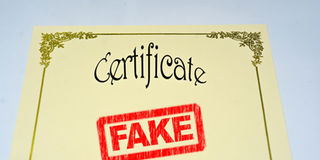
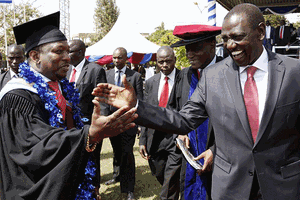
A quack quack here and a quack quack there. But this is not Old McDonald's farm. This is Kenya’s public service where shrewd individuals, driven by desperation and greed, have made normal the use of forged academic papers to secure a job.
Some are doctors, some are advocates, and others are teachers and nurses. Some occupy senior positions, while others are subordinate staff. They cost taxpayers, as some of them contribute to decisions that affect the everyday life of millions without the qualifications to do so.
Jecinter Hezron Adoyo was flying high at the Commission on Revenue Allocation (CRA). She was a senior analyst and personal assistant to the commission’s chairperson. She had joined CRA in 2017 on the strength of some “stellar academic papers”, a master’s degree in development studies from the University of Nairobi and a bachelor’s degree in sociology from the same university.
Before her luck ran out, Ms Adoyo had earned more than Sh15.2 million in salary between August 2017 and July 2023, on the strength of forged academic papers.
Even after first denying charges against her in court, on February 2, she entered a plea bargain with the Ethics and Anti-Corruption Commission (EACC), with Sh3 million recovered.
Ms Adoyo’s case is not an isolated one. A 2023 report by the Kenya National Qualifications Authority, the State agency that vets academic qualifications, revealed that nearly 250,000 civil servants possessed fake certificates.
Mr Lawrence Masinde Barasa, an ICT assistant at Nairobi City Water and Sewerage Company, and Mr Felix Ojwang Balamu, a marketing assistant at the same firm, were convicted last year over forged academic certificates.
Richard Munyao Munidi, a former ICT Officer at the Independent Electoral and Boundaries Commission, presented a forged degree certificate in IT from Jomo Kenyatta University of Science and Technology to secure employment at the commission. His case ended in 2024 when he entered a plea bargain, with EACC recovering Sh3.5 million.
In 2020, the EACC recovered some Sh12.8 million from Peninah Wambui Karomo after the former Rural Electrification Authority employee entered a plea bargain with the anti-graft agency. She had secured employment at the electrification agency using fake academic certificates.
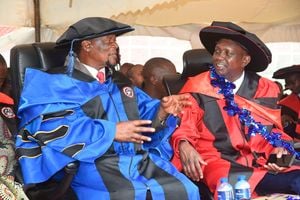
Beyond the “small” names, high-profile politicians and public figures have been embroiled in allegations of acquiring suspect university degrees, with questions surrounding the authenticity of their academic credentials. Various politicians have faced scrutiny during election cycles, with some barred from running due to fraudulent academic documents.
In 2013, The National Alliance Kajiado gubernatorial candidate Taraiya Ole Kores was barred from participating in the General Election. He had a degree purportedly from the Universidad Empresarial de Costa Rica, which later turned out to be fake.
Cabinet secretaries Hassan Joho (Mining) and William Kabogo (ICT), Juja MP George Koimburi, former Malindi MP Willy Mtengo, Kapseret MP Oscar Sudi and former Kiambu Governor Ferdinand Waititu, among others, have also battled questions over their academic credentials.
Public Service Commission (PSC) Chairperson Francis Meja.
Public Service Commission (PSC) Chairperson Francis Meja said that on average, 2.6 percent of certificates in the country are fake, going by previous verification exercises conducted by the commission. He observed that the crisis is being fuelled by over-reliance on formal qualifications and academic certifications to secure employment in the country.
“The percentage is not small because it should not be there in the first place. It is a systemic problem because it is not easy to verify the certificates, and so an individual knows they can survive for a number of years without being detected,” he said.
Mr Meja added that forgeries manifest in various forms, such as faked documents, altered certificates and papers that are illegally obtained through corruption or manipulation of institutional systems.
“At the basic education level, people are tampering with the grades to enhance them. This is being done to ensure you meet the minimum qualifications for the job being advertised,” said Mr Meja.
“At the university, we have students who drop out but somehow, even without their parents’ knowledge, look for ways to obtain a certificate. Some of them even organise fake graduation ceremonies complete with gowns and take photos as evidence, but in an actual sense, the certificate is not genuine,” he added.
Institutional weaknesses and lack of or weak vetting procedures have acted as contributors to the escalation of the problem. This is in addition to corruption and bribery in education and examination institutions, as well as among employers.
In 2024, an academic certificates verification exercise by the Parliamentary Service Commission found that more than 200 staffers working in Parliament were holders of fake academic papers . Some 1,300 people are on the commission’s payroll, excluding staff in MPs’ constituency offices. The audit netted high-ranking officials, including directors and deputy directors. Some of the casualties were aides of top officers in the parliamentary leadership, including those working for commissioners.
Interestingly, some of the implicated officers had worked in Parliament for decades and were approaching retirement, while others were junior employees who had been in employment for less than two years.
Former Public Service Commission chairman Anthony Muchiri.
Photo credit: Sila Kiplagat | Nation Media Group
Former PSC boss Anthony Muchiri, in his exit report released in December 2025, revealed that authentication of academic and professional certificates in the public service began in June 2012, when the commission issued a framework requiring verification of the documents before making appointment or promotion decisions in ministries, departments and State corporations.
He observed that the framework initially gained little traction among institutions and stakeholders. But in October 2022, the commission launched a verification exercise for all public service employees.
Public institutions were directed to audit the credentials of officers appointed within the preceding 10 years and to ensure continuous validation before appointments or promotions. The exercise uncovered over 2,000 forged certificates, leading to the dismissal of 449 officers.
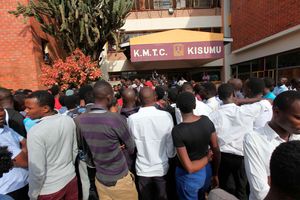
Out of the 53,599 certificates and result slips submitted to the Kenya National Examinations Council some 1,280 were found to be forged. According to the report, Kenya Medical Training College led with 274 cases of forged academic papers, followed by Kisii Public Service Board, which had 171 cases. Homa Bay Public Service Board (144), Migori County government (93), Nairobi City Water and Sewerage Company (76) and Kenya Railways (60) were the most affected institutions.
Additionally, in the 195 ministries, departments and agencies, out of 29,000 officers whose certificates were subjected to verification, 787 were found to have secured appointments, promotions, or re-designations through fraudulent documents. Further investigations uncovered 859 cases of forged academic certificates and 160 cases involving fake professional qualifications.
The report revealed that fake certificates were pervasive in State corporations and semi-autonomous government agencies, accounting for the highest number of reported forgeries at 76.3 per cent, and ministries and State departments at 17.9 per cent.
Mr Muchiri said the commission had since institutionalised certificate authentication in all recruitment and promotion processes to safeguard integrity in the public service.
The EACC has received 853 reports of falsification of academic certificates since January 2023 alone. Of these, 691 cases have been under investigation, with 182 files completed, 27 convictions achieved, two acquittals and one withdrawal recorded. Some 60 cases are still pending in court, 41 are awaiting review at the Office of the Director of Public Prosecutions, and 51 are still with the commission.
According to the EACC, the numbers could even be more since Kenya has for a long time lacked a centralised database of its degree, diploma and certificate holders, making verification an arduous task for employers.
A striking case is an inquiry into allegations of forgery against a deputy director at the Office of the Auditor-General. Investigations by the EACC established that during recruitment for the position of an assistant manager audit, the suspect submitted a Bachelor of Commerce (Accounting) second class honours, Upper Division, from Mount Kenya University, having studied from 2008 to 2010.
However, following a verification process, the Academic Registrar at the university said that the certificate was a forgery and that the suspect’s name was not in the graduation booklet. During the period of her employment, the suspect earned more than Sh28.4 million. In the same office, an office assistant had submitted a forged KCSE certificate to secure employment, and now EACC wants to recover Sh3 million from the suspect.
In other cases, a suspect altered her grade from D to C plain to secure employment as a locum clinical officer in the Health department at the Masinde Muliro University of Science and Technology. The suspect never attended the Kenya Medical Training College despite presenting a Diploma in Community Nursing certificate.
“Consequently, the Nursing Council of Kenya registration certificate number KRCHN1403 is also a forgery. For the period of employment at the Masinde Muliro University, the suspect earned Sh7,584,574 as salary,” reads the report from EACC.
The commission has managed only 50 convictions between 2020 and 2026, with the bulk of the convictions (28) being in 2025. According to the commission, efforts to address the vice through enforcement have been slow and fragmented in the past. Additionally, it has been difficult to prove the elements of forgery, leading to many cases being determined on technicalities. Further, established cartels and criminal networks make it easier to forge or obtain fake credentials and certificates that are hard to detect.
To rein in the vice, EACC has intensified investigations on public officers and ramped up recovery of monies earned on account of falsified certificates. So far, the interventions have resulted in the recovery of Sh14.3 million as of 2025 realised through court awards, out-of-court settlements, alternative dispute resolution and plea bargaining. From the ongoing investigations, the commission targets recovery of more than Sh400 million.
Threat to national development
EACC boss Abdi Mohamud said that the use of forged certificates undermines the credibility of the public service, casting doubt on the competence of those entrusted with serving the public. He added that the vice erodes public trust and is a threat to national development. This is in addition to undermining the integrity of education and employment frameworks.
As part of its recommendations, EACC wants the government to establish a centralised national database where all institutions that award qualifications will be required to submit the qualifications. The portal would allow digital verification and authentication of academic and professional certificates. The commission observes that the system should also enable reporting of suspected certificates to the law enforcement agencies in real time, while also providing safeguards to ensure that all certificates stored therein are tamper proof.
Further, EACC wants the government to make it mandatory for all entities that are recruiting to verify and authenticate the academic and professional qualifications held by the potential employees, with the procedures simplified and made cost-effective.
The commission also wants law enforcement bodies to put in place early detection mechanisms able to trace the perpetrators, the methods and apparatus that they use, and the sources of their resources, as well as scaling up investigations and prosecutions of persons alleged to hold fake or falsified qualifications.
“Law enforcement and prosecution authorities should consider publishing the names of persons found to have falsified academic and professional qualifications as a deterrence measure, and as a means of information to other potential employers,” said the EACC boss.