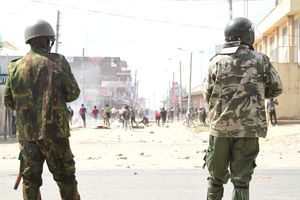
On two separate occasions, the Judiciary has borne the brunt of public protests, with court stations coming under attack by demonstrators.
During last year’s protests—sparked by widespread opposition to the controversial Finance Act, 2024—protesters vandalised the Chief Justice’s offices at the Supreme Court building.
The office of Chief Justice Martha Koome sustained significant damage, necessitating extensive repairs and refurbishment that took several months to complete.
In addition to the physical destruction, the Judiciary was compelled to scale down several of its programmes due to budget cuts, largely attributed to the suspension of the Finance Act.
Among the affected initiatives were the ongoing construction of court stations across the country, judicial training programmes, and the recruitment of new judges.
The recruitment of judges had reached an advanced stage, with advertisements concluded, candidates shortlisted, and interviews scheduled.
Then, Justice Koome announced that a circular from the Treasury had limited the expenditure to only critical and essential services.
Following the announcement, Judicial Service Commission (JSC) suspended all pending recruitment including the much-awaited hiring of 11 judges of the Court of Appeal after the Treasury restricted its expenditure to 15 percent of the appropriated budget.
“This directive has far-reaching consequences on the operations of the Judiciary and the JSC. In this regard, we are compelled to make major adjustments to planned programs and activities,” Justice Koome said then.
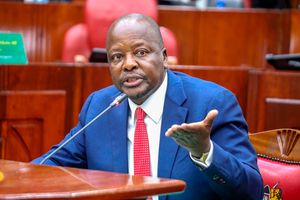
Chief Justice Martha Koome speaks during the swearing-in ceremony of the new IEBC Commissioners at the Supreme Court in Nairobi on July 11, 2025.
Photo credit: Bonface Bogita | Nation Media Group
The Judiciary said in its last State of the Judiciary report that it has been operating at 68 per cent of the approved establishment by June 30, 2024.
The Court of Appeal has 28 judges of the required 70, the High Court has 95 judges out of the required 200 while the ELC has 52 judges and the required number is 63.
The Judiciary has consistently raised concerns regarding underfunding and recurrent budget cuts, which has hindered the full implementation of its core programmes.
“Several courts continue to operate under serious constraints—including shortages of judges and judicial officers, heavy caseloads, inadequate infrastructure, and significant gaps in human and financial resources,” said Justice Koome in May, 2025.
Speaking during the opening Kombewa law courts in Kisumu County, which was constructed with the support of the Seme constituency NG-CDF, Justice Koome said her vision is to establish a magistrates’ court in each of the country’s 290 constituencies.
“With the opening of the Kombewa Law Courts, Seme becomes the 143rd constituency to have a magistrates’ court,” she noted. “While we celebrate this achievement, we remain acutely aware that 147 constituencies are still without one,” said Justice Koome.
And one year later, during the first anniversary of the Gen Z protests, the Judiciary was once again targeted.
This time, the attacks were directed at the newly established Dagoretti law courts, as well as the old Ol Kalou and Kikuyu law courts.
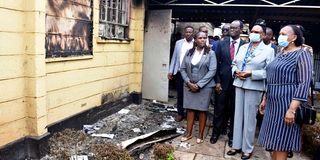
Chief Justice Martha Koome (center, grey jacket) tours Kikuyu Law Courts on June 26, 2025, which was vandalized and burnt down by unknown persons during protests.
Photo credit: Francis Nderitu| Nation Media Group
Speaking in the aftermath of the attacks, Justice Koome condemned the destruction, describing it as an affront to the constitution and the rule of law.
While touring the damaged Kikuyu Law Courts, the CJ emphasized the importance of courts as neutral spaces where disputes are resolved and rights are upheld.
“Targeting the courts undermines the very foundation of our democratic and legal order,” said CJ Koome. “Building courts in Kenya is a painstaking process that involves years of planning, resource mobilization, and negotiation within a severely constrained budget. The destruction of these facilities rolls back hard-won gains in access to justice—especially for marginalized communities who depend on these courts for protection and redress.”
Justice Koome sympathized with peaceful protesters who lost their lives while exercising their constitutional right and businesspeople who lost their property, noting that goons took advantage of peaceful protests to cause mayhem and destroy property.
“There is a gap in the law and we need to address that the right to picket, the right to demonstrate, should not be taken advantage of by criminal elements and terrorists,” she emphasized.
CJ Koome informed the public that although physical files were destroyed by fire, there was nothing to fear as proceedings are recorded and files are kept online.
“We have our information in the court tracking system. If they were destroying this place to destroy files and erase evidence, then they did not succeed. We have them stored in our CTS system,” she said.
The destruction, however, has not dampened the Judiciary’s efforts to win back the confidence of Kenyans.
Speaking on Friday during the swearing in of new Independent Electoral and Boundaries Commission (IEBC) commissioners, Justice Koome noted that public trust in institutions was at its low.
Justice Koome said there was a growing perception that public agencies have become disconnected from the people they serve.
“This trust deficit between the government and the citizenry is dangerous. As a person of faith, I believe this is a season for rebuilding—for repairing the breach,” said the CJ.
Justice Koome said the most urgent breach is the erosion of trust between citizens and state institutions.
She said the Judiciary had accepted the challenge and was working through the court users committees to improve service delivery and restore public confidence.
“This deficit of trust is not a theoretical problem—it threatens the very foundations of our democracy, social cohesion, and constitutional order. You must rise above this crisis of confidence,” said the CJ.
Chief Justice Martha Koome.
Photo credit: File | Nation
And recently, the Judicial Service Commission (JSC) announced the recruitment of 45 new judges of the Court of Appeal, High Court and the Environment and Land court (ELC).
The commission announced vacancies of 15 judges of the Court of Appeal, 20 judges of the High Court and 10 judges of the ELC.