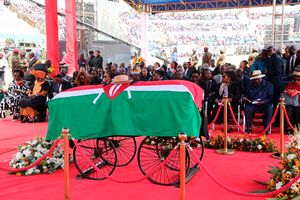
Before the tides of modernisation swept through the Luo community, death was handled with quiet dignity, simplicity and a profound sense of collective respect.
Traditionally, when someone died, the community would come together immediately. Burial took place the following day, or within two days at most. The body was laid to rest on its side and wrapped in animal skin to symbolise a humble return to the earth and the serene completion of life's natural cycle.
Lavish ceremonies were unheard of. Mourning was private and solemn, with no desire to flaunt wealth or social standing. Death was accepted as inevitable and not dramatised.
But with the passage of time and modernity, these customs gradually began to shift. The advent of mortuaries, the use of modern coffins, and evolving religious and cultural influences transformed the way death was treated among the Luo.
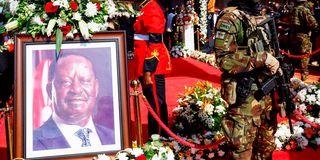
Raila Odinga's children (from left) Rosemary, Winnie and Raila Junior lay a wreath on their father's grave during his burial ceremony in Bondo, Siaya County on October 19, 2025.
Photo credit: PCS
Today, it is not uncommon for bodies to remain in morgues for several weeks. What was once considered unthinkable has now become a symbol of pride. The longer the body remains before burial, the more honour it is believed to bestow upon the family.
Funerals have evolved into social events, complete with tents, caterers, public address systems and large numbers of guests, which can often overshadow the quiet grief of those who are bereaved.
For a man of his stature, this wish was both striking and symbolic. At a time when funerals have become costly affairs, his desire for a swift burial was a profound return to ancestral values.
In an interview with the Daily Nation , Luo elders expressed deep admiration for Mr Odinga’s final wish, describing it as a courageous and dignified reminder of the community’s once-sacred traditions.
President William Ruto lays a wreath on the grave of former Prime Minister Raila Odinga during the burial ceremony in Bondo, Siaya County on October 19, 2025.
Photo credit: PCS
"This is a return to our roots. There is no pride in keeping the dead for weeks. It only brings unnecessary burden to the bereaved," said elder Pilister Karewe.
She lamented the transformation of funerals into feasts and how mourning had shifted from sacred silence to social gatherings.
'In the past, the period of mourning was a quiet and respectful time. The bereaved family wasn't even allowed to cook. Nowadays, funerals have become celebrations where people come more to eat and socialise than to offer their condolences,” she observed.
Another elder, Jacob Agola, urged the community to reconsider what dignity in death truly means.
"Keeping a dead body in the morgue is no longer a mark of honour. It has become a burden to grieving families. Nowadays, barely a week passes before you receive a WhatsApp message adding you to a funeral contribution group," he said.
The coffin of Kenya's former Prime Minister Raila Odinga, who died while receiving medical treatment in India, lies in a grave surrounded by floral wreaths during his burial at the Kango Ka Jaramogi home in Bondo, Siaya County, Kenya, October 19, 2025.
Photo credit: Thomas Mukoya | Reuters
Mr Agola encouraged people to consider writing wills, often a taboo subject, to ease future uncertainties.
‘People fear that writing a will invites death. But death comes when it will. A will simply communicates your wishes and prevents disputes. Whether one is kept for a day or a month, one won’t come back,” he remarked, adding that quick burials are not disrespectful.
“Some believe burying someone within days is dishonourable. On the contrary, it spares families emotional and financial strain,” he said.
The elders also recalled other fading customs. Traditionally, a respected man was buried in his matrimonial homestead. In Mr Odinga’s case, while he was not laid to rest at his matrimonial home, the family followed an established plan. His father, Jaramogi Oginga Odinga, had chosen a family burial site long ago, one that carried historical and personal significance.
“When an elderly man dies, he should be buried in his homestead, but Jaramogi’s family made their decision, and it must be respected. Still, in most traditional setups, burial is at one’s home,” said Mr Agola.
Other customs once held sacred have also faded. For example, if a woman died before her dowry was fully paid, the outstanding amount had to be settled before burial. Failure to do so could even bar her children from marrying.
To many elders, Mr Odinga’s final wish represents more than personal preference; it could mark a cultural turning point. A call to return to the understated wisdom of the past.