There is a new Kenyan name in the Guinness World Records, and it has, quite literally, jumped from the frying pan into the record books.
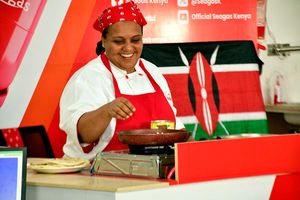
Ms Dorcas Kwamboka, a Rongai-based chef and proprietor of Mpenda Ngano Kitchen, is now the official holder of the record for the fastest time to make three chapatis: two minutes and 26.92 seconds.
Now she wants President William Ruto to organise a reception when her official certificate arrives from London.
Truphena Muthoni, a climate and environmental advocate and mental-health survivor, braves a heavy downpour as she hugs a palm tree in Nyeri town during her 72-hour tree-hugging marathon.
Photo credit: Joseph Kanyi|Nation Media Group
She received the confirmation email on Thursday, officially announcing that she had beaten the previous record holder, Uganda’s Raymond Kahuma, by nearly a minute.
The entry on the Guinness World Records website reads: “Dorcas Kwamboka is a chef based in Ongata Rongai, Kenya, with a passion for food, cooking, and record-breaking. She has always enjoyed making chapatis, so she put her skills to the test and managed to beat the previous record by 43 seconds.”
In an interview with the Nation , Ms Kwamboka said the record sounds easy on paper until one attempts it.
She added that participants must follow strict rules, including having professional referees to do the timing, using high-definition cameras to record the attempt, ensuring the chapatis are fully cooked and that each has a diameter of at least 15 centimetres.
“Since this involved food, I also needed a public health officer to confirm that I was cooking in a clean environment and that what I was preparing was fit for people to eat,” Ms Kwamboka told the Nation on Friday, adding that the attempt had to take place in an open setting before a crowd, with some members of the audience required to sample the chapatis.
“The Guinness organisers need to see that there was a crowd; that there were people watching you cook. They also have to taste the chapatis and be captured on camera eating them,” she said.
The video recorded on the day she went for the record shows that, as the referee barked “go”, the pan was already heated, and the kneaded dough was ready. With the timer running, she pinched the dough into three balls, placed them in front of her and got to work with the rolling pin. Moments later, the first flatbread was on the pan, with the other two following in quick succession.
For many Kenyans, chapati is comfort food. It is the meal of Sunday lunches, Christmas gatherings, roadside cafés, school visits and countless family treats. For Ms Kwamboka, however, it is also business. Through Mpenda Ngano Kitchen, she prepares and delivers food on order, with chapati among the products that have built her loyal clientele.
The record is now an extension of what she has been doing for years: cooking, posting her work online — mainly on her Facebook page, Doky Dorcas — taking orders, and proving that skill can be transformed into a livelihood.
Ms Kwamboka said she started cooking professionally in 2016 after realising that a home kitchen could be turned into a viable enterprise. From her latest achievement, she hopes other Kenyans will learn that they can build successful businesses, no matter how modest their beginnings.
“We can actually make a living from within,” she said. “We don’t have to be employed to make it. You can just start with whatever you have. In my case, I didn’t have a job, and I love cooking.”
“They should not wait to be employed. Start with whatever you have. Cook even just five chapatis, then tell your neighbour, ‘I’ve cooked these chapatis. Taste them and tell me if it’s something you would buy,’” Ms Kwamboka advised.
During our interview, she said the most trying part of the record attempt was the six-month wait for the organisers to decide whether her submission had been successful.
This, she said, was because there were many sceptics who believed her attempt would fail. A good number of record attempts made in Kenya never receive official recognition, and she feared hers would be one of them.
“It’s been six months of waiting; six months of negative energy from people. I’m just enjoying this one little by little,” she said. “During the waiting period, there is always that tension. Then you see your followers telling you, ‘They haven’t rewarded you because of this and this.’ They were already drawing their own conclusions. So I am so excited that it has finally come.”
Following her achievement, commentators have urged her to capitalise on the recognition by pursuing sponsorship deals, and she is open to the idea. She believes flour brands should see the obvious connection.
“Who’s a better person to tell you this is good if it’s not me?” she posed. “I’m looking forward to working with any brand that would like to come forward and support me.”
She also said she hopes to target more Guinness World Records in future, but for now she wants to savour her first success.
“I would like to go for more records surrounding what I do,” Ms Kwamboka said.
“It would be something very good because this belongs to all of us as Kenyans. The record has moved from Uganda to Kenya,” Ms Kwamboka said.