The National Social Security Fund’s (NSSF) involvement in questionable treasury bond trades worth Sh12 billion may have seen workers lose billions of shillings in retirement savings, Auditor-General Nancy Gathungu has revealed.
The irregular transactions, which involved purchase of bonds at a premium and selling them off cheaply, have been flagged by the Auditor-General in the NSSF’s audited accounts for the financial year 2023/24.
Members of Parliament have picked the audit query, and want the NSSF management to explain the apparent irregularities.
NSSF Managing Trustee David Koross, while appearing before the National Assembly’s Public Investments Committee on Social Services, Administration and Agriculture (PIC-SSAA), was yesterday at pains to defend the transactions.
This is despite acknowledging that the bonds were sold at a cheap price despite being procured expensively, a matter that is also being investigated by the House Finance and National Planning Committee.
What concerned the PIC SSAA members is the admission by Mr Koross that NSSF outsourced the process of investment to six fund managers and gave them the discretionary investment mandate “but within the fund’s approved investment policy statement (IPS).”
National Social Security Fund (NSSF) Chief Executive Officer David Koross before the National Assembly PIC on Social Service Administration and Agriculture at Bunge Tower Nairobi on May 21, 2025.
“We are talking about the Sh12 billion that was involved in the bonds’ transaction. Was the investment choice the efficient way of handling public funds? This is huge,” said Saboti MP Caleb Amisi, the committee vice chairperson who chaired the session.
Mr Amisi spoke as the committee made a decision to summon the management of Central Bank of Kenya (CBK) and Capital Markets Authority (CMA), the industry regulators, over the irregular bonds trade by the NSSF.
The matter is also being investigated by the Finance and National Planning Committee of the National Assembly, which is focusing on two CSD accounts of NSSF, those of an individual and a local commercial bank.
The audit report on the accounts of NSSF for the 2023/24 financial year capturing the schedule of treasury bond purchases, sales and redemption and bank statements shows that bonds purchased at a nominal value of Sh5.2 billion were sold for Sh4.32 billion.
This, the audit says, was below the bond's par value by Sh789.2 million, which was contrary to the 2020 Fund Investment Policy Statement, 2020.
Section 2.1 of the Fund Investment Policy Statement 2020 states that the board has a responsibility to invest the NSSF assets in a responsible and prudent manner.
“It was noted that some bonds recorded high capital losses and the yield rate was minimal and management did not compare the high capital losses with the yield rate for each bond,” the audit report states.
“In the circumstances, the Fund assets investment may not have been undertaken prudently.”
Mr Koross told the committee that the purchase and sale of treasury bonds in the secondary market are subject to market forces, “including prevailing interest rates, demand, and supply dynamics.”
“The prices at which these bonds are traded often deviate from their nominal values. The key driver to purchase of bonds is interest rate movements and accrued interest component,” said Mr Koross.
He stated that although the treasury bonds are “typically” issued with a fixed interest rate, when market interest rates fluctuate, the price of existing bonds adjusts accordingly.
However, it was the NSSF decision to give the six fund managers the discretionary investment mandate that saw the committee members led by nominated MP Bishop Jackson Kosgey committee members hit the roof.
“Prudent use of public resources is guided by proper planning. Allowing the fund managers to make their own isolated decisions based on these priorities is dangerous,” said Bishop Kosgey.
“I am not persuaded that this is a prudent way of spending public funds,” the Bishop noted.
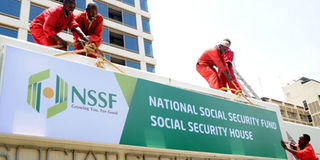
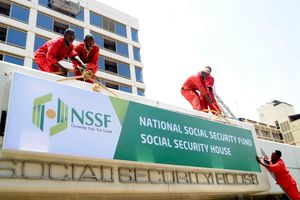
National Social Security Fund building in Nairobi
Photo credit: Sila Kiplagat | Nation Media Group
Pressed further, Mr Koross explained that bonds are generally sold at a discount if the coupon rate is lower than the current market rate “as investors will only purchase the bond at a price below its nominal value, a discount, to compensate for the lower return.
“The fund managers sold bonds which had lower yields with the objective of deploying proceeds into higher yielding bonds so as to improve the returns for the fund, which has been a challenge for a number of years,” said Mr Koross.
However, Ms Gathungu notes that audit verifications carried out revealed that similar bonds purchased and sold during the year under review were purchased at a premium, prices higher than the nominal cost, and sold at discounted prices.
Auditor-General Nancy Gathungu.
Photo credit: File | Nation Media Group
This, according to the audit, resulted in a capital loss of Sh272.05 million and “no satisfactory explanation was provided for the decision to purchase the bonds at a premium and sell at a discount within the same period.”
This contravenes the Fund Investment Policy Statement, 2020.
Section 2.8 of the policy statement requires that “investments shall be made with proper judgment and care under the circumstances prevailing which pursue prudence, discretion and intelligence exercise considering probable safety of the capital as well as the probable income to be derived.”
“In the circumstances, the assets of the fund might not have been invested prudently and safeguarded from decline in value,” the audit states.
The investigations by the Finance and National Planning committee into the matter came after CBK detected and alerted CMA of the questionable bond dealings by the NSSF.
At the centre of CBK’s August 19, 2024 letter to CMA CEO Mr Wyckliffe Shamiah was the questionable bond transactions through the NSSF CSD accounts and those of Mr Humphrey Wachira Gichuru and Pergamon Investment Bank Ltd.
“The Central Bank of Kenya would like to bring to your attention some irregular trades carried out between May to July 2024 between NSSF Kenya, Humphrey Wachira and Pergamon Investment Bank Limited,” reads the letter signed by Mr David Luusa, CBK’s Director of Financial Markets Department.
According to the letter, the NSSF’s CSD accounts involved in the trade are 114813-0004 and 142816-0004 with Mr Wachira’s CSD accounts 234783-0004 and 265560-0004 and Pergamon bank’s CSD accounts 245351-0004, 207255-0004 and 245221-0004.
“The purpose of this letter is to request the CMA to review the conduct of the above-mentioned parties and share the actions taken with the Central Bank of Kenya,” said Mr Luusa.
According to Mr Luusa, CBK’s analysis of the trades between the parties indicates that the NSSF Kenya was buying bonds at significantly higher prices than the market average “while in some cases, NSSF Kenya sold some bonds at lower prices and bought the same bonds at higher prices in a few days.”
Mr Shamiah was required to contact CBK’s Deputy Director in charge of Debt Management for specific transaction details relating to the NSSF’s bonds trades but he was not available to explain the steps taken to address the concerns raised by CBK.