Hello

Your subscription is almost coming to an end. Don’t miss out on the great content on Nation.Africa

Ready to continue your informative journey with us?

Hello

Your premium access has ended, but the best of Nation.Africa is still within reach. Renew now to unlock exclusive stories and in-depth features.

Reclaim your full access. Click below to renew.

Caption for the landscape image:

How the Njonjo factor shaped LSK, but Muthoga takeover shifted tide

Scroll down to read the article

In case you missed the first part of this #LSKDecides2026 series, start here: Lawyers, power and protest: How LSK  learned to speak—or stay silent

------

Independence in 1963 had had not only ended the colour Bar, at least on paper – but brought Jomo Kenyatta into power. 

The Bar itself was stubbornly white—not simply in complexion, but in reflex, habit and professional self-image. The new Attorney-General, Charles Njonjo, was easily recruited into British circles and favoured maintenance of the status quo in the judicial system. 

He moved with ease in British legal circles and preferred continuity rather than rupture. As the legal adviser to Kenyatta—once prosecuted and imprisoned by the colonial State— Njonjo supported a Bar and Bench that retained its whiteness and British orientation. By doing that, Njonjo insulated the Attorney-General’s office from the disruptions that rapid Africanisation would have brought, keeping key legal institutions culturally familiar and politically manageable. 
It was a gatekeeping strategy in new nationalist clothing: the same exclusionary architecture could persist, now justified as stability, competence, and continuity. 

The LSK president at independence, Gerald Harris, easily transitioned into a High Court judge. 

For years, the result was a muted LSK—less confrontational, more cautious—operating within a postcolonial order that preserved many colonial professional hierarchies even as it proclaimed their end. Njonjo allies took control of LSK and the critics, who included Lee Muthoga, had to wait longer. By backing the Bar and the Bench to retain its whiteness, Njonjo’s role as AG would face no handicaps. It was a classic gatekeeping strategy.

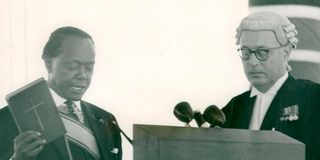
Lee Muthoga

Lee Muthoga. 

Photo credit: File | Nation Media Group

Njonjo, Britain's familiar furniture, and LSK

To understand the Law Society’s post-independence paralysis, the long season when it struggled to act as a watchdog over the Kenyatta regime, you have to understand the comfort Njonjo represented to a frightened establishment. 

Njonjo was a young, perhaps brilliant, and impeccably credentialed to the world the expatriate profession understood. He moved in the idiom of English legal culture with a fluency that felt, to the old guard, like continuity itself. In an era when everything else looked unstable and where political noise rotated around Pan-Africanist’s impatience to Africanise every sector, Njonjo was the familiar furniture. He gave the LSK some breathing space. 

The expatriate Bar did not simply admire him; it recognised him. He was not merely Kenyan; he was the kind of Kenyan the old establishment could understand, the kind whose thinking sounded like theirs. If Kenya was going to be governed by former “terrorists,” if power was going to pass into hands that had once been watched, tried, detained, and insulted, then the legal profession wanted a bridge—someone who could stand inside the new state yet keep one foot planted in the old order. 

Njonjo said as much in Parliament when challenged to Africanise the legal profession. One MP, Karungaru, claimed that “attorney general is black, but instead of attracting black people to work with him, he does not allow that.” 

Njonjo dismissed the parliamentary talk as rubbish. 

“Are they saying that we should pick people simply because they have black faces…” 

With such support, the white legal community cultivated Njonjo quickly, as did the British government which paid the judicial officers seconded to Kenya. 

The Law Society’s closeness to Njonjo did more than shape its external posture; it magnified its internal weaknesses. As an institution trying to hold together a profession, LSK was split by race and resources and was politically compromised. The proximity to the Attorney-General offered the Society cover and access, but it also softened its willingness to confront the State. 

The “Njonjo experiment” has long been used within the LSK to extract favours from the government. Under Kenyatta, with the legal machinery overseen by a man the white Bar regarded as its protector, the Society’s oversight role was blunted by a mix of gratitude, fear, and calculation. It could not easily bite the hand it relied on to survive its own era. 

Attorney-General Charles Njonjo and Jomo Kenyatta.

Attorney-General Charles Njonjo and Jomo Kenyatta. 

Photo credit: File | Nation Media Group

So as Kenyatta pushed through constitutional amendments that gutted the Uhuru constitution and concentrated power in the executive, the LSK stayed quiet. When KADU was compelled to abandon ship and fold into KANU—clearing the path for a de facto single-party state—the LSK stayed quiet. 

When Odinga was pushed out—his dissent treated not as a legitimate political position but as a threat to be contained—the LSK stayed quiet. When Pio Gama Pinto was assassinated, and when Tom Mboya was killed soon after, the Society again offered little more than the safety of silence, choosing caution over confrontation even as the political temperature rose and the boundaries of lawful power narrowed. 

Pio Gama Pinto

Pio Gama Pinto.

Photo credit: File | Nation Media Group

Mourners overcome by grief on learning about Mboya's murder. Mboya’s death, as minister, secretary-general of the then ruling party Kanu, and Kenyatta’s blue-eyed boy was to change the political history for a long time. PHOTO/FILE

New critics - Lee Muthoga 

But Njonjo found new critics. Young lawyer Lee Muthoga was the best known. 

For newly qualified African advocates, the barrier was not only examinations; it was capital. The costs of practice included offices, rent, clerks, transport, robes, law reports, and the long months before a name attracted briefs. To start off, banks demanded collateral, and the colonial economy had made collateral a racialised commodity. 

Many young African lawyers came from peasant families with insecure titles or land that did not easily convert into bank-ready capital. The result was a cruel circle: you needed resources to practice, but you needed practice to earn resources. 

That is how Muthoga, then a student, fired a letter to Njonjo demanding State assistance for loans, and a deliberate policy to support African advocates entering private practice. Muthoga argued that African lawyers “anxious to serve our country in private practice” but were pushed into non-legal appointments because they could not get into established firms “predominantly manned by non-citizens.” 

Lee Muthoga

Lee Muthoga. 

Photo credit: File | Nation Media Group

Muthoga’s letter was important because LSK was unwilling to address some of the handicaps facing its aspiring members. It had continued with its indifference and culture of silence on the predicaments facing African lawyers. 

Though Muthoga’s letter was copied to the Permanent Secretary of the Treasury, the President of the Law Society, the Chair of Legal Education, and the Principal of the Kenya School of Law only two replies came: From Tudor Jackson, the English principal of the Law School, and one from the Attorney-General’s office. Conspicuously absent was a reply from the Law Society’s president, S. N. Waruhiu, the first African to hold that office and, symbolically, the man most “placed to fight for the interests of the African lawyer.” 

Lee Muthoga

In this undated photo, Charles Njonjo is seen when he officially inaugurated the Law Faculty at University of Nairobi. On his right are University Council chairman B. M. Gecaga, Principal Dr Karanja and LSK President Samuel Waruhiu.

Photo credit: File | Nation Media Group

His silence was read not as neutrality but as inheritance: proof that African leadership inside inherited institutions could reproduce inherited distance. 

Waruhiu was a Njonjoist. He was a political conservative cut from the same cloth as the AG. Both men were sons of colonial-era chiefs, and both had little patience for radical nationalists. Waruhiu’s family carried its own grievance: his father was assassinated by Mau Mau supporters — an attack some accounts controversially link to Chief Koinange wa Mbiyu. The killing became a turning point, seized upon by the colonial government as the justification for declaring a State of Emergency. Waruhiu’s LSK leadership was always masked by the same background. 

Jackson’s reply mattered for a reason. He regretted he could not assist, saying he had tried and been defeated by “a combination of the Treasury, the Banks and the Industrial and Commercial Development Corporation.” The obstacle, in other words, was not simply professional prejudice. It was the postcolonial economy itself—finance vetoing decolonisation without ever saying the word. 

On 15 October 1975, police entered Parliament, seized, and detained Jean-Marie Seroney, an MP and LSK member, and Martin Shikuku—an open breach of parliamentary immunity for speeches made in the Assembly. The two MPs were stripped of their seats and held in solitary confinement until Kenyatta’s death, denied adequate food, medical care, and family visits. Seroney never recovered, and LSK was mute. 

MP Jean-Marie Seroney (left) shares a joke with former Kitutu East MP George Anyona (centre) and former Embakasi MP Mwangi Karungaru at Parliament Buildings. 

Politics of delay

In this terrain, the Njonjo factor hardened into its third shape: the politics of delay. With expatriates still numerous and influential, and with the white Bar still commanding the best work, Njonjo’s influence grew. Resistance to Africanisation could be framed as standards, professionalism, patience. But to young African advocates, the effect looked simpler: the door remained heavy, and the man holding the hinge sat in the Attorney-General’s office. 

The antagonism became open. The fire-spitting revolutionary lawyers from Dar es Salaam hated Njonjo; and he hated them too. Njonjo became the symbol of a profession whose distribution of opportunity still looked colonial—not merely in skin but in the arrangement of power. 

With Njonjo at the helm of legal power, the Law Society itself began to drift toward dysfunction. The Black Bar—bruised by defeats and alienated by the Society’s posture—withdrew from LSK life. The White Bar, increasingly parochial and resigned, stopped investing in the institution’s future. With both camps disengaging, the Society hollowed out from within. Meetings failed for lack of quorum and LSK was left teetering on collapse. 

And in professional politics, collapse creates opportunity. 

The opportunity was hidden in the fine print: Section 13 of the Law Society of Kenya Act. Section 13 governed leadership elections. The President and Vice-President—later Chairman and Vice-Chairman—could only be held by past Council members, and candidates were elected by sitting Council members. In a Society where Africans had barely begun to occupy Council seats, Section 13 functioned like a padlock; locking out Africans. 

A lawyer named Kibuchi saw the mechanism and named it. He framed Section 13 as an anti-democratic bottleneck and published a resolution for an ordinary general meeting on February 2, 1974. The resolution declared Section 13 had “outlived [its] intended purpose,” violated “the principle of democratic choice,” and called for amendment so the Chair and Vice-Chair would be elected by the membership at large. It asked that the Attorney-General be advised and urged to amend the Act. 

The response from the old guard was swift. Council, still dominated by non-Africans, resolved to write to Njonjo advising against the amendment. Only two Africans sat against nine non-Africans. The numbers on Council were the profession’s history in miniature. 

Gatekeeping disguised as standards

Then came a counter-move that revealed the Njonjo factor in its fourth shape: gatekeeping disguised as standards. Informally, Njonjo was asked to amend the Advocates Act to increase residential training to two years. He did so through the Statute Law (Miscellaneous Amendment) Bill, 1974. The intent, as young African lawyers read it, was obvious: slow African entry by making the path longer and more expensive. 

But this time, the Black Bar found a lever beyond the Society. Through allies in Parliament, they helped defeat the Bill. The victory mattered not only because it blocked a training change, but because it shattered the myth of State unity. 

On February 8, 1975, the resolution came back, moved by Richard Otieno Kwach and supported by five African lawyers and opposed by seven English members. The resolution passed 38–23, even with 22 English lawyers in attendance. The White Bar demanded a poll of all members, hoping the broader membership would reverse the result. But the arithmetic of the profession had shifted. The poll confirmed the victory. 

Kwach and Gautama were tasked with drafting the formula to transmit to Njonjo. The irony was sharp: the protector of the old guard now had to receive the paperwork of their loss. 

Thus, by 1975, the Law Society found itself under mounting pressure—both from within the profession and from a political climate that was tightening the space for independent institutions—and was compelled to revisit and reform its own rules. Those reforms, however, did not automatically translate into a more assertive posture. They were, at first, largely an attempt to steady the Society’s internal footing: to manage tensions around representation, professional standards, and the question of whether the LSK would merely regulate lawyers or also defend the wider principles that made legal practice meaningful—fair process, judicial independence, and the rule of law. 

In 1977, K.C. Gautama, remembered for having stood with the Africans was elected chairman of the LSK. After Kenyatta’s death, LSK set out to publish a statement calling for the democratic election of the country’s new President. When word reached Njonjo that the LSK wanted the next President democratically elected, he issued stern warnings to Council members and had police tail them. He sent police to lawyer Paul Muite’s offices where the statement was being drafted. 

Njonjo then called media houses and threatened to shut down any outlet that carried the statement existed: no newsroom dared report it. In 1979, Amos Wako, a known Njonjo critic, but a partner in a “White Bar” establishment, Kaplan and Straton, was elected chairman as President Moi took power and the Nyayo era began to harden into its most characteristic habits—centralisation, surveillance, and punitive attitude toward public dissent. 

Wako was intimidated by Njonjo and threatened with detention. The result was a period in which the Society appeared cautious, muted, and politically inconsequential at precisely the moment when lawyers—through the courts, through public debate, and through professional solidarity might have been expected to play a more visible role. Njonjo was then the Minister for Constitutional Affairs and according to lawyer Paul Mwangi, in his book Black Bar, he made Wako toe the line. 

The tide only began to turn after Muthoga took the helm. Under his leadership, the Society’s posture shifted from quiet accommodation to open challenge. Muthoga’s strategy was not simply to “oppose the regime” in the abstract, but to confront the specific power centers through which executive influence was asserted—most notably Njonjo, whose authority, aura and reach were themselves beginning to wane. 

By taking on Njonjo, Muthoga effectively took on the culture of impunity that Njonjo represented: the idea that law could be invoked as a weapon against critics rather than as a restraint on power. In doing so, he helped recast the LSK from a professional guild into a more openly political moral force—one willing to insist that legal practice was inseparable from the broader struggle over constitutionalism, rights, and the limits of executive authority. 

But still the State wanted to control LSK and after Muthoga came Mutula Kilonzo, a Moi apologist and lawyer, who neutered LSK to the Nyayo establishment.

A young Mutula Kilonzo (centre) when he was chairman of the Law Society of Kenya. Here he is seen chatting with Attorney-General Mathew Guy Muli (left) and Vice-President Mwai Kibaki. 

It marked the beginning of a new phase in the LSK’s public life: a constant push and pull between confronting political power and being tethered to it. From then on, the Society would often find itself either challenging the political class—or being drawn into its orbit. 

A new era of LSK either confronting local politicians or being tethered to it had started. 

Tomorrow: Moi’s Playbook: Reward, Surveillance and Bar capture. 

Follow our WhatsApp channel for breaking news updates and more stories like this.