Premium
IBEC: Why SRC wants to sink Sh80m on 'Productivity' Conference

Salaries and Remuneration Commission (SRC) Chairperson Sammy Chepkwony.

What you need to know:
- A further Sh15 million is earmarked for National Productivity and Performance Awards.
- The forum is intended to reposition the public wage bill “not as a fiscal burden, but as a lever for economic transformation.
The Salaries and Remuneration Commission (SRC) is seeking approval to spend Sh80 million to organise a National Productivity and Performance Conference. The agency argues that improving labour productivity is key to containing the ballooning public sector wage bill.
The request was made during the 29th Intergovernmental Budget and Economic Council (IBEC) meeting held at the Office of the Deputy President Kithure Kindiki, where SRC presented its latest assessment of wage bill trends and labour productivity across national and county governments.
According to documents tabled at the meeting, Sh65 million of the proposed budget would go towards organising the conference, covering venue hire, hospitality, logistics, delegate services, branding, communication, preparatory meetings and retreats, programme delivery including a digital platform, its documentation and media coverage.


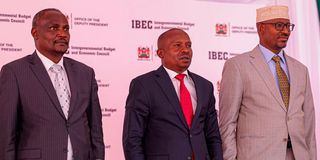
Deputy President Kithure Kindiki (centre), Treasury CS John Mbadi, Council of Governors Chairman Ahmed Abdullahi during the 29th Ordinary Session of the Intergovernmental Budget and Economic Council, in Nairobi on February 13, 2026.
A further Sh15 million is earmarked for National Productivity and Performance Awards, which would include preparatory meetings and procurement of awards, bringing the total estimated cost to Sh80 million.
“The conference will present a strategic platform for linking public service productivity with revenue generation and wage bill sustainability and propose national strategies to support the establishment of a National Productivity Index, strengthen performance contracting, and align remuneration policies with institutional outcomes,” read the presentation by SRC Chairperson Sammy Chepkwony.
He told the meeting that the conference, planned for May 2026, would bring together about 4,000 participants drawn from national and county governments, the private sector, civil society, academia, professional bodies and development partners.
The forum is intended to reposition the public wage bill “not as a fiscal burden, but as a lever for economic transformation” when linked to measurable productivity gains in the public service.
“It will foster engagements cognizant of the fact that wage bill sustainability may not be achieved solely through expenditure cuts, but by investing in a public service that delivers higher returns through higher revenue collection, greater responsiveness and effective service delivery at both National and County levels,” read the presentation.
The funding request comes against the backdrop of persistent pressure on the wage bill, which SRC said stood at 43.3 per cent of ordinary revenue in the 2023/2024 financial year and is projected at 40.4 per cent in 2024/2025, still well above the 35 per cent target set for 2028.

Salaries and Remuneration Commission Chief Executive Officer Ali Abdulahi Surraw.
The commission warned that without deliberate interventions to raise labour productivity, wage bill growth would continue to outpace revenue collection.
SRC attributed the slow progress to several structural challenges, including the growing number of public sector employees, duplicated and overlapping functions across government institutions, weak payroll controls, and wage demands that are not aligned to productivity levels.
Data presented at the meeting showed that labour productivity in the private sector is more than three times higher than in the public sector, with the gap widening over time.
As part of its recommendations, the commission asked IBEC to endorse labour productivity improvement as a core strategy for achieving wage bill sustainability and to allow SRC to seek the Sh80 million from the National Treasury to convene the conference.
It also called for accelerated staff rationalisation, elimination of duplicated functions and full migration of government payrolls to a unified human resource information system.
Follow our WhatsApp channel for breaking news updates and more stories like this.