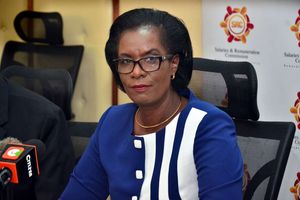
Salaries and Remuneration Commission Chief Executive Officer Ali Abdulahi Surraw.


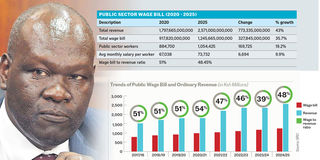
A bombshell directive by the High Court regarding Kenya’s ballooning wage bill, now at a staggering Sh1.24 trillion for 1.05 million public sector employees, portends a big blow to civil servants.
Implementing the order issued on Friday is likely to lead to retrenchment of public workers, an audit on roles, dismissals over integrity issues or fake certificates, and a loss of fat perks and allowances.
“There is no equity in a nation whose population is over 50 million but half of its total revenue is gobbled up by only just over a million public and State officers in remuneration and allowances,” Justice Lawrence Mugambi, sitting at the High Court in Milimani, said in his January 30 ruling.

Justice Lawrence Mugambi.
The court ordered the Salaries and Remuneration Commission (SRC) to ensure that the country’s public wage bill is progressively reduced to a maximum of 35 per cent of ordinary revenue within the next four years. The court will supervise the reduction.
“For the next four and a half years, the SRC shall file an affidavit in this court on June 30 of each year, commencing June 30, 2026 and ending on June 30, 2030,” the court ordered.
Such affidavits, the court ordered, shall contain time-bound strategies to achieve the 35 per cent ratio, advisories issued to curb abuse in payment of allowances, and savings being made each year from such measures.
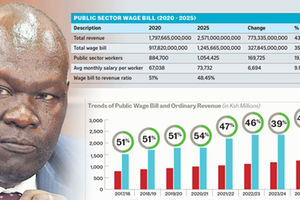
SRC data shows that for the last 10 years, the public wage bill-to-revenue ratio has ranged between 43.33 per cent and 54.77 per cent.
According to the commission’s fourth quarter bulletin released in July 2025, the highest percentage of wages relative to the country’s revenues paid over the last decade was disbursed in the 2020-2021 financial year. During that period, public workers were paid Sh987.8 billion.
Prior to 2020-2021, the percentages were wobbling. In the 2015-2016 financial year, it stood at 46.59 per cent. It was followed by 46.59 per cent in 2016-2017; 51.54 per cent in 2017-2018; and 51.06 per cent in 2019-20.
Afterwards, the percentages stood at 47.06 in 2021-2022; 47.87 in 2022-2023; and 43.33 in 2023-2024.
SRC projected that for the year ended July 2025, the percentage would be 40.64 per cent, the lowest in a decade, where civil servants were expected to take home Sh1.245 trillion from what the government earned.
Friday’s court directive was due to a petition filed by activist Eliud Matindi, who argued that Kenya’s ballooning wage bill undermines fiscal sustainability and violates constitutional principles of prudent financial management. He had filed the petition in August 2023, mainly aggrieved by a review of public officers’ salaries.
While agreeing with his position, the court said the application of public revenue should prioritise the development of the nation and collective wellbeing of its people in order to realise rights under Article 43 such as health, education, housing, food, clean water and social security.
According to the court, the SRC has a duty to ensure that public wages remain within the realistic fiscal limits while Parliament, county assemblies, the National Treasury plus county treasuries are bound by the statute and regulations to ensure wage bill-to-revenue ratio is enforced legally within the set limits.
Mr Matindi contended that despite repeated policy pronouncements, the government had failed to enforce the statutory 35 per cent wage bill-to-revenue ratio set out in the Public Finance Management Act.
The number of public sector employees increased by 138,500 in the five financial years to the one ending in July 2024. As per the SRC data, it shot up from 884,700 in the 2019-20 financial year to and 1,023,200 in 2023-24.
Though the revenues have also been growing, the rise in manpower poses a headache in reducing the public wage bill. Already, the SRC has suggested what this return to the 35 per cent ratio will mean.
Backdated salaries
According to Commission’s end-of-term report covering the 2018-19 to 2023-2024 financial years, the four main ways that the reduction can happen are improving labour productivity, managing the wage bill, controlling employee numbers and leveraging on technology.
The report added that a key strategy agreed upon during an April 2024 conference in Nairobi — which brought together the two levels of government — was an audit of the employees’ paperwork.

Government workers have crossed a million in number taking the public wage bill to a quarter past Sh1 trillion
The gathering agreed to “undertake public sector wide audit on academic certificates for officers serving in both national and county government institutions in order to root out employees with fake certificates, enhance integrity, accountability performance and productivity”.
There was also a bid to move all payrolls to the Human Resource Information System-Kenya by June 30, 2025.
“Eliminate duplications and mitigate overlap of mandates, roles and functions across,” the SRC said in its end-of-term report. “The public service institutions to review and rationalise their staff establishments with a view to align to affordability, fiscal sustainability, right composition, skills set and fit for purpose organisation structures that will facilitate the institutions to achieve the 35 per cent by 2028.”
Using the example of 2020/2021 financial year, the SRC in its end-of-term report, showed how the missed 35 per cent target hurts Kenyans. Of the Sh988 billion wage bill (54.8 per cent of ordinary revenue), Kenya should only have spent Sh631 billion.
“This would have left additional resources to the tune of Sh356 billion for development and other priorities,” the SRC said in its report.
Another key contention in Mr Matindi’s petition was the backdating of some salaries. He faulted the commission’s decision to increase and backdate the new rates of remuneration and benefits for State officers for the 2023-24 year, saying it violated the Constitution.
Furthermore, he submitted that the SRC failed to provide adequate information to the public to enable the people to understand how it arrived at the decision to increase the remuneration and benefits for State officers.
He argued that the commission keeps talking about having a public wage bill that is fiscally sustainable, but has failed to act in the setting of the remuneration and benefits for State officers.
The SRC defended itself, saying the implementation of the remuneration and benefits structures was done in compliance with the Constitution and the law and was not subject to anyone’s direction or control.
According to the commission, the purpose of revising and increasing the rates—in the 2023/2024 period that Mr Matindi argued about in court—was, among others, informed by the need to cushion the officers from inflation through effecting the cost of living adjustment.
Furthermore, the SRC said that Treasury had already budgeted for and confirmed pre-allocation of the funds to cater for the proposed 3rd Cycle review increases in its letter of October 31, 2022 to begin from the financial year 2023/2024.
Fiscally unsustainable
The commission said that the backdating was meant to cover for the period of prolonged delay in implementation prior to the gazettement of the revised rates.
The court noted that the reason for the backdating has been sufficiently explained as it was not done impulsively but was founded on sound reason.
According to the court, the state of affairs is fiscally unsustainable and totally indefensible.
“It is a direct violation of Article 10 (2) (d) on ‘sustainable development’ (part of our national values and principles of governance) as such excessive consumption does not guarantee intergenerational equity, that is, as we meet our present needs, we must also ensure our future generations will be able to meet theirs as well,” said the court.
Follow our WhatsApp channel for breaking news updates and more stories like this.