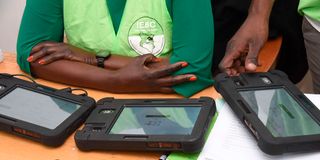
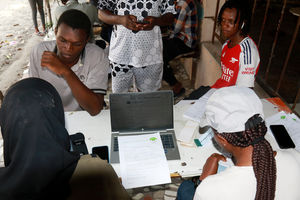
The electoral commission has shifted to using data from the National Registration Bureau (NRB) and the Directorate of Immigration Services (DIS) to set its voter registration targets to improve accuracy.
Previously, the commission relied on census data to estimate voter registration targets. However, it now says the model “has proven inaccurate, unsustainable and not verifiable”.
Even as it announced the shift in a report to the National Assembly’s Constitutional Implementation Oversight Committee (CIOC), the Independent Electoral and Boundaries Commission (IEBC) maintained that it still hopes to register 6.3 million new voters ahead of the 2027 General Election.
If IEBC achieves the 6.3 million target, the total number of registered voters in 2027 will rise to 28.4 million, up from the 22.1 million voters registered during the August 9, 2022 General Election.
A voter goes through the voter registration process at Roysambu in Nairobi on February 6, 2022.
Photo credit: File | Nation Media Group
The target was set using census-based voting age population (VAP) data, which IEBC is now abandoning in favour of the more accurate voter eligible population (VEP) model that draws directly from NRB and DIS records.
“The commission noted that it is shifting its target-setting framework from VAP to VEP, which focuses on the actual number of citizens who possess the requisite registration documents,” reads the CIOC report.
Qualifications for voter registration include possession of a national identity card or a valid Kenyan passport.
According to the committee’s report, the VEP model narrows targets to citizens who actually hold national identity cards or passports.
“This data-driven targeting approach ensures that resources are deployed efficiently and that performance benchmarks are realistic and attainable,” the report states.
IEBC noted that census data includes individuals who are ineligible to register as voters, such as non-citizens, undocumented citizens and refugees, leading to inflated targets.
On voter registration modalities, the commission said it plans to adopt several strategies to ensure no eligible Kenyan is disenfranchised. These include continuous voter registration at all 290 IEBC constituency offices.
Other measures include the use of Huduma Centres as registration points, ward-based registration drives, continuous registration in institutions of higher learning, and listing of Kenyans living abroad.
IEBC constituency offices will continue serving as service points for first-time voter registration and updating voter particulars upon issuance of national identity cards or passports.
Independent Electoral and Boundaries Commission (IEBC) Chairperson Chairperson Erastus Edung Ethekon during a forum with Civil Society Groups, the media and CBOs at Mombasa Beach Hotel on August 13, 2025.
Photo credit: Wachira Mwangi | Nation Media Group
“Registered voters can update or correct their information, while those who have lost eligibility—through death, conviction, or renunciation of citizenship—can be removed from the register through a formal process,” IEBC said.
Each of the 290 constituency offices has been allocated additional kits to facilitate voter registration, transfers and change of preferred voting centres.
Continuous voter registration resumed on September 29. The exercise allows eligible Kenyans to register, transfer their registration, correct details, or inspect their records at any constituency office nationwide. However, areas where by-elections were held on November 27 were excluded.
As of October 31, IEBC reported that 90,020 new voters had been registered, alongside 15,619 transfers and 188 voter detail updates. This raised concerns that the 6.3 million target may not be achieved.
Nonetheless, the commission says past experience shows that continuous voter registration at constituency offices has yielded limited results, prompting a renewed focus on enhanced ward-based continuous voter registration (ECVR).
“As a strategy to address this challenge, the commission intends to conduct ECVR and update the voters’ register to improve its comprehensiveness,” IEBC said.