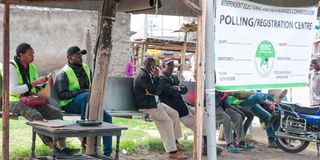
With just four days to the deadline, the electoral agency has registered 1.87 million new voters—hitting about 75 per cent of its 2.5 million target—as it steps up efforts ahead of the 2027 General Election.
In a status update released on April 24, the Independent Electoral and Boundaries Commission (IEBC) said it had registered 1,876,274 new voters since the exercise began on March 30, marking a significant surge as the deadline approaches.
“With four days remaining, we urge all eligible voters who have not yet registered to seize this opportunity to enlist as voters,” IEBC Chairperson Erastus Ethekon said in the statement.
IEBC fixed a target of 2.5 million new voters for this phase of registration, with the scale of mobilisation pointing to a deliberate effort to significantly expand the voter base beyond the 2022 register.
IEBC officers in Kapsoya Estate, Eldoret City of Uasin Gishu Country on the first day of the commission’s continuous voters registration on September 29, 2025.
Photo credit: Jared Nyataya | Nation
“The credibility and legitimacy of any election is dependent on a comprehensive and accurate Register of Voters,” the commission said, noting that the process is anchored in Article 38 of the Constitution, which guarantees political rights, including participation in free and fair elections.
Data released by the IEBC shows that Nairobi leads in new registrations with over 209,000 voters, followed by Kiambu (97,557), Nakuru (81,166) and Kakamega (80,711).
The numbers reflect both population density and the intensity of mobilisation efforts in urban and politically competitive regions.
In contrast, traditionally lower-turnout areas such as Lamu and Isiolo recorded under 10,000 new voters each, highlighting persistent disparities in voter registration across counties.
Lamu has so far registered the lowest at 8,345, while Isiolo has netted 9,291 voters.
The Nyanza region posted moderate numbers, with Kisumu registering 37,090 new voters, Siaya 33,295, Homa Bay 39,770 and Migori 37,004.
Observers say these figures could prove significant as political parties intensify grassroots mobilisation ahead of 2027.
Beyond new registrations, the commission reported 159,410 voter transfers and 2,817 updates of voter particulars, signaling increased mobility and voter awareness, especially among urban populations.
IEBC has sought to assure the public of the integrity of the voter register, outlining a multi-layered verification system designed to eliminate duplication and fraud.
IEBC officials register a youth at the Nakuru Town-East Constituency offices on September 29, 2025, during the start of the continuous voter registration.
Photo credit: Boniface Mwangi | Nation
The process begins with physical registration, where applicants present official documentation for identity verification.
This is followed by the capture of biometric data—including fingerprints, facial images and iris scans—to ensure each voter is uniquely identifiable.
“The captured data is subjected to automated biometric de-duplication, which includes fingerprint matching and alphanumeric comparisons,” the commission said. “This process identifies duplicate registrations, conflicting records and any anomalies within the dataset.”
Once verified, the data is consolidated into a central database before undergoing cleaning, validation and adjudication. The preliminary register is then opened to public scrutiny for 30 days, allowing voters to confirm their details and lodge objections where necessary.
The register is later subjected to an independent audit before being certified and published in the Kenya Gazette as the official voters’ roll.
Upon conclusion of the current mass registration phase on April 28, the IEBC will revert to Continuous Voter Registration at designated centres, including all 290 constituencies, 57 Huduma Centres and its headquarters at Anniversary Towers in Nairobi.
New registered voters since March 30
32. Elgeyo-Marakwet– 22,532
33. Tharaka-Nithi– 22,315