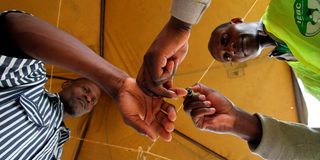
The Independent Electoral and Boundaries Commission (IEBC) is mulling allowing prisoners to vote for the five other elective positions besides that of President in a move aimed at enhancing inclusivity and enabling them to exercise their democratic rights.
As it is, prisoners are only allowed to vote for the President.
If the proposal sails through, inmates will, for the first time, vote for Governor, Senator, Woman Representative, Member of Parliament and Member of County Assembly.
IEBC Vice Chairperson Fahima Araphat said the Commission has announced a special plan to register all prisoners in correctional facilities as voters and convert the prisons into polling stations.
“We will not discriminate against anyone, including prisoners. We will ensure that all Kenyans get an opportunity to register. We have strategies in place to guarantee equality for everyone, and prisoners have a democratic right to vote for the other five elective positions in the 2027 General Election,” she said during a visit to Taita Taveta County.
Ms Fahima Araphat Abdallah.
Photo credit: Nation Media Group
She added: “Previously, only prisoners were allowed to vote in prisons, but in the coming days, we are considering allowing prison staff and their families to cast their votes at the same centres.”
According to Ms Araphat, Article 83 of the Constitution of Kenya requires that every citizen who qualifies for registration as a voter be registered for the purpose of voting during elections. The Constitution further outlines that every adult citizen of sound mind, who has not been convicted of an election offence during the preceding five years, qualifies to be registered as a voter.
Therefore, prisoners jailed for offences other than election offences, and who are adults of sound mind, are eligible for registration as voters.
In 2013, in the case of Kituo Cha Sheria v IEBC & 2 Others , the petitioner sought to compel the IEBC to provide for the registration of prisoners as voters during the subsequent General Election. In its determination, the court affirmed that there is nothing in the Constitution disqualifying prisoners who meet the requirements under Article 83(1) from voting.
The court ruled that limiting prisoners’ right to vote was contrary to the principles and vision of a democratic state, which Kenya aspires to be. For democracy to be effective, the right of citizens to elect their representatives must be exercised equally and without discrimination.
The Vice Chairperson urged Kenyans to turn out in large numbers to register, noting that only five days remain before the exercise ends. She said more than 1.3 million voters have been registered against a target of 2.5 million, which the Commission expects to reach in the coming days.
“We began the Enhanced Continuous Voter Registration (ECVR) exercise on March 30, 2026, and it is expected to conclude on April 28, 2026. We are moving across the country to encourage citizens and stakeholders to turn out in large numbers and register as voters,” she said.
Meanwhile, IEBC Commissioner Prof Francis Aduol, speaking separately, urged Kenyan youth to take advantage of their numbers to influence the country’s leadership.
According to the commissioner, up to 57 per cent of registered voters are aged 35 years and below.
He said the ongoing registration drive will increase these numbers further, with the exercise targeting at least 6.5 million new voters, the majority of them first-time voters.
“Youth should participate in the electoral process. They have the same rights as any other Kenyan and a responsibility to come out and vote,” Prof Aduol said during a stakeholders’ meeting at Tom Mboya University in Homa Bay Town.
He added that their numbers can be used to express their voices and determine the country’s leadership.
This was particularly evident during the Gen Z-led protests that began in June 2024 as a social media-driven movement against the Finance Bill 2024 and later evolved into widespread demonstrations calling for better governance, accountability, and the resignation of President William Ruto.
Since then, there have been several youth-led initiatives pushing leaders to be more accountable.
Prof Aduol, however, noted that while youth are vocal in demanding change, many do not turn out to vote.
“It is not sufficient to speak about what they want to see in their wards, constituencies, and the country if they do not come out to vote. I urge the youth to register and, on election day, express themselves through their votes,” he said.
The voter registration exercise will end on Tuesday, with the IEBC maintaining that it will not be extended.
In Homa Bay County, the electoral agency has registered 37,439 new voters, representing 59.56 per cent of its target of 62,857. Ndhiwa Constituency leads with 7,307 new voters registered by Thursday evening.
Prof Aduol said elections remain the most effective tool for youth to influence leadership and governance.
“We expect that by the time we conclude the process, a significant percentage of the targeted voters will have registered,” he said.