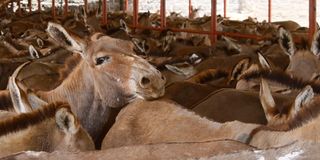
Illegal trading in donkey meat and skin has persisted in parts of the country despite a crackdown by the government and animal welfare organisations.
The animals that were secretly slaughtered are suspected to have been stolen by a gang involved in the illegal trade. This has also put consumers at risk of contracting diseases.
The donkey population in Kenya suffered a slump in numbers, with data from the Kenya Veterinary Association showing that between 2016 and 2019, the donkey population had already fallen by more than 40 per cent.
Days after the commemoration of the World Donkey Day, residents of Kajiado West sub-county woke up to a rude shock after a lorry was intercepted ferrying donkey meat.
The lorry was intercepted at Kimuka Centre along the Ngong-Suswa Road by an irate mob who torched the lorry's cabin after mistaking it for ferrying their stolen livestock.
Ms Maureen Jepkemboi, the Kajiado West Sub-County Police Commander said the lorry was intercepted on Tuesday morning by members of the public, who beat up two men in the vehicle. The two men were later rescued by the police.
“Initially, the residents thought the lorry was transporting their stolen livestock, only to find donkey meat and skins in it that were packed into sacks,” she said.
“However, even as officers intervened, the crowd’s anger boiled over and they set the vehicle’s cabin ablaze, completely damaging the bonnet.”
A preliminary report from the Kajiado County livestock department confirmed that the confiscated meat was from 30 donkey carcasses, with an equivalent number of skins recovered.
She recalled a separate case at Birika area, where authorities buried 34 donkey carcasses.
In Kitui's Mwingi West sub-county, about 4,000 donkey skins were impounded on April 11, 2026, by a multi-agency team deployed on the Thika-Garrisa highway.
A report on impounded donkey skin seen by the Nation shows that the consignment was intercepted and detained at Nguutani Police Station.
The hides had been flayed, salted, and sun-dried while being prepared to be released to the market.
Barely a month later, another 3,720 donkey hides, packed in 124 bundles of 30 pieces each, also sun-dried and salted, but transported without documentation, were detained in Kitui.
The stock was released under unclear circumstances, but intercepted again in neighbouring Machakos County.
During the World Donkey Day celebrations held in Kitui County on May 8, Brooke East Africa (BEA) noted a declining donkey population from an estimated 1.8 million in 2009 to about 1.1 million in 2019.
They attributed the drop to growing pressure on the species, driven by increasing demand, overuse, and limited investment in structured breeding and welfare systems.
According to BEA, despite their critical role, donkeys are still largely treated as tools of labour rather than sentient beings with clear welfare needs.
In many low-income and arid communities, donkeys remain essential for daily survival, directly supporting access to water, agriculture, and transport.
They also noted that evidence continued to show that donkey welfare is closely tied to human welfare. In arid and semi-arid regions, a single donkey can save households hours of physical labour each day, especially in water transport, where families would otherwise walk long distances under harsh conditions.
“However, this reliance is not matched with adequate policy attention, enforcement of welfare standards, or sustained investment in their protection,” the organisation stated, adding that donkeys remain under pressure while still largely invisible in many development and planning frameworks.
The Kenya Agricultural and Livestock Research Organisation in collaboration with Brooke East Africa released a report on donkey slaughter and its implications on community livelihoods, which put a price tag on that collapse. It estimated that income foregone by donkey owners and users amounted to Sh28.3 billion between April 2016 and December 2019.
Strikingly, that figure is 15 times more than the Sh1.82 billion in gross revenues generated from the export of donkey meat and skins during the same period, exposing the trade as a bad deal for Kenya.
In 2020, the government banned commercial donkey slaughter in response to the population decline, which led to the closure of four slaughterhouses.
Given that the Turkana community culturally eat donkey meat, the consumption of donkey meat is not illegal, but the illegal sale and transportation of it goes against the Meat Control Act (Cap 356), veterinary public health licensing, county government permits, and export certification systems overseen by the Directorate of Veterinary Services.
However, Dr Raphael Kinoti, Regional Director for Brooke East Africa, noted that there are glaring loopholes that have kept the trade alive, with the first being that while the slaughter of donkeys is illegal, the consumption of donkey meat is not.
“You can eat the meat, but in order to eat the meat, you need to slaughter the donkey. However, the slaughtering of the animal is illegal, which is the challenge,” he said.
The second loophole is that donkey skins and hides are not illegal in Kenya. Unlike wildlife skins, teeth, and trophies, donkey skin has not been declassified, meaning it can technically be exported like any other leather, said Dr Kinoti. Traders exploit this loophole to move the skin across the country and beyond its borders.
In the recent seizures, Dr Kinoti pointed a finger at an alleged unlicensed facility in the Mwingi area.