The dhow, christened MV Mashallah, was found carrying more than 1,024 kilogrammes of crystalline methamphetamine of 98 per cent purity, concealed in black polythene bags wrapped in yellow tape labelled “100 per cent roasted and grounded Arabica coffee.”
The investigations to unravel the owner and destination of the drug haul have now widened into a complex, multi-agency inquiry that stretches from the deep seas off East Africa to forensic laboratories and courtrooms, revealing the global nature of the crime and the legal hurdles Kenya must navigate to secure convictions.
The dark vessel was crewed by six Iranian nationals: Jasem Darzaen Nia, Nadeem Jadgai, Imran Baloch, Hassan Baloch, Rahim Baksh and Imtiyaz Daryayi.
They are being held at the Port police station pending the conclusion of investigations and a determination on whether they will face formal drug trafficking charges.
By January 12, when they will be presented in court, they will have spent three months in custody following their dramatic arrest on the high seas on October 24.
The court granted the Anti-Narcotics Unit an additional month to complete its investigations, which the State has described as complex and heavily dependent on forensic and transnational inquiries.
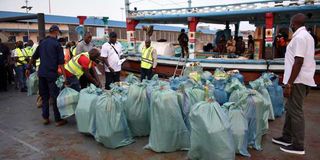
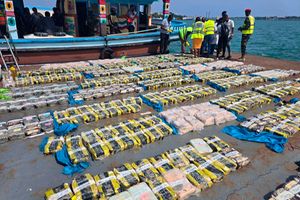
Packages of substances weighing 1,035.986 kilograms suspected to be methamphetamine valued at Sh8.2 billion at the Mombasa Port on October 25, 2025.
Photo credit: Pool
Investigators have repeatedly stated that the scale of the consignment, the nature of the seized substances and the suspected international networks involved necessitate extended time to compile evidence.
The State also argues that the matter touches on national security and forms part of wider efforts to combat transnational organised crime. The additional time is expected to allow detectives to piece together the final elements before the Director of Public Prosecutions determines, in January, whether the six foreigners will be charged.
The dhow was intercepted approximately 630 kilometres east of Mombasa, outside Kenya’s Exclusive Economic Zone (EEZ) and within international waters.
Authorities later described it as a “dark vessel,” operating without identification. According to officers involved in the operation, the six crew members ignored repeated calls by the Kenya Navy to stop, prompting a boarding operation under the Safe Seas Africa framework, supported by the Seychelles Coast Guard patrol aircraft.
Once escorted to Kilindini Port, detectives secured a search warrant and uncovered 769 packages of methamphetamine weighing over a tonne. The interception immediately placed Kenya on the global narcotics radar as a potential transit pathway.
This reputation had already been shaped by earlier high-profile cases, including the MV Amin Darya heroin haul in 2014 and the 2006 cocaine seizure.
This is the second-largest narcotics seizure in Kenya’s history. Unlike previous cases, however, this operation involved a stateless vessel intercepted far beyond Kenya’s EEZ. This fact both complicates and strengthens the State’s legal mandate to prosecute the suspects under international law.
Multiple government agencies were involved in the operation, including the Kenya Navy, the Directorate of Criminal Investigations, the Anti-Narcotics Unit, the Kenya Coast Guard Service, the Kenya Revenue Authority, Port Police, National Intelligence Service and the Kenya Ports Authority Police.
Investigators believe the dhow belongs to a cartel operating along the East African coast, part of a wider transnational syndicate, and that the consignment was intended for markets within the region.
Interior Cabinet Secretary Kipchumba Murkomen linked the haul to extremist-linked supply chains and reaffirmed that Kenya remains vigilant in protecting its maritime borders.
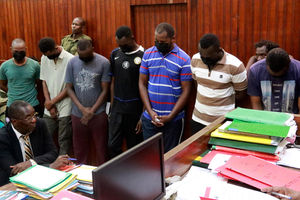
Five of the six Iranians accused of trafficking meth when they appeared at the Shanzu Law Courts on October 28, 2025.
Photo credit: Wachira Mwangi | Nation Media Group
He announced that the drugs would be destroyed publicly once presented in court, following established State practice.
However, the fact that the interception occurred outside Kenya’s territorial waters presents a significant legal test. Kenya’s territorial sea extends 12 nautical miles, approximately 22 kilometres, while its Exclusive Economic Zone extends 220 nautical miles, about 407.44 kilometres, from its coastline.
Beyond this lies the high seas, governed by international conventions rather than domestic law. The State must therefore prove the precise point of interception and demonstrate that Kenya acted within its rights under international maritime law.
This is not new legal terrain. In 2014, MV Amin Darya was intercepted with liquid and solid heroin worth Sh1.3 billion, but the High Court later overturned the crew’s life sentences due to inconsistent testimony and lack of clarity over the vessel’s location at the time of interception.
The ruling delivered this year exposed procedural weaknesses and collapsed what had appeared to be a watertight case.
The current matter shares striking similarities with the 2014 case: a stateless vessel, a foreign crew and an arrest in international waters.
Legal experts, however, argue that Kenya may be better positioned this time. Under the United Nations Convention on the Law of the Sea of 1982 (UNCLOS) and the 1988 Vienna Convention, Kenya has jurisdiction to board, seize and prosecute stateless ships engaged in drug trafficking on the high seas.
These provisions mean that despite the dhow’s interception beyond Kenya’s Exclusive Economic Zone, the State’s authority is internationally recognised. The outcome will now depend on how well prosecutors and the detectives seal the procedural gaps and inconsistencies that weakened the earlier case.
In the 2014 matter, the vessel bore no flag, carried two names and had conflicting documentation. Although the High Court ultimately held that Kenya had acted within its rights under international law, procedural lapses proved fatal.
In the current case, detectives are banking heavily on data extracted from electronic devices recovered from the six suspects. Seven gadgets, including mobile phones, a satellite phone and a GPS device, are at the centre of efforts to uncover communication logs, coordinates, financial connections and operational instructions that could reveal the shipment’s owners and accomplices across borders.
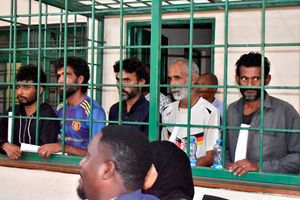
Some of the six Iranian crew members under tight security after a seizure of narcotics aboard an Iranian Vessel worth Sh8.2billion some 650 km off the shore of Mombasa.
Photo credit: Wachira Mwangi | Nation Media Group
Inspector Shadrack Kemei of the Anti-Narcotics Unit told the Shanzu Court that forensic examination of the devices was critical to tracing the network behind the consignment. He sought 30 more days to analyse the gadgets at the Directorate of Criminal Investigations headquarters in Nairobi and insisted that the suspects must remain in custody to protect sensitive digital evidence.
The court has compelled the suspects to provide their unlock codes. Investigators believe the digital trail could expose financiers, coordinators and the larger logistical chain.
Detectives believe that the presence of a Thuraya satellite phone and a GPS device suggests sophisticated navigation and communication systems designed to evade maritime surveillance.
The foreigners have been described as flight risks with no fixed residence in Kenya and are likely to remain in custody until investigations are complete and further appropriate action is taken.
This latest seizure adds to a list of high-profile narcotics cases that have shaped Kenya’s anti-drug narrative since the beginning of the twenty-first century.
The 2006 Sh6 billion cocaine seizure, the 2014 Sh1.3 billion heroin haul and now the Sh8.2 billion 2025 methamphetamine consignment illustrate a recurring pattern of large-scale trafficking operations exploiting East Africa’s maritime corridors and affirming Kenya as a transit hub for international drug cartels.