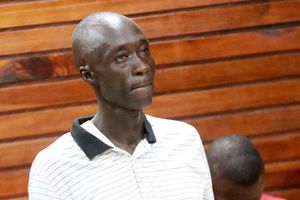
On February 13, 2026, the High Court, sitting in Mombasa, sentenced former Likoni Officer Commanding Station (OCS) Yunus Athman to life imprisonment for the 2018 murder of a 20-year-old man.
Lady Justice Wendy Kagendo Micheni found Athman guilty of fatally shooting Mbaraka Maitha Omar at Mwenza Village in Likoni, after the officer went to arrest him over allegations of theft.
The prosecution, led by Ngiri Wangui from the Director of Public Prosecutions, called more than 20 witnesses who placed the former Chief Inspector at the scene and challenged claims that the deceased had posed any threat.
“The court considered mitigation, the pre-sentence report and the victim impact statement before settling on a custodial term for the remainder of his natural life. As a police officer, the convict had a statutory duty to protect life, but instead used unlawful force against a defenceless civilian,” stated the judge in the landmark ruling.
The court heard that Athman fired several shots at the deceased, killing him on the spot, despite there being no resistance during the attempted arrest.
Police Constable Yunus Athman, who is accused of the murder of Mbaraka Maitha Omar when he appeared before the high court, in this photo taken on October 22, 2025.
Photo credit: Kevin Odit | Nation Media Group
Several witnesses testified that the victim was unarmed and did not pose any danger to the officer or the public.
In a separate case, two police officers were on July 29, 2025, convicted and sentenced to 35 years in prison after being found guilty of killing a suspect for not wearing a face mask during the Covid-19 pandemic in 2020.
While in custody, Dennis Lusava was subjected to a brutal assault.
Policemen slapped with 35-year jail term each over murder
Witnesses revealed that the officers kicked, punched and used electric cables to torture him. Eldoret High Court Judge Reuben Nyakundi ruled that the prosecution had proven beyond a reasonable doubt that the two constables were directly responsible for Lusava’s death.
The judge condemned the murder, describing the act as a blatant abuse of power by officers meant to protect the public.
These convictions add to a growing body of cases in which courts have imposed stiff penalties on law enforcement officers found culpable in murders. According to the Independent Policing Oversight Authority (Ipoa), thousands of complaints have been handled to date.
On Monday, Ipoa revealed that 3,988 police officers are currently under investigation for alleged misconduct, while only 47 have been convicted.
The disclosure, made by IPOA Deputy Director for inspection, monitoring and preventive services Munene Mugambi during a televised interview on February 16, 2026, highlights the scale of oversight challenges within the National Police Service.
A police officer about to beat a protestor outside Anniversary Towers in Nairobi on May 16, 2016. PHOTO | EVANS HABIL | NATION MEDIA GROUP
“As we speak, we have 3,988 officers under investigation for police excesses. These include matters pending at Ipoa. Out of these, we have secured convictions against 47 officers across 33 case files involving deaths, serious injuries, sexual offences and other human rights violations,” revealed Mr Mugambi.
Some of those involved were once ‘untouchable’ officers who wore a badge of authority promising to uphold the law and protect citizens.
Some have been convicted, and others face the consequences of unlawful force, with these convictions shining the spotlight on the thin line between duty and abuse of power.
Those convicted now serve as a cautionary tale that officers sworn to uphold the law can be held accountable for lives they unlawfully took.
A police officer beats man outside Milimani Law Courts on October 1, 2024.
The National Police Service has, over the past two years, faced sustained criticism from human rights groups over extrajudicial killings and excessive use of force, particularly during peaceful protests, in informal settlements and during security operations.
Mr Mugambi said the latest figures reflect both the prevalence of alleged misconduct and Ipoa’s determination to ensure accountability.
“The investigations cover a wide range of offences, including deaths, serious injuries, sexual offences and other human rights violations. Investigations are time-consuming, involving the collection of statements, internal review, and referral to the Office of the Director of Public Prosecutions (ODPP),” he stated.
“Investigations are not an event. To expect convictions at this point is to over-expect,” Mr Mugambi added, noting that scrutiny is necessary to ensure cases are legally sound and withstand judicial review.
Addressing criticism over the perceived slow pace of investigations, Mugambi said, “We are keen to nail those involved in police excesses. That doesn’t necessarily mean investigations are stalled. We emphasise a methodical approach to secure convictions rather than rushing cases to satisfy public expectations.”
However, the official noted that funding and resource shortages limit Ipoa’s efficiency.
“We are not denying that we have funding and resource challenges. We have been appealing to members of Parliament to support Ipoa and allocate sufficient resources,” he said.
Since its inception in 2011, the authority has investigated complaints of unlawful killings, torture, sexual misconduct and other police abuses.