Outside the Nairobi Funeral Home, Khadija Riyami stood as if in a trance, speaking very slowly, the pain of her husband’s violent death weighing heavily on her.
Vincent Ayomo, 28, a mechanic, had left for work in Kitengela on Sunday morning. By nightfall, the father of a one-and-a-half-year-old was lying in a morgue — shot below the left eye, the bullet exiting at the back of his head.
"I was called yesterday by his colleagues telling me that Vincent has been shot dead…They told me that he was crossing the road going for some spare parts when he was shot. That some police officers were the ones who shot him,” she recounted.
“I immediately made calls to family members and my friends and we started going round in mortuaries in Kitengela but did not find him. We were told to look for him at Nairobi Funeral Home. We came in the morning and found him here. I positively identified him,” she added.
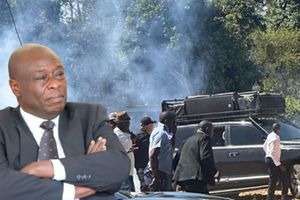
Vincent’s killing happened as chaos erupted during a rally by ODM rebels led by Nairobi Senator Edwin Sifuna. What was billed as a political meeting quickly descended into chaos, with running battles, cloud of teargas and gunfire.
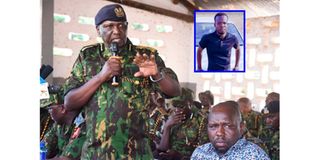
Mr Vincent Ayomo.
Photo credit: Pool
According to his colleague Peter Oluoch, Vincent was not part of the rally.
“I was in church yesterday and after service, I decided to go check on the garage where I worked with Vincent,” Mr Oluoch said.
“As I left, I called Vincent Ayomo and he told me that he was working at the garage and would only leave once he was done with some work. The plan was that I meet him there.”
But by the time Mr Oluoch approached the area, the situation had deteriorated.
“I found teargas and bullets were flying everywhere. I feared crossing the road,” he said. Rain began to fall. He sheltered at a nearby supermarket.
“The line got cut as soon as I received it. I called back immediately and a stranger received the call. The person told me bluntly, ‘Your friend has been shot, he fell down and died instantly.’”
“A bullet had hit below his eye and exited behind his head…No stone can hit someone in the eye, tear through flesh and exit at the back of the head. All I ask for is justice. The people mandated to protect us are the ones who are shooting at us,” he said.
Vincent’s elder brother, Moses Ayomo, was at home when the calls began.
“I had a strange feeling on Sunday that I could not work and went back home. Around 6:30pm, a phone call woke me. It was from a relative in Nyakach. He asked me, ‘Have you heard what happened?’ He told me Vincent had been shot dead.”
As he tried to leave the house, gunfire echoed through the neighbourhood.
“The loud gunshots continued until past 9pm,” he added.
Vincent’s death has become more than a family tragedy. It has reignited a fierce national debate about escalating violence at political rallies — and allegations of an “unholy alliance” between rogue police officers and hired goons deployed to disrupt opposition events.
Isinya Sub-County Police Commander, Simon Lokitari, confirmed more people were injured during the chaos.
Mr Lokitari, however, said it was too early to determine the cause of Vincent’s death, noting an autopsy would be conducted to establish whether he was shot.
“So far we (police) have recorded one fatality and three people sustained injuries. We encourage those who sustained injuries to come out and make a report at Kitengela Police Station,” said Lokitari.
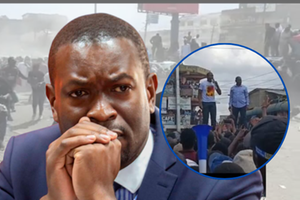
Police deployed teargas canisters directly into the ODM rally led by Edwin Sifuna, effectively ending the scheduled event before it could conclude.
Photo credit: Labaan Shabaan | Nation
For months, opposition leaders and civil society groups have accused sections of the security apparatus of either working with or turning a blind eye to organised gangs that descend on rallies armed with crude weapons. In many cases, they say, the violence unfolds in the presence of police — and sometimes alongside them.
Yesterday, opposition leaders returned to police headquarters for a meeting with Inspector General of Police Douglas Kanja to demand action on rogue police and goons blamed for violence at a church service at Witima in Othaya three weeks ago.
The attack was the latest in a string of incidents in which armed police and goons have disrupted meetings attended by former deputy president Rigathi Gachagua.
Police have either been complicit as goons attack government critics or openly sided with the attackers. This worrying trend was evident during anti-government protests in 2024 and 2025, and also during last year’s by-elections.
Led by Mr Gachagua, the DCP leader, Kalonzo Musyoka (Wiper Patriotic Front) and Eugene Wamalwa (DAP-Kenya), the opposition leaders stood frustrated outside Mr Kanja’s office yesterday. They were informed the police boss wasn’t present.
Mr Wamalwa attacked the police for what he termed “an unholy alliance with goons,” warning that Kenya is sliding into a dangerous phase where state power is fused with street-level violence.
“Instead of having a government that is accountable to the people that respects human rights, we have a goonvernment where goons and government officers work hand in hand,” he claimed.
Mr Gachagua alleged that officers linked to attacks at rallies and church gatherings had been identified but shielded from prosecution.
He further accused President Ruto and Interior Cabinet Secretary Kipchumba Murkomen of presiding over an administration intolerant of democratic competition — an accusation that government officials have previously rejected.
“This is just the beginning of pressure from the Kenyan people because if we allow this impunity ahead of the general elections next year, there could be anarchy in this country. We must bring order and the IG and the people under him must be held to account by the people of Kenya. The police themselves are also complaining about harassment,” Mr Gachagua said.
“He (Kanja) escaped a very important meeting which involved the security of all Kenyans. It was a meeting well known by the police but still, people died,” Mr Musyoka said. Mr Kanja did not respond to Nation’s inquiries.
Mr Sifuna, through a statement, condemned what he described as state-sponsored political violence and pressed the police to explain Vincent’s death.
“He committed no crime. He provoked nobody. So why did the police kill him? Kenyans will not surrender and live on their knees,” Mr Sifuna said.
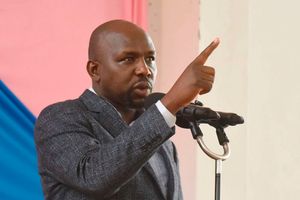
“Those thinking that they can use tear gas to manage how Kenyans think and who they associate with are daydreaming. The trend you are setting will come back to haunt you,” Mr Nyoro said.
NPS was yet to release a detailed public account of what transpired in Kitengela by the time of going to press.
In previous cases, police have typically promised internal investigations and urged patience pending forensic analysis. Critics argue that such responses have become mundane — buying time while public outrage fades.
Residents scamper for safety after tear gas canisters were lobbed at Witima ACK Church in Nyeri County during a Sunday service that was attended by Rigathi Gachagua on January 25, 2026.
Photo credit: Pool
Often, players in the political battlefronts and reports have pointed out that political intolerance, hired gangs and perceived police impunity are combustible. Kenya’s history shows how quickly politically charged violence can spiral when trust in law enforcement erodes.
At stake is not just public order, but the legitimacy of institutions tasked with protecting citizens’ constitutional rights — including the right to peaceful assembly.
As the country edges closer to the 2027 elections, the stakes are rising. Rallies are no longer just political theatre; they are flashpoints. The line between crowd control and lethal force appears increasingly blurred.
Inspector General of Police Douglas Kanja speaks to chiefs and assistant chiefs from West Pokot, Baringo and Elgeyo Marakwet counties on April 28, 2025 as Interior Cabinet Secretary Kipchumba Murkomen looks on.
Photo credit: Jared Nyataya | Nation Media Group
For Khadija Riyami, however, the politics feel distant.
“We saw him. He was shot below his left eye and the bullet exited at the back of his head,” she said.
Fredrick Ojiro, Head of Rapid Response at Vocal Africa, said Vincent’s killing fits a disturbing pattern.
“A week does not pass without the police being involved in the shooting of innocent Kenyans…Vincent had just left work and was not involved in any way in the rally, and even if he had gone, what wrong had he committed to warrant the shooting?” he posed.
Mr Ojiro compared the incident to the recent shooting of Cheryl Adhiambo in Huruma, where a post-mortem confirmed death by gunshot.
“We are tired of the statements released by the National Police Service every time young people are killed, claiming they will arrest offenders shortly after they get post-mortem examination results,” he said. “How long will we be doing post-mortem examinations and no officer involved is arrested?”
He called on Inspector General Douglas Kanja to act decisively, adding that both he and Interior Cabinet Secretary Kipchumba Murkomen should consider resigning if accountability continues to stall.
The activist also criticised the Independent Policing Oversight Authority (Ipoa) on their “snail-paced” response to the numerous incidents of police brutality and killings, saying they should “act and produce results”.
In response, Ipoa issued a statement saying it has launched investigations into the fatal incident during the rally in Kitengela, “that left one person dead and others injured”.
Ipoa vice chairperson Ann Wanjiku said they have deployed a rapid response team to establish the circumstances surrounding the incident and determine whether officers from NPS used force lawfully and proportionately.
The watchdog, which monitored rallies in Kajiado and Mombasa on February 15, also expressed concern over the violence.
“The investigations aim to establish the circumstances surrounding the incident, determine the extent of police involvement, access whether the use of force was justified, and evaluate whether it was proportionate as defined by the law,” Ms Wanjiku said.
Ipoa also pledged to make its findings public and recommend action against any officers found culpable.
Investigators, Ms Wanjiku said, will also assess compliance with constitutional policing standards and relevant laws governing crowd control and public order management during political events.