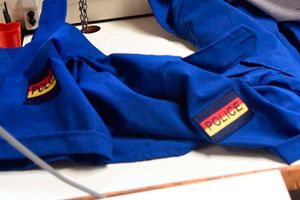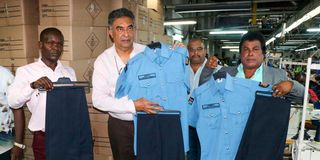
Bedi Investments Limited Managing Director, Jaswinder Bedi, and his management team display newly sewed police uniforms at the plant in Nakuru City on September 4, 2026.

The new general-duty police uniform was meant to be one of the visible symbols of a broader attempt to reform the National Police Service.
Instead, within days of its unveiling, it became the subject of a political and public storm over who won the tender, how much the uniforms will cost taxpayers and whether the change was necessary in the first place.
At the centre of the controversy is Nakuru-based textile manufacturer Bedi Investments Limited, the company the National Police Service says was awarded the contract to manufacture and stitch the new uniforms.
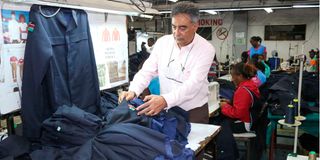
Bedi Investments Limited Managing Director Jaswinder Bedi displays police uniforms made from his plant in Nakuru City on September 3, 2026.
In an exclusive interview with Nation, Bedi has broken its silence, offering its account of how it won the tender, what it is producing and why the figures circulating in public are, according to the company, misleading.
Managing Director Jaswinder Bedi said the procurement was structured as a framework arrangement with individual prices attached to different uniform items rather than a single lump-sum contract.
“We were not awarded a contract of Sh2.8 billion, and I don't know where this number is coming from,” Mr Bedi said.
According to Mr Bedi, the company has been in the textile business for five decades and has supplied uniforms to the Kenyan Government for more than four decades.
The company's first order for Kenya Police uniforms dates back to 1992. However, its role at the time was largely limited to supplying fabric, with the garments being stitched by other manufacturers.
The latest contract, he explained, emerged from a wider police reform process that began in 2022 following recommendations by a commission chaired by former Chief Justice David Maraga.
The new uniform was part of the recommendations aimed at restoring the identity and morale of the police service, adding that there was a new entry of uniforms specifically designed for expectant police officers.
According to him, the procurement process moved to the bidding stage in 2023, when four textile manufacturers were invited to participate, including Thika Cloth Mills Limited, Sunflag Textile, Knitwear Manufacturing Limited, Rivatex East Africa Limited and Bedi Investments.
All four companies submitted bids, after which samples were subjected to evaluation by the Kenya Bureau of Standards, with only Rivatex and Bedi Investments submitting the required samples.
The process was subsequently subjected to public participation countrywide before the procurement was concluded and the award made in 2026, taking nearly four years from the beginning of the reform and procurement discussions to the eventual award.

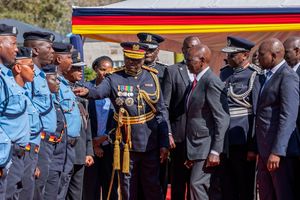
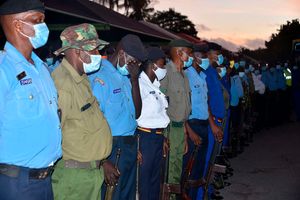
President William Ruto and Inspector-General (IG) of the National Police Service Douglas Kanja admire the new officers' uniform during the passing-out parade of more than 6,000 police recruits at the National Police College Main Campus in Kiganjo, Nyeri County.
“What people are seeing is four months of production; the process of procurement took almost four years, and it was only concluded in 2026 before it was awarded the same year. In less than four months, we have turned these uniforms around. These uniforms were individually measured. It is a made-to-measure uniform, not just a run-of-the-mill uniform; everything was done in detail. The system nevertheless gives the company sufficient data to reproduce an officer's uniform where necessary,” Mr Bedi said.
Mr Bedi revealed that his firm was contracted to supply 58,701 police uniforms, with every officer individually measured.
Rather than producing standard sizes and distributing them across the country, the company established measurement centres in different counties where officers were measured before their details were entered into the company's production system.
For a national police force spread across counties with vastly different climatic conditions, he argued, colour uniformity is critical.
He said the company's long experience in textile manufacturing, its workforce and vertically integrated production system also gave them an advantage over competitors.
“All four of us were invited to participate; we are the only ones who are doing fibre dye production. We were spinning all our fibres pre-dyed so that we have the colour fastness that is required for a big force like the police. Whether you are in Mandera, Nairobi, Mombasa or Kisumu, the uniform will be the same colour. We are very happy that for the first time in 60 years, the Kenya Police has adopted that there should be a uniform for expectant mothers, which I think is super important,” Mr Bedi said.
According to Mr Bedi, the production started about two months ago, with more than 3,000 uniforms being produced every day, with the company expected to complete the order by the end of September.
One of the most contentious issues surrounding the contract has been a figure of Sh2.8 billion that has circulated publicly as the alleged value of the award.
However, Mr Bedi denied that Bedi Investments was awarded a Sh2.8 billion contract.
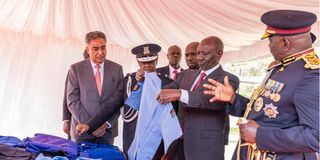
He explained that the procurement was structured as a framework contract based on individual pieces, with prices attached to items such as shirts and trousers rather than a single lump-sum award.
He said the contract would run for two years but declined to disclose the unit prices, describing them as classified information.
Previously, he said, different components of the uniform were supplied through separate procurement chains, with different suppliers handling items such as buttons, collars, badges, emblems, lining and fabric.
The new model, according to Bedi, brought the different components together under one complete uniform supply arrangement.
“We were not awarded a contract of Sh2.8 billion, and I don't know where this number is coming from. There was no figure attached to the tender. It was based on individual pieces. This is the first time they have complete uniform supplies, and that is why it is called a complete set of uniforms. The government has done really well and saved over 30 percent of their budget by just changing the model of procurement. It is a pilot contract,” Mr Bedi said.
Despite the controversy surrounding the contract, Mr Bedi noted that the reports on social media questioning whether Bedi Investments had actually won the tender did not shake the company because its management knew the process it had gone through.
He maintained that the company had participated in a legitimate procurement process and had emerged successful based on its technical capability, quality and competitiveness.
“Any name can be out there; it doesn't really bother me. Honestly, it didn't matter because we knew we were doing the right thing. We won this contract on pure merit. We won this contract for being the most competitive and also because we make the best quality. At the end of the day, the world average on fake news is 56 percent while Kenya's average is 86 percent,” he said.
The police order occupies only part of the company's production capacity.
During a tour of the factory, other uniforms destined for institutions in Kenya and across Africa were also being produced.
Bedi Investments supplies uniforms to more than 15 African countries, including Zambia, Tanzania, Uganda, Rwanda, Burundi, Malawi, Botswana, Namibia and Gabon.
The company also manufactures uniforms for corporate clients and other institutions.
Mr Bedi said the factory has handled contracts involving Kenya Wildlife Service and the Kenya Defense Forces, among others saying that the company does not manufacture sensitive uniforms for stock, but produces them against confirmed orders.
The company deliberately focused on institutional uniforms, which he described as a more stable market covering schools, hospitals, security agencies and corporates.
Mr Bedi noted that one of the company's biggest advantages is its ability to manufacture a uniform from fibre to finished garment under one roof.
The firm uses fibre-dyed production, which Bedi said helps maintain colour consistency and fastness.
Beyond garment stitching, the company produces more than four tonnes of cotton yarn every day and over 200,000 metres of material every month.
“We don't produce even one extra piece; it depends on orders, because they are sensitive. We cannot have them sitting in our warehouse for security reasons. We are one of the only companies that do everything from the fibre to the fashion, all here in this factory,” he said of the factory that has employed about 1,100 people.
A second factory under construction is expected to create another 2,000 jobs when it begins operations in the coming months.
For Bedi, the controversy surrounding the police uniform tender is ultimately a question of whether the public has seen what happens behind the finished garment.
“We have one of the most modern factories in Kenya, and we have the latest machinery. We have a digital printing machine, which not many people have. We have the capacity to manufacture here; the NPS uniforms are made in Nakuru,” he said.
Follow our WhatsApp channel for breaking news updates and more stories like this.