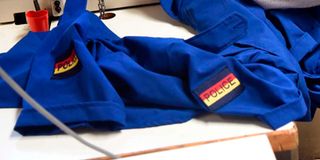
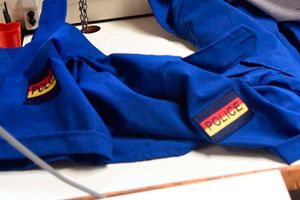
A court dispute between a senior police officer and a tailor has exposed claims that some officers could be using local tailors to make their uniforms, raising fresh concerns over breaches of strict regulations governing the manufacture of police attires.
The case has also raised questions about accountability within the police service and adherence to rules that restrict the production of official uniforms to authorised contractors.
At the centre of the dispute is Inspector Samuel Kariuki, formerly the deputy officer commanding Changamwe Police Station in Mombasa, and a tailor identified as Mark Onyango Otweyo.
A petition filed by the Centre for Litigation and Trust claims the officer breached police regulations by allegedly instructing the tailor to make a police uniform.
However, Inspector Kariuki disputes the claim and insists he was the victim of fraud after paying Sh4,200 for a uniform that was never delivered.
Court filings indicate that police regulations require uniforms to be produced only by authorised manufacturers to prevent counterfeits, safeguard quality and restrict access to official insignia.
The case now before the High Court pits the NGO against Inspector Kariuki, the Inspector-General of Police, the Director of Public Prosecutions and the Independent Policing Oversight Authority.
Inspector-General of Police Douglas Kanja.
Photo credit: File | Nation Media Group
The organisation argues that allowing unauthorised civilians to manufacture police uniforms undermines security and increases the risk of counterfeit attire entering circulation.
According to the petition, no police officer has the authority to commission a civilian tailor to produce police uniforms unless the person is an approved supplier.
But in a replying affidavit, Inspector Kariuki denies wrongdoing and instead accuses the tailor of deceiving him.
“On August 9, 2025, while in my office at Changamwe Police Station, a man came and introduced himself to us as Mark Otweyo,” the officer states in the affidavit.
Inspector Kariuki says the man claimed he was a tailor capable of making police uniforms and that he produced attire for officers stationed at the police station.
A Mombasa-based organisation wants the Inspector General of Police to investigate a senior police officer for allegedly instructing a tailor to make for him a pair of police uniform,
Photo credit: File | Nation Media Group
“He informed me that he is a tailor and that he was in a position to make police uniforms,” the officer says.
He adds that the tailor also claimed he had delivered a uniform to the Officer Commanding Station earlier that day.
According to the affidavit, the tailor promised to deliver a uniform within three days after receiving payment. Inspector Kariuki says he sent Sh4,200 to the tailor through mobile money for the service.
“He thereafter asked me to pay him Sh4,000 for the service. I sent Sh4,200 to his mobile number,” he says.
However, the officer claims the promised uniform was never delivered. He says repeated attempts to contact the tailor were unsuccessful, prompting him to report the matter at Changamwe Police Station.
“On September 18, 2025, I reported the matter at Changamwe Police Station after my effort to meet him through his mobile phone had proved futile,” he states.
Police investigations led to the arrest of the tailor. Prosecutors later charged him with obtaining money by false pretences under Section 313 of the Penal Code.
Vigilance House in Nairobi, the National Police Service headquarters.
Photo credit: File | Nation Media Group
The charge states that the suspect obtained Sh4,200 from the officer by pretending he was capable of making a police uniform.
However, the civil petition paints a different picture. The Centre for Litigation and Trust argues that the officer’s conduct violated strict National Police Service regulations governing the manufacture and supply of official uniforms.
The organisation also claims the tailor’s arrest was intended to conceal the alleged breach of the rules.
The NGO wants the court to compel authorities to investigate the officer and take appropriate action if wrongdoing is established.
Inspector Kariuki, however, maintains that the allegations against him are baseless.
He accuses the organisation of filing a speculative case and attempting to interfere with the constitutional mandate of investigative and prosecutorial agencies.
“The application is vexatious, bad in law and therefore lacks merit,” he says in the affidavit, urging the court to dismiss the case with costs.
The court is expected to consider the competing claims when the matter comes up for mention on March 18, 2026.