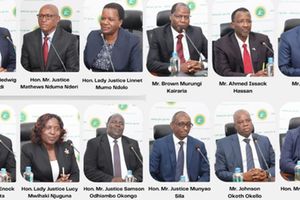
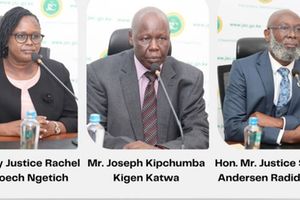
The Judicial Service Commission (JSC) petitioned Parliament to expedite the passage of a proposed law that seeks to establish a dedicated pension framework for judges of superior court, providing for annual pension adjustments pegged to five percent.
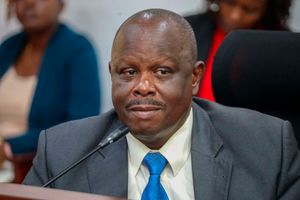
In a brief captured in the report of the Constitutional Implementation Oversight Committee (CIOC) of the National Assembly, JSC Vice Chairperson Isaac Ruto noted that the delayed enactment of the Judges' Retirement Benefits Bill 2025 “is denying retired judges fair compensation in line with rising living costs.”
Judicial Service Commission vice-chairperson Isaac Ruto.
Photo credit: File | Nation Media Group
Inflation stood at 4.4 per cent in January 2025, compared to 3.3per cent a year ago, according to official data from the Kenya National Bureau of Statistics.
The cost of living has, in previous crises, hit highs of 19.72 per cent and 11.7 per cent in November 2011 and May 2017, respectively, significantly eroding the purchasing power of workers and retirees.
The Judges' Retirement Benefits Bill 2025, which was tabled in the National Assembly on June 19, 2025, by Majority Leader Kimani Ichung'wah, seeks to establish a fund into which all pension contributions by the judicial officers would be made and managed by a board of trustees.
“The Bill seeks to establish a dedicated pension framework for judges of superior courts, providing for annual pension adjustments pegged to five percent,” the CIOC report captures Mr Ruto saying.
Article 162 (1) of the Constitution identifies superior courts as the Supreme Court, Court of Appeal, High Court, and the courts established by Parliament with the status of the High Court to hear and determine disputes relating to employment and labour relations and the environment.
The memorandum and objects of reasons of the Bill state that it has been in development since the late 1990s and “marks a significant step towards realising the principles of the Constitution in respect of the Judiciary, its independence and the remuneration and benefits of judges of superior courts.”
By enhancing the retirement packages, including pension, post-retirement transport benefit, and the post-retirement medical benefit, the Bill gives preferential treatment to the retired judges of the superior court over other public servants who are not entitled to similar inflation-adjusted benefits.
The JSC vice chairperson defended the proposed law, noting the “unique demands of the judicial service.”
“The commission emphasises the unique demands of judicial service that justify a dedicated pension framework,” says JSC.
The Bill, as published, defines ‘pensionable emoluments’ to mean the basic salary and house allowance payable to a Judge.
JSC notes that currently, pension reviews are conducted every two years under the Pensions Increase Act, which grants a three percent increment applicable to all pensioners.
“If the proposed Bill is passed into law, these general provisions will no longer apply to judges, whose benefits will be handled separately under a specialized scheme,” says JSC.
Under the proposed framework, judges will contribute 7.5 percent of their salaries during service, with the government contributing 15 percent of each judge’s pensionable pay with contributions charged directly to the Consolidated Fund (CF).
Parliament buildings in Nairobi. A Bill sponsored by Caroli Omondi, the MP for Suba South, is causing unease.
Photo credit: Dennis Onsongo | Nation Media Group
This means that pensions will be paid from a proposed judges’ retirement benefits fund if the Bill becomes an Act of Parliament. The Bill further proposed that judges who exit service due to mental or physical incapacitation shall be entitled to at least 50 percent of what they would have gotten had they served for at least ten years and exited upon reaching the retirement age of 65 years.
According to Article 260 of the constitution, Judges of the superior courts are State Officers just like the President, his deputy, and members of the Cabinet, Chief Justice and his deputy, MPs, chairpersons and members of constitutional commissions, and holders of independent offices- Auditor-General and Controller of Budget.
The others are county governors, Principal Secretaries, Magistrates, MCAs, Director of Public Prosecutions, the Chief of the Kenya Defense Forces (CDF) and service commanders, Director-General of the National Intelligence Service (NIS), and the Inspector-General and Deputy Inspectors-General of police.