Judiciary seeks extra Sh20.4bn for resolving election disputes
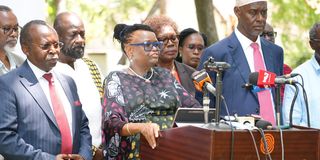
Chief Justice Martha Koome and other leaders in Mombasa during the rollout of Election Dispute Resolution (EDR) training programme.

The Judiciary has asked Parliament to approve an additional Sh20.4 billion for the 2027/28 financial year, warning that a funding shortfall could constrain preparations for resolving disputes arising from the 2027 General Election.
The institution is seeking Sh50.7 billion to finance its operations, reduce case backlogs, upgrade court technology and train judicial officers ahead of the elections. However, the National Treasury has capped its allocation at Sh30.4 billion, leaving a deficit of Sh20.4 billion, or about 40.2 per cent of the proposed budget.


Chief Justice Martha Koome said adequate funding would enable the Judiciary to strengthen its capacity to handle election petitions and political disputes, which must be resolved within strict constitutional and statutory timelines.
“During election time, training for judges, magistrates and judicial officers on electoral laws and dispute resolution, upgrading ICT systems, courtroom automation, and operationalising new courts and tribunals will all be achieved if Parliament approves our budget,” she said.
The proposed budget comprises Sh46.2 billion for recurrent expenditure and Sh4.5 billion for development projects. Separately, the Judicial Service Commission has requested Sh1.833 billion.
The funding request comes as the Judiciary begins an eight-month Election Dispute Resolution (EDR) training programme targeting more than 400 judges, judicial officers and other personnel ahead of the August 2027 General Election.
Speaking in Mombasa during the rollout of the programme, Ms Koome said the Judiciary was taking deliberate steps to ensure courts are adequately prepared to resolve electoral disputes independently, fairly and expeditiously.
She said early preparation was essential because election petitions often involve complex legal questions, scrutiny of evidence and challenges relating to electoral processes, while courts are required to make determinations within prescribed timelines.
“Our responsibility is to ensure that the courts have the institutional capacity, professional competence and operational systems necessary to administer electoral justice effectively,” she said.
Part of the proposed funding will support the Judiciary Committee on Elections and the Political Parties Disputes Tribunal (PPDT), which are expected to play a central role in resolving election-related petitions and political disputes.
The Judiciary also plans to strengthen court registries, improve filing and records management, streamline hearing schedules and ensure judgments are prepared and delivered on time to avoid administrative delays during the election period.
Ms Koome said the training would equip judicial officers with specialised knowledge of the constitutional and statutory frameworks governing elections, including pre-election disputes, election petitions, jurisdiction, statutory timelines, scrutiny and recounts, results management and transmission, emerging electoral jurisprudence and appeals.
Technology will also feature prominently in the preparations, with judicial officers expected to strengthen their capacity to assess digital evidence and resolve disputes involving electronic records and election results management systems.
“Modern elections increasingly involve electronic records, digital communication and technology-based results management systems. Our judges and judicial officers must be adequately equipped to assess digital evidence, determine questions concerning electoral technology and apply the relevant legal standards,” she said.
Ms Koome said these efforts would help counter misinformation and improve public understanding of the judicial process at a time when election-related cases are likely to attract intense political interest.
She assured Kenyans that the Judiciary would remain independent and impartial, urging political leaders, parties, candidates and their supporters to respect court proceedings and avoid intimidation or undue influence.
The Chief Justice also called on the media to report responsibly on electoral matters, distinguishing allegations from established facts and political commentary from judicial determinations.
With the 2027 General Election approaching, the Judiciary faces the task of preparing for a potentially heavy election-related caseload while continuing to handle ordinary cases and address existing backlogs.
Fair hearing
Ms Koome said the institution would continue pursuing the resources required to strengthen its professional capacity and operational readiness.
She maintained that every electoral dispute properly brought before the courts would be determined on its merits, based on the evidence presented and the applicable law.
The chairperson of the Judiciary Committee on Elections, Supreme Court Judge Mohamed Warsame, said the early preparations were intended to minimise avoidable administrative delays while safeguarding every litigant's right to a fair hearing.
He said the Judiciary was assessing its staffing, financial, technological and logistical requirements to ensure courts and registries can handle the anticipated workload.
The institution will also strengthen public communication and access to information on electoral dispute resolution, including explaining the jurisdiction of courts, procedures for filing petitions and the legal principles guiding judicial decisions.
Follow our WhatsApp channel for breaking news updates and more stories like this.