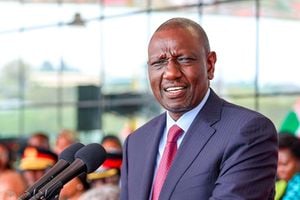
Military personnel will cater for their own meals starting Tuesday after President William Ruto’s administration scrapped the food subsidy programme for the Kenya Defence Forces (KDF).
In a memo obtained by Nation , beginning July 1, 2025, the KDF will transition from the current exchequer-funded lunch programme to a Pay-As-You-Eat (PAYE) system.
The move has triggered widespread disquiet among military personnel particularly junior soldiers who have depended heavily on the subsidised meals.
Some soldiers, speaking in confidence, said the change would severely strain their finances, especially those servicing loans potentially forcing them to skip meals if the new system is implemented.
For years, it has been a tradition both in Kenya and globally for military personnel to benefit from subsidised meal programmes.
No more free lunch for KDF as govt ends State-subsidised program in military barracks
However, the Ministry of Defence has defended the decision citing the need to streamline budget allocations, enhance efficiency in the use of public resources and allow personnel access to a wider variety of meal options.
“Vide the above-referred letter, the implementation of the subject programme is scheduled to commence on 1 July 2025. In this regard, authority is granted for you to demand Ration Scale (4) for 14 days with effect from 1st July 2025 for use as seed capital for the programme,” an internal memo dated June 23, 2025, and signed by Brigadier and Chief of Logistics Eric Nzioki, states.
“Your demands should reach this headquarters no later than June 25, 2025. Please note that it is envisaged that the proceeds from the seed capital will form a self-sustaining revolving fund to be administered by the PAYE management committees established at formation/base/unit levels to oversee the operation of the messing facilities,” the document adds.
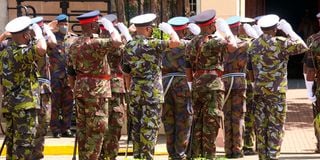
KDF soldiers march at Uhuru Gardens in Nairobi during Madaraka Day celebrations on June 1, 2022.
Photo credit: Evans Habil | Nation Media Group
The new system is expected to utilise existing infrastructure and amenities to support the PAYE model.
“Additional requirements will be considered progressively on a case-by-case basis in the next financial year, 2025/26. Please note and take action,” the memo further states.
This is not the first attempt by the KDF to introduce the PAYE system. Previous efforts were abandoned due to resistance from service members.
Top KDF officials argue that the current subsidy programme has significant leakages that continue to burden taxpayers.
In the renewed push, the KDF has outlined “comprehensive guidelines to ensure a smooth transition and effective implementation of the PAYE system”.
These include a comprehensive sensitisation programme for all service members to enhance understanding of the new system.
Service commanders have also been instructed to prioritise upgrading mess infrastructure and capacity during the second half of the 2024/25 financial year, with adequate funding allocated in the 2025/26 financial year.
A document dated January 17, 2025, directed the establishment of management committees at formation and unit levels to oversee the mess operations.
The same document indicated that the committee presented its findings to the Service Commanders Committee Meeting held on October 29, 2024.
The meeting also recommended the adoption of secure, cost-effective and convenient cashless payment methods, such as mobile money Paybill numbers and Quick Data Processing (PDQ) machines.
The document further called for a comprehensive risk analysis to identify and mitigate factors that may undermine the system's efficiency and effectiveness.
“In view of the above, note that the PAYE system is scheduled to be operational on July 1, 2025. As such, you are required to fast-track preparations and guidance as outlined in paragraph 3. Accordingly, you are to update and liaise with DHQ Insp (Defence Headquarters), who are to prepare a status report for submission to this HQ by February 15, 2025,” the document stated.
In response to Nation’s previous inquiries, the Ministry of Defence said the move aligns with best military practices both regionally and globally.
KDF personnel outside Parliament Buildings in Nairobi on November 21, 2024 where President William Ruto delivered the State of the Nation address.
Photo credit: Evans Habil | Nation Media Group
“It is important to note that the implementation of the new lunch feeding system will only affect KDF personnel stationed at peacetime locations. Personnel in operations and training will not be affected as they will continue with their entitled scales,” the ministry clarified.
It added that the current exchequer-funded system is not cost-effective, lacks flexibility, limits convenience and denies personnel variety in meals.
“Consequently, the system is faulted for the loss of working hours due to long queues and duplication of ration scales when personnel are reassigned urgently to different camps,” the Ministry said.
The Ministry added that the PAYE system will eliminate inefficiencies in the current model and save resources for other critical military needs.
“The funds previously allocated to the exchequer feeding programme will be redirected toward improving mess infrastructure, acquiring catering equipment and settling of pending ration and food bills,” it stated.
The Ministry further noted that a Ration Cash Allowance was introduced into the KDF in 2000 after provision for breakfast and dinner was abolished.