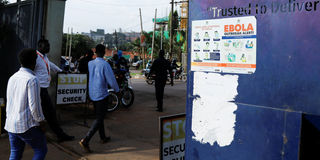
Infectious disease experts from the United States have arrived in Kenya and are preparing an Ebola facility that Secretary of State Marco Rubio says will be operational within seven days.
The White House confirmed on Wednesday that it is establishing a “state-of-the-art facility” in Kenya to receive Americans exposed to Ebola that is built, staffed and run entirely by Americans, with no Kenyan public health officers involved in the project in Laikipia County.
President William Ruto convened an emergency meeting with part of his Cabinet Secretaries, local leaders and some envoys on the Ebola situation in the region. However, the Nation is not privy to what was discussed. What is clear is that by the time they sat down, the train, as one senior health official put it, had already left the station.
“They are already in the country doing the facility,” a source with direct knowledge of the arrangements told the Nation .
Senior Trump administration officials told Reuters that the facility will become operational on Friday with a 50-bed unit.
Patients who need to be evacuated from Kenya will be taken to third countries, not the United States, the official said, because it is faster, and to protect Americans at home.
The Kenya Medical Practitioners, Pharmacists and Dentists Union (KMPDU) on Thursday gave the government a 48-hour ultimatum to publicly disclose the full terms of its deal with the US or face a nationwide doctors’ strike. Secretary-General Davji Bhimji Atellah said what no government official has been willing to confirm publicly: that the facility is being established at the Laikipia Air Base.
“Kenya is a sovereign republic, not a geopolitical isolation ward,” the union said.
“We will not sit back and watch Kenya be treated as a containment colony for a lethal pathogen that we did not generate.”
The union demanded that the government explains “why Kenya has been selected as the designated dumping ground for exposed US citizens while nations directly bordering the epicentre are bypassed”.
“If the United States believes the 12-hour medevac flight back to Washington is too dangerous for its citizens, by what logic is it safe to fly infected or exposed individuals into Kenyan airspace and drop them in Laikipia? The US government openly states: we cannot and will not allow any cases of Ebola to enter the United States. If it is too dangerous for America, it is too dangerous for Kenya,” Dr Atellah said
KMPDU issued three non-negotiable demands. First, the government must immediately publish the bilateral text of the agreement and explain why Kenya was chosen. Second, the government must explain how it is prioritising the construction of a foreign biohazard facility while public hospitals cannot afford basic supplies. Third, if the facility proceeds, the government must use it as leverage to permanently employ thousands of unemployed Kenyan doctors and nurses into the public health system, fully funded by the state and the international partners driving the deal.
The Health Ministry, through Public Health and Professional Standards Principal Secretary Mary Muthoni said that Kenya is at liberty to engage other partners in combating the Ebola virus that has so far claimed the lives of over 100 people in the Democratic Republic of Congo (DRC).
“Kenya will engage other countries, including the United States of America, in strengthening its systems as long as it is done within the laws of the country,” she said.
She added that any engagement with another country to have an isolation centre is not new as Kenya did the same during the Covid-19 pandemic.
“The US government is working with the government of Kenya and other partners to plan for a facility for asymptomatic individuals suspected of exposure to the Ebola virus,” a US administration official said.
“Kenya and the United States share a historic health partnership that over decades has benefited both Americans and Kenyans. Our joint response to the current Ebola outbreak is a natural extension of our long-standing cooperation.”
No Kenyan will be allowed inside the American unit. The infected Americans will be treated by American infectious disease experts only.
“So, if they will not allow Kenyans to mix with their citizens, why are they bringing it here?”
Kenya’s health workers are training separately for potential cases, with no crossover with the US experts.
'Reckless, unethical and possibly unlawful'
Professor Lawrence Gostin, Director of the World Health Organization Centre on Global Health Law, did not mince his words: “The US plan to launch an Ebola facility in Kenya is reckless, unethical and possibly unlawful. It could be a death sentence for brave health and humanitarian workers. Chances of recovering from Ebola are vastly higher in specialised US hospitals.”
Prof Gostin further pointed to the President Donald Trump administration’s role in the delayed outbreak detection.
“Rubio is blaming the WHO for the delayed detection of Ebola. He should look in the mirror. If USAID and CDC [Centers for Disease Control and Prevention] were active in the DRC, detection could have been earlier. If CDC labs had tested the virus, false negatives would have been caught. Scapegoating WHO avoids US accountability,” he said.
The Law Society of Kenya was equally direct, with its president, Charles Kanjama, saying Kenya should decline the request outright.
“We equally want to see the Kenyan government take robust measures to avoid cases of Ebola from entering Kenya. That includes declining the request by the US government to set up an Ebola treatment centre in Kenya, where patients from other countries will be flown in,” he said.
The LSK argued that treatment facilities should be established near the outbreak epicentre in eastern DRC or western Uganda, not in a country with no active cases and one isolation unit.
“No partnership should compromise our sovereignty or place the Kenyan public at undue risk,” Maraga said, adding that the Cabinet Secretary’s statement “neither provides clarity nor discloses details of the proposed arrangements, and thus fails to provide the specific assurances Kenyans rightly expect”.
Inside the Ministry of Health, the official line has fractured. Medical Services PS Ouma Oluga told the public this week that Kenya has “the highest isolation capacity,” that Kemri is “the fourth most prepared laboratory in the entire world” and that Kenya has the infrastructure, expertise, and workforce to manage Ebola and even to host American patients.
His colleague, Ms Muthoni told this newspaper something entirely different—Kenya has only one purpose-built viral haemorrhagic fever isolation unit. It is at It is at Kenyatta National Hospital in Nairobi.
Dr Oluga’s claim that Kemri is the fourth most prepared laboratory in the world for infectious diseases has no cited source. No internationally recognised preparedness index reviewed by the Nation supports the assertion.
The Nation has established that Uganda was approached by the US before Kenya. It is not clear whether Uganda declined or not. The Kenyan government has not confirmed or denied this. But the sequence matters— Kenya was not selected because it is the most capable country in the region, it is more likely it was because it was available.
There is currently no approved vaccine and no approved treatment plan for the Bundibugyo strain that is currently spreading in DRC and Uganda.