The United States government is planning to quarantine Americans exposed to Ebola on Kenyan soil. Kenya's government knows about it. And beyond that, it is saying almost nothing.
When Daily Nation sent Health Cabinet Secretary Aden Duale ten specific questions about the reported facility, we wanted to know why Kenya? Where the quarantine facility will be located, when the persons exposed to Ebola will be arriving, and whether Kenyans face any additional risk of infection.
However, the response that came back did not answer any of the questions raised. Instead, Mr Duale issued a two-page statement confirming that "ongoing discussions" are taking place with the US government and other global partners on Ebola preparedness. The statement said Kenya "welcomes partnerships that strengthen global health security”. It further stated that Kenya is "ready" and "capable”.
It said nothing about who approved the arrangement, on what legal basis, or what it means for Kenyans.
Health Cabinet Secretary Aden Duale.
Photo credit: File | Nation Media Group
The Wall Street Journal, the New York Times and Reuters on Tuesday reported that the Trump administration intends to deploy US public health officers to Kenya to staff the facility, which would house Americans exposed to or infected with Ebola in the Democratic Republic of Congo and Uganda.
Some members of the US Public Health Service Commissioned Corps have already received deployment notices, the report said. This means the talks between the two countries are at the tail-end and that the staff could arrive in the country soon.
The US Centres for Disease Control and Prevention separately asked staff to volunteer for urgent deployment to support Ebola screening at Kenya's entry points, according to an email seen by Reuters.
President William Ruto delivers his speech during the historic signing of a peace deal between President Donald Trump, President Félix Tshisekedi of the DRC and President Paul Kagame of Rwanda in Washington DC on December 05, 2025.
Photo credit: Reuters
The facility was pending approval from the Kenyan government as of Tuesday. Mr Duale's statement, released the same day, suggests that approval may be closer than the government is letting on.
The Daily Nation asked CS Duale whether he was aware of the arrangement and whether it was true. His statement confirmed awareness of discussions but stopped short of confirming the facility itself.
We asked whether the United States made a formal request, when it was approved, by whom, and on what basis. The statement did not refer to any formal request, any approval process, or any legal or diplomatic framework under which the arrangement would operate.
We asked whether the facility falls under the existing US-Kenya health cooperation framework. No answer was given.
We asked why Kenya was chosen to host the facility. The statement said Kenya has a "long-standing partnership" with the US and is a regional health security leader. It did not explain why Americans exposed to a deadly virus would be quarantined in East Africa rather than flown home. We asked where the Americans would be quarantined, isolated, and treated. No answer.
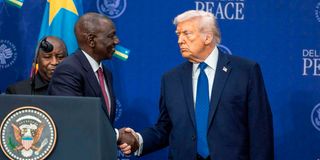
President William Ruto (left) and US President Donald Trump.
Photo credit: Pool
We asked when the Americans are expected to begin arriving, or whether some are already here. No answer. We asked why they cannot simply be flown back to the United States. No answer.
CS Duale's statement is carefully worded. It neither confirms nor denies the existence of the facility. It acknowledges "ongoing discussions" while insisting that "any arrangements regarding international health cooperation will be guided by Kenya's national laws, public health regulations, biosafety and biosecurity standards."
Health Cabinet Secretary Aden Duale during an interview in Nairobi on January 26, 2026.
Photo credit: Dennis Onsongo | Nation Media Group
The phrase is significant. It does not say the arrangement has been finalised. It does not say it has not. It simply says that when or if it happens, Kenya's laws will apply.
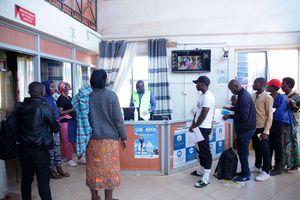
The statement also updated the number of travellers screened at Kenya's ports of entry to more than 55,000, and confirmed that ten people have been tested for Ebola, all of whom returned negative results.
What the statement does not say is whether the facility, if built, would be subject to Kenyan inspection, staffed by Kenyan health workers, governed by Kenyan biosafety protocols, or open to any form of public accountability.
Kenya has one isolation centre capable of handling Ebola, at Kenyatta National Hospital. It has a handful of biosafety level laboratories that can confirm Ebola samples. Further, it does not have an approved vaccine or treatment for the Bundibugyo strain currently circulating in the DR Congo and Uganda.
Ebola spreads through direct contact with bodily fluids such as blood, saliva and sweat from an infected individual.
Photo credit: Shutterstock
Into this context, the US government is reportedly proposing to bring its own exposed and infected citizens and build its own facility to house them.
Infectious disease experts contacted separately by Daily Nation said a quarantine facility in Nairobi makes medical sense, provided it meets the required standards.
Dr Moses Masika, a virologist who has conducted Ebola outbreak simulations in Kenya, said isolating exposed individuals at JKIA rather than flying them across continents reduces transmission risk for other travellers.
"For a patient who is sick, they would rather be quarantined here than travel all the way to the US," he said. "This is about reducing the time a person needs to get care and reducing exposure to other people while struggling to get care. If it is well equipped, well managed, and a standalone facility, there is no risk."
Prof Matilu Mwau, Senior Principal Clinical Research Scientist at KEMRI, said a US-funded facility would ultimately benefit Kenyan patients too.
"After they stop using it, they won't demolish it," he said. “First of all, Ebola is a disease that is so lethal that it is difficult to spread the way Covid-19 did. So, for that reason, it can't spread like wildfire. So, it means that if it hits us in Kenya, it will probably only affect a few people. So, the fact that we have one isolation facility is a good thing. Having more than one is better. But one is good for any expected eventualities.”
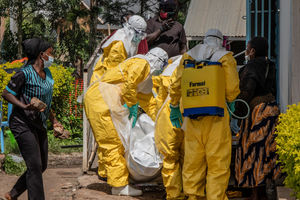
Red Cross workers wearing personal protective equipment (PPE) place in a coffin the body of Dr Tibenderana Katho Blaise who worked at the Centre Medical Evangelique (CME) in Hoho commune and died of Ebola virus, as aid agencies intensify efforts to contain a new Ebola outbreak caused by the Bundibugyo virus, ahead of his burial in Bunia town, Ituri province, Democratic Republic of Congo, May 26, 2026.
Photo credit: Reuters
He adds, “If US builds another one and they put their citizens there, that's fine because it will eventually benefit us. It's a good thing to build an isolation unit.”
The alternative, he said, is to fly their people to America, which they can also do.
“They have chosen to do it here. They could even build in Somalia, even against Somalia's wishes. Kenya is an ally of the United States, and it's also a progressive country. Kenya is quite progressive. It's not communist. It's a friend of America, we don't have a long-term enmity,” he said.
Both experts, however, were speaking to the principle of such a facility. Neither had been briefed on the specific plan being reported because, as far as can be established, no one outside a small circle of officials in Nairobi and Washington has been.
Mr Brown Ashira, the Secretary General and CEO of the Public Health Union, said while it is a beneficial opportunity, public health infrastructure needs to be properly embedded and constructed.
The establishment of an international quarantine facility, he noted, demands heavily fortified isolation sectors and foolproof containment designs that leave "no iota of any risk to the members of the public.
Doctors at an Ebola isolation centre. The current Ebola outbreak in DR Congo is caused by the Bundibugyo virus, a rare Ebola strain.
Photo credit: File | AFP
He adds: “If the deal moves forward, it must be backed by heavy, ring-fenced international financing to spark public health emergency employment and adequately staff border entry points, isolation zones, and diagnostic laboratories.”
He emphasised that a fundamental tenet of epidemiology is to contain an infection at its point of origin rather than transporting the risk. "And the reason is simple, you don't actually risk making sure that other people are exposed to the same symptoms," Mr Ashira argued.
"For Kenya to safely navigate this, the risk level to its citizens must be maintained at zero per cent. This requires extensive, specialised capacity building for frontline clinicians, border screening personnel, and surveillance teams. Lessons from the Covid-19 pandemic demonstrate how quickly imported infections can overwhelm local systems; therefore, the State must ensure that any foreign partnership adheres strictly to local legislation, specifically Cap 242 of the Public Health Act, as well as the International Health Regulations (IHR 2005)” said Ashira.
“If these strict regulatory boundaries are respected and properly funded, the partnership could offer substantial long-term benefits. This new partnership could provide local medical professionals with unprecedented exposure to cutting-edge global health practices and advanced training exchange programs.”
“By treating the agreement as a catalyst for domestic investment, Kenya could leverage foreign capital to build a resilient surveillance network, scale up its health workforce, and ultimately transform a potential biological threat into a permanent upgrade for its national public health defence.”
Thermometers are pictured at the entrance of an Ebola Treatment Centre in the Eastern Congolese town of Butembo in the Democratic Republic of Congo, October 4, 2019.
Photo credit: REUTERS/Zohra Bensemra/File Photo
A government official involved with the negotiations revealed that these plans are not part of the US-Kenya health framework that is currently being implemented by the MOH. The plans, said the official, are simply part of bolstering Kenya’s response to Ebola. This involves an international coalition, including the US government, the United Kingdom, and Kenya.
“I believe the laboratory capacity and testing were not sufficient. They lacked many supplies, so requests were made. There is, however, a major assistance package coming through to help Kenyan laboratories with lab support, testing, personal protective equipment and really almost everything, assuming there is some kind of surge or if the outbreak crosses the border,” said the official.
“I know Washington has already sent funds directly to the DRC. Groups like Samaritan's Purse have been setting up isolation facilities. So, my understanding is that this is part of a broader effort involving multiple bilateral initiatives with countries like Uganda and the DRC. There isn’t going to be a single Ebola facility for Africa because the continent is too large. So, this is more of a pre-emptive, precautionary effort in Kenya to set something up just in case,” the official said.
He said matters of a facility being set up in the country are still being finalised, and that “things are moving quite quickly.”
“I know both governments have been involved in these discussions, but I can’t really comment on exactly when, who or how. There has, however, been close coordination.”
“In terms of ‘Why Kenya?’, the outbreak is becoming so large that multiple points of isolation and response are needed. I also think this is intended to help Kenya by enhancing the country’s capacity to isolate cases. I don’t want to say ‘treat,’ because I honestly don’t know whether this would be a treatment facility. I have heard it may simply be an isolation or staging facility, a place to quarantine and triage patients. If people are infected, they would then be evacuated by air,” said the official.
He said that the reason those who are exposed will not be directly flown to the US is to protect passengers travelling by air, as Ebola takes 21 days to incubate.
Medical workers check on an Ebola patient in the Democratic Republic of Congo.
Photo credit: AFP
“What happens if you have someone suspected of exposure? Do you immediately put them on a plane back to the US or Germany? Or do you first isolate, quarantine and monitor them for symptoms?
Public health protocols require suspected cases to be isolated and observed before they can travel. I believe lessons from previous outbreaks showed that you don’t just put people on a plane without knowing whether they are infected.”
“So, what do you do until then? Where do you conduct tests? Where do you observe them? Where do you isolate people who may have been exposed in order to protect the public and other travellers? I think that’s one of the contingencies being considered. And I think one of the considerations for the proposed site involved access to a good airstrip. That’s what I know so far,” mentioned the official.
The official also revealed that none of the exposed patients has already been brought into the country, as discussions are still ongoing.
“Discussions are ongoing, and preparations are being made. I know equipment is being transported around Africa, but I don’t know what is already on the ground in Kenya. As far as I know, there are no exposed individuals here yet. There is no operational facility yet. There are discussions about setting up something temporary that would be isolated from urban centers, but I don’t believe there has been any agreement yet. Discussions will focus on what Kenya actually needs, what the U.S. is asking for, and whether there is a need to identify and build a temporary isolated facility,” the official told the Nation .
The proposed facility comes as the Bundibugyo Ebola outbreak, the third-largest on record, continues to worsen. The WHO has declared it a public health emergency of international concern. In DRC, there have been 906 suspected cases, 105 confirmed, and 223 suspected deaths. Uganda has reported seven confirmed cases and one death.
Africa CDC has placed Kenya on a high-risk list of ten countries due to heavy cross-border movement with both the DRC and Uganda. Kenya shares a border with Uganda and has significant air and trade links to the DRC.