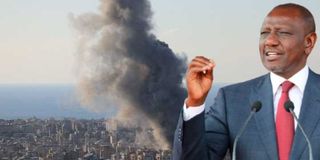
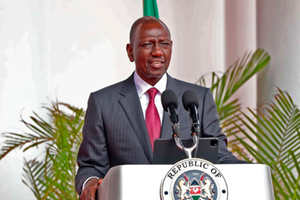
Kenya has clarified its position on the escalating conflict involving Iran, the United States and Israel, insisting it is not taking sides but opposing the spread of violence beyond the main belligerents.
Nairobi expressed concern over missile strikes on countries hosting American military facilities, warning that the regionalisation of the conflict poses a grave threat to international peace and security.
Foreign Affairs Principal Secretary Korir Sing’oei.
Photo credit: File | Nation media Group
Foreign Affairs Principal Secretary Korir Sing’oei told the Nation on Monday that Nairobi was not backing any side in the war, but was only opposed to escalating violence.
His explanation seemed to clarify what looked like contradictory statements from President William Ruto and his senior diplomats, who had initially called for trust in multilateral processes on dialogue before the president condemned Iran for attacking third-party countries.
The US and Israel launched attacks on Iran on Saturday after a preliminary assessment allegedly showed the country was planning to launch attacks on US interests in the Gulf. Those raids have since killed more than 500 people in Iran, including the Supreme Leader Ayatollah Ali Khamenei. Iran responded by firing missiles at military sites in the Gulf.
“We have taken no sides at all,” Dr Sing’oei said. “To us, while the main conflict is itself a threat to peace, the attempt to regionalise the conflict by targeting third-party states exponentially increases the risks of destabilisation, and further jeopardises chances for quicker resolution.”
The enmity between Iran and Israel routinely drags in the US, which considers protecting Israel a primary national interest. But under President Donald Trump, annihilating the Iranian regime and its ambition for a nuclear bomb has become a more direct policy, with the US attacking Iran twice in a year.
While Nairobi had guarded a key tea market in Iran (now under controversy after Iran protested fraud in sales last year), it also balances ties with Israel, which has provided aerial defence and agricultural technology to Nairobi, among other programmes. Nairobi also has a significant trade market in the Gulf, now estimated to be around $6 billion, with over 100,000 Kenyans working in Gulf countries.
“Kenya strongly condemns the strikes on the UAE [United Arab Emirates], Qatar, Saudi Arabia, Iraq, Oman, Kuwait, Jordan and Bahrain in the evolving conflict in the Middle East,” he said, arguing the “regionalisation of this conflict poses a grave threat to international peace and security”.
“At this defining and perilous moment in global history, longstanding multilateral institutions remain indispensable frameworks for the resolution of the current crisis in the Middle East. Kenya calls for urgent multi-stakeholder engagement towards de-escalation,” he added.
Gulf countries have enhanced trading with the Ruto administration, including government-to-government oil deals and the purchase of carbon credits in Kenya.
On Saturday, Foreign and Diaspora Affairs Cabinet Secretary Musalia Mudavadi called for restraint, dialogue and coordinated international action as a guide for the global response to the conflict.
Prime Cabinet Secretary and CS for Foreign and Diaspora Affairs Musalia Mudavadi.
Photo credit: File | Nation Media Group
“De-escalation and diplomacy remain essential to safeguarding international peace, economic stability and secure supply chains,” he said at an event in Nairobi to mark the 130th anniversary of the Victory of Adwa, which Ethiopians commemorate annually to mark their defeat of Italian colonisers.
“Kenya remains committed to working with regional and global partners in advancing peaceful solutions and sustainable development,” he added.
Dr Sing’oei said Kenya stands “in solidarity with countries calling for de-escalation and a return to UN Charter-based mechanisms for resolving matters in dispute.”
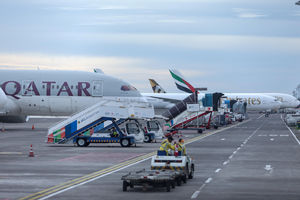
Meanwhile, Kenya told all its nationals in the Gulf to take precautions by staying indoors after missiles and shrapnel from intercepted drones fell in various areas.
The US and Israel have said the attacks will not stop until the Iranian regime lays down arms and agrees to totally end its nuclear programme. The attacks came just days after talks on the nuclear programme, mediated by Oman, failed to reach a solution.
Jordan, Kuwait, Qatar and Bahrain, which are home to US military bases, have been targeted in retaliatory attacks by Iran. Oman, Saudi Arabia and the UAE have also been hit in the attacks that have left a trail of deaths and destruction of major installations in the region.
In making its position on the ongoing war known, Kenya must have reviewed possible implications that could either hurt or benefit it in the international arena.
Smoke rises following an explosion, after Israel and the US launched strikes on Iran, amid the US-Israel conflict with Iran, in Tehran, Iran, March 2, 2026.
Photo credit: Majid Asgaripour | Reuters
Kenya has long-standing strategic diplomatic relations with the US that span security as well as trade. It considers the US as a major economic and security ally. Among the existing frameworks between the two countries is the African Growth and Opportunity Act that allows duty-free access for Kenyan exports.
According to Prof Macharia Munene, a history and international relations expert, President Ruto is playing it safe.
“This is a survival tactic. He wants to be in the good books of the US and Israel. He is playing safe and to endear himself to the US so that Trump can count Kenya as one of the countries that stood with it during this moment,” Prof Munene told the Nation .
“It would have been better if he just kept quiet, but it looks like more of self-preservation. Ruto’s administration has been on the spot recently over the issuance of passports to controversial characters linked to Sudan’s Rapid Support Forces (RSF),” the don added.
Iran’s Ambassador to Kenya Dr Ali Gholampour during an interview at the Iranian Embassy in Nairobi on February 16, 2026.
Photo credit: Evans Habil | Nation Media Group
In a previous interview with the Nation, Iran’s ambassador to Kenya Ali Gholampour said Nairobi and Tehran were pursuing plans to increase bilateral trade fivefold to $1 billion (Sh129 billion).
Speaking in Nairobi on Monday, Dr Gholampour said that bilateral relations between Tehran and Nairobi remain intact, even as regional tensions soar.
He reiterated that Iran values its long-standing diplomatic and economic ties with Kenya and emphasised that the outbreak of hostilities should not derail cooperation between the two nations.
Although regional instability has disrupted travel, trade and security calculations globally, he said that Tehran continues to see Kenya as a partner in diplomacy and economic exchange.
“Iran and Kenya share a history of diplomatic engagement and mutual respect,” the ambassador said.
Kenya has explored expanded links with Tehran in the past, including trade in energy and educational exchanges, although some deals, such as an oil supply agreement, were later affected by external pressures and sanctions.
Following the attacks over the weekend, Tehran described the strikes as a “flagrant violation” of international law and its sovereignty, denouncing them as acts of aggression that undermined ongoing diplomatic efforts.
Iran’s subsequent retaliation involved missile and drone attacks targeting US and Israeli military installations across the Middle East.
Kenya currently hosts a US military base in Manda, Lamu.
Asked if President Ruto’s remarks would affect the Tehran and Nairobi’s relations, the diplomat downplayed the matter. “I do not believe this will affect our relations... I believe every country has an obligation to uphold international law and to do its utmost to de-escalate tensions in order to ensure peace for all nations, including those in Africa and Kenya,” he said.
The conflict has triggered international calls for restraint and de-escalation—including from the UN secretary-general and several world powers—but Iran’s messaging to Kenya conveyed both defiance and a plea for collective action to prevent broader conflagration.
At an emergency UN Security Council session convened over the weekend, the UN secretary-general called for an immediate halt to hostilities and stressed that military escalation threatens civilians and regional stability.
Smoke rises after reported Iranian missile attacks, following strikes by the United States and Israel against Iran, in Manama, Bahrain, February 28, 2026.
Photo credit: Reuters
Other nations, including Pakistan, have independently warned that the conflict could spiral into a wider regional conflagration and urged renewed diplomatic dialogue.
The Iranian ambassador in Nairobi reinforced this position, saying that only collective diplomatic pressure rooted in respect for sovereignty and the international legal order can avert further escalation. He urged countries bound by the UN Charter—including Kenya—to speak out against violations of territorial integrity and support a return to negotiations.
Beyond immediate security concerns, global markets and trade routes could feel the effects of continued conflict. Disruptions of key transit corridors in the Middle East could impact Kenya’s economy, particularly trade routes for fuel, agricultural exports, and remittances from workers in the Gulf.