Hello

Your subscription is almost coming to an end. Don’t miss out on the great content on Nation.Africa

Ready to continue your informative journey with us?

Hello

Your premium access has ended, but the best of Nation.Africa is still within reach. Renew now to unlock exclusive stories and in-depth features.

Reclaim your full access. Click below to renew.

William Ruto
Caption for the landscape image:

Kenya’s ganglands: Report reveals unholy union between criminals and politicians

Scroll down to read the article

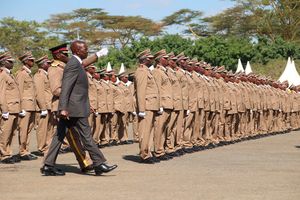
President William Ruto launches the Jukwaa la Usalama Report at State House, Nairobi, on December 2, 2025.

Photo credit: PCS

By day they provide private, aggressive protection to politicians in public rallies and events.

By night, they rob, maim and kill civilians.

Bullets have shaken hands with ballots, with drugs enabling some aspects of that friendship. The status quo has spread pain, trauma and loss – of lives and property – each day over several years, in what has become a way of life.

Nairobi has become their capital, statistics show, hosting nearly half of the more than 300 criminal organisations in Kenya.

An Interior ministry report has formally acknowledged how the unholy mix of politics and crime has made Kenya a gangsters’ paradise, with the State now pledging to divorce that union through radical policy changes.

The report, which compiled feedback from the Jukwaa la Usalama initiative – roundtables State security actors held with citizens in all 47 counties – lays bare an intricate web of groups involved in political violence, coercion, land grabbing, extortion and community intimidation.

The Jukwaa la Usalama report, unveiled by President William Ruto at State House in Nairobi on Tuesday, offers the clearest government admission yet of a problem that has long simmered beneath the surface.

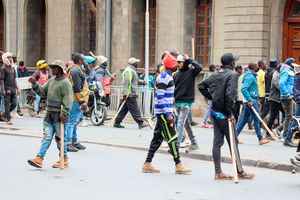
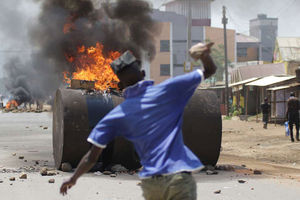
From Nairobi’s sprawling informal settlements to the coastal belt and Rift Valley farmlands, the report documents the presence of hundreds of gang networks; some old, some newly formed, others reactivated during political seasons, whose activities range from disrupting political events and enforcing loyalty for local leaders, to terrorising communities, conducting land invasions and extorting business owners.

The report lists more than 130 gangs in Nairobi alone, including the resurfacing of Mungiki, one of the country’s most infamous criminal organisations.

The groups’ activities span political violence, kidnappings, coercion and murder, and many of them, security agencies say, regroup during election cycles as informal enforcement units for political interests.

Across the western counties of Kakamega, Busia, Bungoma and Trans Nzoia, groups such as Jeshi Jinga, 42 Brothers, M23, Kapenguria Six and Usiku Sacco dominate the local crime landscape.

Their operations include violent disruptions of rallies, coercion of residents and enforcement of political loyalty, often functioning as hired muscle for politicians seeking dominance in their constituencies.

Their deep ties to local power networks make dismantling them even more complex.

In Nakuru, the notorious Confirm gang and its offshoot Wateitei illustrate a recurring challenge — crime cycles that reappear shortly after police crackdowns, often because offenders are released quickly or reorganise under new leadership.

“Even though the gang members are continuously arrested, charged and jailed, they exhibit recidivist behaviour by engaging in the same crime immediately after they are released,” part of the report stated.

The report notes that these groups engage in theft, assault and extortion, mostly targeting low-income neighbourhoods where policing is thin, and community fear is widespread.

The coastal region faces a different combination of land-driven and politically fuelled criminal networks.

In Mombasa, groups such as the Mombasa Republican Council (MRC), Panga Boys, Team Mashamba and Mawoz are implicated in land grabbing, extortion and intimidation of landowners.

Kilifi, the report established, faces similar threats from Team Mashamba, Mawoz and remnants of Mungiki, while in Kwale, Panga Boys have weakened following arrests and rehabilitation programmes, but remain an active threat.

Elsewhere, Machakos grapples with Gaza and Mungiki networks that have been linked to land invasions and the illicit control of mining sites.

At the same time, Murang’a, the birthplace of Mungiki, continues to confront reassembling elements of the group, whose historical political entanglements give it unusual resilience.

MP Peter Kaluma speaks to journalists moments after he was attacked by goons at Agoro Sare polling centre in Kasipul. 

Photo credit: George Odiwuor | Nation Media Group

The cumulative picture is deeply unsettling — gangs are not only widespread but embedded in political, economic and social structures.

Their activities disrupt governance, undermine public safety and sabotage development.

It is against this backdrop that the government’s Jukwaa la Usalama security reforms take on heightened urgency, with the State indicating that the battle against gangs must begin where they thrive the most — at the grassroots.

During the launch of the report, President Ruto declared that the era of leaving chiefs vulnerable to armed gangs must come to an end.

“In the villages, there are goons carrying machetes, knives and other weapons and attack chiefs and assistant chiefs, hurting citizens and bringing death,” he said.

He also announced that he had instructed the Inspector-General to operationalise the long-dormant National Government Administration Police Unit (NGAPU) and deploy 1,860 officers to help chiefs at the community level. The unit’s staffing will grow progressively, with the aforementioned number of officers forming the initial deployment.

NGAPU, once obscure, will now be revived, equipped and deployed as a specialised unit for escorting chiefs during raids, enforcing administrative directives and providing armed backup in gang-prone areas.

New Content Item (1)

In addition to bolstering personnel, the President approved a significant boost in the chiefs’ operational budgets, directing that their Authority to Incur Expenditure be increased by Sh15,000 every quarter. This, he said, is intended to ease mobility, improve intelligence gathering, support community policing structures and strengthen logistical capacity during operations.

On his part, Deputy President Kithure Kindiki described chiefs as “the eyes and ears of government” and the most reliable agents for transmitting policy and mediating local disputes.

He stressed that the security of the country’s future and its economic aspirations hinge on safe communities.

“All investments can go up in flames if security is not durable and stable,” he warned.

Interior Cabinet Secretary Kipchumba Murkomen, who spent months touring the country and consulting security personnel, said empowering chiefs would fasten and expedite the transformation of Kenya by strengthening the government’s presence where it matters most.

To enhance documentation and response time, the President said every chief will receive a digital tablet within six months to file reports electronically, log incidents and build real-time datasets on gang activity, drug trafficking, domestic violence, land disputes and other crimes.

“This will create a seamless channel of information between chiefs and police stations, increasing accountability and ensuring faster intervention. The digital reports will link directly to police databases and trigger immediate follow-ups, a critical improvement in areas where gangs reorganise quickly after crackdowns,” he said.

The report also documented a major bottleneck that has long slowed responses to crime — inaccessible or incomplete police stations.

Many chiefs operate in remote areas where the nearest station is far away, complicating emergency coordination or the handling of suspects.

To close this gap, President Ruto announced plans to construct 900 police stations over the next two years, using resources drawn from the Interior Ministry, the National Government Constituency Development Fund and the Affordable Housing Programme.

Alongside this infrastructural expansion, the government will operationalise 24 new sub-counties, 88 divisions, 318 locations and 675 sub-locations to place state authority closer to the communities that need it most.

The logic is simple — smaller jurisdictions allow chiefs and assistant chiefs more time and proximity for community mobilisation, surveillance and early detection of gang activities, reducing the administrative gaps that criminal networks exploit.

Another threat documented in the report is the strong connection between drug abuse and gang recruitment, particularly among unemployed young men.

“To address this challenge of drug abuse ravaging our youth, I have instructed the Inspector-General of Police, to revamp the Anti-Narcotics Unit, and increase its members from 160 to 500, supported by the establishment of 34 regional offices across the country,” President Ruto said.

The government will also push for a unified framework for liquor licensing to curb unregulated alcohol outlets that serve as gang recruitment hubs. Additionally, county governments will be required to build rehabilitation centres aimed at reducing the pool of vulnerable youth drawn into criminal networks.

A vehicle that was damaged when goons attacked Governor George Natembeya's convoy in Chwele ward, Kabuchai constituency on November 22, 2025.

Photo credit: Shaban Makokha | Nation Media Group

Coastal and eastern counties, frequently affected by land-related gangs, are expected to benefit from strengthened policing and digital reporting systems that will allow quick action against land-grabbing schemes.

Beyond administrative reforms, the government announced wide-ranging measures to support and motivate officers engaged in anti-gang operations.

These include the construction of 17,500 housing units for police and prison warders, the procurement of 3,000 vehicles, shifting to electric models to reduce fuel constraints, and the promotion of all 5,892 chiefs trained in the recently concluded training, effective June 2026.

The President also directed that all police constables aged 50 and above be promoted, and new transfer guidelines be introduced to ensure officers are not moved abruptly or forced to serve for more than three years in high-risk zones.

Village elders, who often provide the earliest intelligence on gang movements, will for the first time be formally recognised, issued government IDs and paid a monthly stipend of Sh3,000 starting June 2026.

The Jukwaa la Usalama report lays bare an uncomfortable truth — that gangs have become entrenched, adaptive and powerful, often operating with political protection or in areas where the State’s presence is weak.

For chiefs who have long faced armed gangs with little more than a notebook and a whistle, the reforms signal a long-overdue shift.

Follow our WhatsApp channel for breaking news updates and more stories like this.