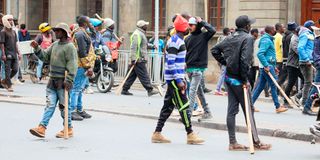
For as little as Sh500, a young man in Kenya can be hired to hurl stones, cause chaos during peaceful protests, shout down a speaker at a political meeting, among other “services”.
Those tasked with protecting a politician’s convoy can earn up to Sh1,500, while others deployed to seize contested land, guard illegal businesses, or “discipline” rivals take home between Sh2,000 and Sh5,000 per job.
Such are the rates in the murky world of goons, the unhinged youth who, for a pittance and a drug dose, are ready to put their lives on the line for the whims of political operatives, business magnates and land barons.
Operating under a ragtag chain of command and sometimes paying for their activities with injuries or worse, some don’t like the task, but there is little else they can do. A number of them spoke to a team of researchers for a newly released report, and one recurring explanation was: “I am in it for the money.”
The report, titled “Goonland: Looking Beyond the Money and Violence in the Political Exploitation of Young Men”, also reveals how women are used as mules to transport weapons. Sometimes, even vehicles by security agencies serve the same purpose.
The report was prepared by research firm Odipodev and Tribeless Youth, a network that promotes peaceful coexistence among Kenyan youth. It noted that money changes hands in cash, usually at a petrol station or outside a pub. No receipts, no names, no questions. Payment depends on risk and visibility. Those at the frontline earn the least while those who organise and recruit pocket the most.
What emerges from it is that there is a shadow labour market where political and business interests tap into the desperation of unemployed youth to purchase violence on demand.
Photo credit: Nation Media Group
For instance, disrupting peaceful protests, infiltrating demos to create an impression of chaos, or posing in front of businesses to prevent looting fetches Sh500 from an MCA, Sh1,500 from an MP, Sh2,000 from a governor and Sh2,500 from businesspeople.
“Payments are made via hard cash just before the project is executed to avoid traceability, usually at petrol stations just before the ‘gig’. Any money is acceptable to young men, with no predictable income or future,” the report says.
The National Cohesion and Integration Commission (NCIC) and the National Crime Research Centre (NCRC) have also released reports recently that shed light on the vice.
NCIC’s report “The Evolution of Criminal Gangs in Kenya”, released on Thursday noted that endless politicking in the country is a breeding ground for goons.
“Perennial politicking is a key characteristic of a state vulnerable to organised crime. During electoral periods, politicians engage in endless campaigning, often resorting to hiring goons and thugs to intimidate rivals and secure their influence. This cycle of relentless competition fosters an environment where violence, threats, and coercion become commonplace,” it said.
The NCIC survey notes that the groups have become more organised, merging digital operations with traditional crimes such as armed robbery, drug trafficking, extortion, carjacking, illegal utility connections and M-Pesa fraud.
It also highlights the involvement of minors, with some recruits as young as 11, and most members aged between 15 and 35, often armed with knives, pangas and occasionally firearms. It further identifies social media platforms – including X, Facebook, WhatsApp and TikTok – as central to gang recruitment, propaganda and rapid mobilisation.
A goon chases down a protester in downtown Nairobi as police officers in a van look on.
Photo credit: Reuters
The NCRCs report, dubbed “The Proliferation and Resilience of Criminal Gangs in Kenya”, and which was released recently, echoes these findings, describing how gangs are recruited and funded during election cycles.
“Criminal gangs are popular with some politicians who use them for personal gain, especially during electoral processes. Gang members are hired as goons to offer security or to intimidate political competitors,” it stated.
According to the NCRC, Mombasa leads with 73 active criminal gangs, followed by Nairobi with 56 and Kilifi with 47. The centre warned that political leaders must be held accountable for “directly and indirectly enabling gangs”.
Often, politicians intervene when gang members are arrested, emboldening them and reinforcing the culture of impunity that sustains the goon economy.
Photo credit: Source: Odipodev Research
The new Odipodev report studies the hierarchy of goons, noting that behind every group is something of a chain of command.
At the top sit the clients – politicians, local businesspeople, and land speculators – who fund operations but remain invisible. Their instructions are relayed through handlers, often personal assistants or campaign managers, to obscure any traceability to the head of the command. The handlers contact recruiters, known on the streets as the “big fish”, who mobilise young men from informal settlements or trading centres.
Recruiters act as contractors, couriers handle logistics, and scouts monitor opponents. The system runs on deniability even as the financiers stay out of sight while their proxies translate instructions into action.
Photo credit: Nation Media Group
The Odipodev-Tribeless Youth report established that a recruiter typically manages between 10 and 30 people. They are paid a lump sum from which they deduct their share before paying the rest in cash.
Scouts and fixers, who monitor rivals and coordinate movement, earn slightly more for their intelligence and logistics roles. Women, often overlooked, are hired as mules or couriers to transport weapons and money, their lower profile offering natural cover.
Most jobs are brief. Once the mission is completed, groups disperse until another call comes. There are no written contracts, only whispered instructions and the assurance that loyalty today guarantees the next gig tomorrow.
Recruitment is opportunistic and constant. In Nairobi, Mombasa, Nakuru and Kisumu, recruiters frequent boda boda stages, informal bars, matatu termini and football pitches. They look for the idle, the angry, and the loyal — men known to obey orders without hesitation.
For many recruits, the first gig begins as an errand, like carrying campaign materials, chanting slogans or clearing crowds. Over time, the tasks become riskier, breaking up rallies, intimidating opponents, or protecting illegal activities.
“You start with shouting at a rally for Sh500. Then one day, you’re told to ‘teach someone a lesson’. After that, you are part of the team,” one reformed goon told researchers.
Once in, leaving is difficult. Recruiters often double as local patrons, providing occasional jobs, beer, or protection. Dropping out can invite suspicion or violence.
As one interviewee put it, “The guy who gives you the goon gig is the same one giving you the mjengo (construction site) gig, carwash gig.”
Some age out naturally, marrying, finding casual work, or moving away, but most remain trapped by debt, addiction or fear.
“The guys might come to your house and force you to go for the jobs,” one informant admitted.
Another spoke of regrets: “They say a job is a job and you have to go. But they are not happy about it. It's not their wish because they would want it to end. It’s just because of the money.”
Recruiters sometimes offer limited reintegration, giving ex-fighters small business capital or jobs as boda boda riders but such gestures rarely last. The social hierarchy remains: the recruiter eats well; the soldier survives on scraps.
Pro-Government protesters running after people who were participating in protests in Nairobi on June 17, 2025.
Photo credit: Evans Habil| Nation Media Group
Operations are simple but disciplined. Goon squads rarely use firearms. Instead, they rely on machetes (pangas), slashers, hammers, clubs, bottles, petrol and stones, everyday tools that are easy to buy and discard. Couriers deliver these ahead of time, sometimes hidden in sacks of vegetables or construction material.
On the day of action, motorbike riders ferry the men to the scene, often in small clusters to avoid attention. Phones are switched off, and recruits are warned against livestreaming or taking pictures unless instructed. Payment is delivered in cash, half before, half after, usually by the handler’s aide at a neutral spot.
Afterwards, the group scatters. Some head back to construction sites or boda boda work, others lie low until tensions cool. For most, the job is over within hours.
The goon economy thrives because it is cheap, flexible and effective. A politician can disrupt an opponent’s event for less than the cost of hiring a stage and sound system. A businessman can intimidate competitors or evict tenants without a single court order. The market rewards availability and aggression more than skill.
However, at the bottom of this hierarchy, goons earn barely enough to survive. The average recruit makes less than Sh10,000 a month, below minimum wage, yet remains loyal to the network because of constant small gigs and the informal welfare it provides.
Recruiters and handlers, by contrast, accumulate substantial gains, sometimes collecting hundreds of thousands during election season.
Despite the brutality, most goons operate under an internal code. Loyalty to the recruiter and the client is paramount. Betrayal, particularly speaking to police or journalists, can be fatal. Discipline during operations, not stealing from the client, avoiding unnecessary killing, obeying instructions, is enforced by reputation and peer pressure.
Drugs and alcohol are the social glue of this subculture. Before and after jobs, groups gather to drink or smoke bhang, numbing fear and guilt. Many live with untreated injuries and trauma.
“This job is a little risky,” one respondent said. “If you get hurt, it’s your own fault.”
Another one revealed: “Not all of us came back, and most of us were badly injured during the altercation.”
Some of the unknown men who came into the Nairobi CBD in large numbers on June 17, 2025.
Photo credit: Francis Nderitu | Nation Media Group
The thrill of quick money masks deep instability, constant fear of arrest, revenge or abandonment once politics move on. Despite the danger, many cling to the idea of loyalty.
“You need to be ruthless. You need to be a goon. You need to be a man. So, if they ask you to go there, you go there. You don’t look back,” one respondent said.
In the same vein, a new breed of “goon-fluencers” has emerged, using social media platforms to wield influence and to recruit more goons. These individuals, often mid-level enforcers, post videos of their “missions” or issue threats online, attracting thousands of followers.
Those listed in the report have followers that range from 500,000 to well over 50,000.
Their influence has turned violence into spectacle and given them a dangerous form of legitimacy. Some are now courted by politicians as micro-influencers, blurring the line between propaganda and intimidation.
Community organisations that have tried to rehabilitate violent youth report mixed results. Many men relapse during election seasons, when the demand for hired muscle spikes. Without alternative income and psychosocial support, the lure of Sh1,000 cash-in-hand remains irresistible.
The Odipodev-Tribeless Youth report warns that as unemployment, inequality and political impunity deepen, Kenya risks institutionalising violence as an acceptable form of political and commercial negotiation.
The goon economy is no longer confined to election cycles, it now underpins business disputes, land seizures and even social-media feuds.
To successfully break this cycle, the State, according to the NCRC report, requires to dismantle the supply chain, not just punishing the foot soldiers. That means tracking financiers, enforcing campaign finance transparency, and investing in long-term youth employment and rehabilitation. It also demands confronting a cultural reality, that power and violence have become intertwined symbols of success.
Until that changes, a few hundred shillings will remain enough to buy silence, fear, and the street muscle to enforce both.