Kenya is moving away from the long-standing practice of extracting and exporting raw minerals, adopting a new policy direction that prioritises local processing, value addition and the development of integrated industrial value chains.
President William Ruto said the shift is aimed at retaining more value within Africa’s mineral sector, rather than exporting it in raw form.
“We will process our minerals here in the continent, we will refine them here, we will manufacture them here,” he said while opening the ‘2026 Mining Investment Conference’ in Nairobi. “The full length of the value chain must and will generate value for Africa.”
Rich mineral base, limited local value capture
Kenya’s mining sector has traditionally been anchored on extraction and export of raw minerals despite its diverse resource base.
The country has deposits of gold in western Kenya, titanium along the coast, niobium and rare earth elements in Kwale, gemstones across central and coastal regions, and iron ore in Taita Taveta, alongside copper, manganese and chromite in northern and eastern regions.
“Gold stretches across the western belt from Narok through Migori and Kakamega into Turkana and Marsabit counties,” the President said. “We have niobium and rare earth elements in Kwale, iron ore in Taita Taveta and titanium along the coast.”
Despite this wealth, most minerals have historically been exported in raw form, limiting industrial growth, skilled job creation and overall economic returns.
Africa’s mineral wealth is becoming increasingly central to global industrial growth and the clean energy transition, as demand rises for critical minerals such as lithium, cobalt, graphite and nickel.
Experts say Africa holds about 30 percent of global critical mineral reserves, placing it at the centre of the green energy shift.
However, they warn that without proper regulation, the push for extraction and processing could worsen environmental degradation in already vulnerable regions.
Across the continent, governments are now pushing for greater local value retention through processing and manufacturing, while grappling with how to balance industrialisation and sustainability.
Dr Henry Alake, Nigeria’s Minister of Solid Minerals Development, said Africa can no longer afford to remain a supplier of raw materials.
“For far too long, our continent has largely remained an exporter of raw materials and an importer of finished products,” he said. “We cannot continue exporting raw ores while other economies create industries, jobs, technologies and wealth from African resources.”
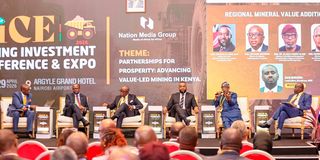
Panelists (from left to right) John Mwendwa, Chief Executive Officer, Invest Kenya, Ryan Hollowell, Commercial Counsellor, US Embassy Nairobi, Harry Kimtai, CBS, Principal Secretary, State Department for Mining - Ministry of Mining, Blue Economy and Maritime Affairs, and Jiten Devacha GM Shanta Gold, during a panel discussion at the MICE Kenya Mining Investment Conference and Expo at Argyle Grand Hotel Nairobi Airport, along Mombasa Road, Nairobi, on April 28, 2026.
Photo credit: Wilfred Nyangaresi | Nation Media Group
“This conversation is bigger than mining. It is about Africa’s industrial future and economic sovereignty,” he said.
Sustainability concerns grow
As Kenya and other African countries expand mining ambitions, concerns are rising over environmental sustainability, including water use, land degradation and emissions from processing industries.
Principal Secretary Harry Kimutai said Kenya is positioning itself as a competitive and responsible mining destination.
“The mining sector is expected to serve not just as a source of revenue but as a catalyst for inclusive growth, industrial transformation and sustainable development,” he said.
Cabinet Secretary for Mining Ali Hassan Joho said the government has made progress in geological mapping, infrastructure development and regulatory reforms to guide responsible extraction.
“Kenya is not only ready and robust in terms of regulations and law,” he said. “Kenya is creating the necessary support infrastructure to spur and open up the industry.”
CS Hassan Ali Joho's speech during Mining Investment Conference
He added that geological surveys have helped identify mineral locations and quantities, reducing investment risks and limiting speculative exploration that can harm ecosystems.
However, expanded infrastructure — including roads and rail networks — also raises environmental concerns linked to habitat disruption and industrial expansion into fragile areas.
Investment and industrial push
The government says it is now focusing on building local capacity to process minerals and develop industrial value chains.
President Ruto highlighted the iron ore pelletisation plant in Taita Taveta, currently in its final stages of construction, as a key milestone.
“The iron ore pelletisation plant in Taita Taveta represents an 11 billion shilling investment that will create approximately 3,000 jobs,” he said.
He added that the project reflects a broader strategy to ensure Kenya’s minerals are processed locally rather than exported in raw form.
Financing, media and private sector role
The conference also highlighted the role of financing and private sector participation in unlocking the sector’s potential.
Panelists (from left to right) Dann Mwangi, NMG's Lead Editor, Broadcast, Dahir Shire Mohamed, Minister of Petroleum and Mineral Resources, Federal Government of Somalia, Anthony Mavunde, Minister for Minerals, United Republic of Tanzania, Hassan Ali Joho, EGH, Cabinet Secretary, Ministry of Mining, Blue Economy and Maritime Affairs, Dr. Oladele Henry Alake, Minister of Solid Minerals Development, Federal Republic of Nigeria and Chairman, Africa Minerals Strategy Group and Losuba Ludoru Wongo, Minister of Mining, Republic of South Sudan, during the MICE Kenya Mining Investment Conference and Expo, themed “Partnerships for Prosperity: Advancing Value-Led Mining in Kenya,” at Argyle Grand Hotel Nairobi Airport, along Mombasa Road, Nairobi, on April 28, 2026.
Photo credit: Wilfred Nyangaresi | Nation Media Group
The Group Managing Director and CEO of Nation Media Group, Geoffrey Odundo, said the media plays a key role in shaping public understanding of development and sustainability.
“Our role is to positively influence society,” he said, adding that responsible reporting should also highlight environmental challenges tied to industrial expansion.
Kenya Commercial Bank said financing will be critical in supporting both large-scale investors and artisanal miners, who often operate without formal environmental safeguards.
“The future of mining in Kenya will not be defined by the resources beneath our soils, but by the partnerships we build above it,” the bank said.
Mining remains one of the most resource-intensive industries, often linked to deforestation, water pollution and land degradation.
Without strong safeguards, experts warn Africa risks trading one form of dependency for another — exporting raw minerals while bearing the environmental cost of extraction.
It is this imbalance that is driving Kenya’s policy shift toward value addition, industrialisation and local processing, while embedding environmental responsibility in the sector’s growth.
President Ruto said future investors will be judged not only on capital investment but also on sustainability standards.
“Investors are looking not only for mineral deposits,” he said, “they are looking for stability, predictability and vision as well.”