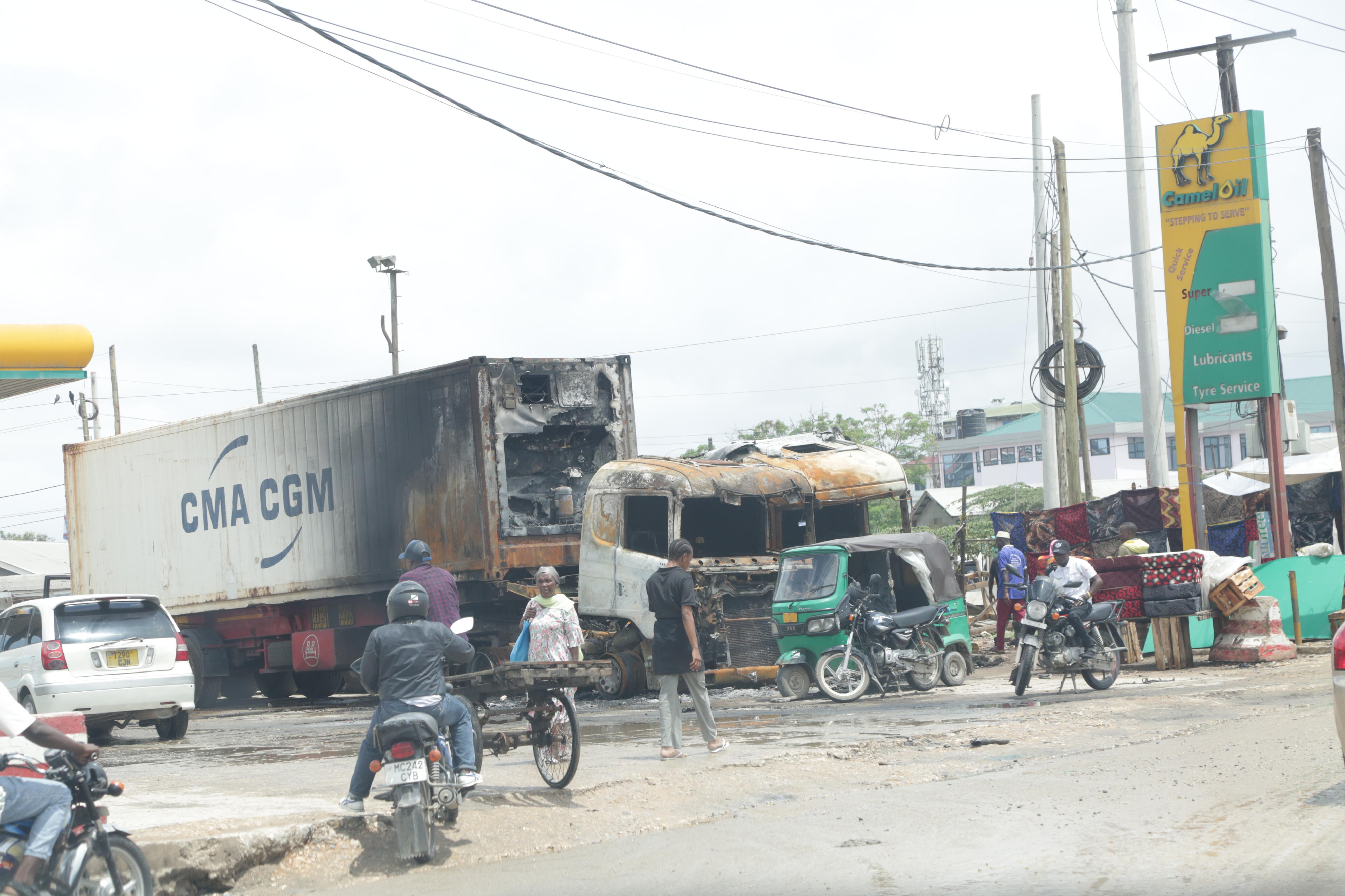
Rose* (not her real name), a Kenyan who works in one of the major cities in Tanzania, has not stepped out since the eve of the general election of October 29.
She fears venturing out because the air is still tense amid police crackdown targeting foreigners, a week after the controversial polls and violent protests.
“We cannot move freely like before. Things are tense right now. I cannot tell you the last time that I stepped out,” she told the Nation.
Even making phone calls is scary, she said. One doesn’t know who else is listening. Cleaning text messages is second nature, as they fear getting caught with the “wrong” messages.
Tanzanian demonstrators participate in violent protests in Dar es Salaam following chaotic election on October 29, 2025.
Photo credit: Reuters
Kenyans who spoke to the Nation on condition of anonymity for fear of being victimised said that they were even afraid of calling their loved ones across the border, or sharing their experiences through social media platforms, after receiving information that their phones were being monitored.
“We have been told that phones are being checked at every police checkpoint. The only way of remaining safe is to erase the conversations and avoid some conversations to avoid the drama,” the scared Kenyan said.
While the government ordered a return to normalcy, Kenyans we spoke to say many businesses are still closed. Visiting friends is out of the question.
“We don’t know what is happening out there. The local media are not reporting anything about the aftermath. We are still relying on information from friends and a few groups on social media.”
Kenyans in Tanzania say they are bearing the brunt of the violent election-related protests, which left dozens dead last week.
There have been reports of arrests, too.
Vocal Africa CEO Hussein Khalid on Wednesday said a Kenyan identified as 29-year-old Fredrick Lorent Obuya was arrested in Dar es Salaam on October 31.
“Fredrick is a lawyer and runs a tour company. According to his friends, he was on his way to Zanzibar on a work-related trip when he was arrested. His last known location was Oyster Bay Police Station,” Mr Khalid said.
He also claimed that the Tanzanian government was targeting activists and opposition figures in an attempt to cover up the bloodbath that opposition parties have said claimed hundreds of lives.
The Kenyan Embassy in Dar es Salaam said that it was still assessing the situation but dismissed the claims that Kenyans were being targeted by the authorities.
In a phone conversation with the Nation , Kenyan Ambassador to Tanzania Isaac Njenga said: “We are still reaching out to Kenyans who are stranded and we are working to respond to all calls from Kenyans in Tanzania.”
Ambassador Njenga said that calm had returned in the country after the lifting of the lockdown measures and that Kenyans willing to travel home were free to do so, as flights and buses had resumed operations.
He said the Ministry of Foreign and Diaspora Affairs in Nairobi would issue a comprehensive report later, as they had been furnished with all the necessary information.
“Nobody is stranded because public transport is back to normal and normalcy has returned…there are certain things we are just trying to make verification on before the statement can be issued,” Mr Njenga said.
Protesters at the Namanga One-Post Border crossing point between Kenya and Tanzania on October 30, 2025, a day after a general election marred by violent demonstrations.
Photo credit: Reuters
The Nation’s efforts to get comments from Foreign Affairs Cabinet Secretary Musalia Mudavadi and Principal Secretary Korir Sing’oei were not successful.
In the immediate aftermath of the October 29 election, discredited by observers from the Southern African Development Community as marred by irregularities and excluding opposition parties, the Samia Suluhu Hassan administration ordered a dusk-to-dawn curfew , cut internet and instituted a violent suppression of the protests.
When the government lifted the lockdown orders and restored internet access on Monday after the hurried swearing-in of President Suluhu in a military facility in Dodoma, the country was still reeling from the violence, death and destruction.
In her inauguration speech, beamed live on the national broadcaster, President Suluhu blamed foreigners for the protests in the country.
She said she was “saddened by violence, lack of peace, loss of human life and destruction of property, including personal property, in certain parts of the country, including our cities.”
Tyres burn along a deserted road in Dar es Salaam on October 29, 2025 during violent protests that marred Tanzania's general election.
Photo credit: Reuters
“What happened does not reflect our character, tradition, and aspirations as Tanzania. It is not ‘Utanzania.’ It wasn’t a surprise that some of those young people who were arrested for participating in violence included foreigners. Our defence and security organs [are] continuing to investigate these incidents to return Tanzania to the peace we [are] accustomed to,” she said.
“The presidents of Zambia and Burundi have pronounced themselves on this matter. The violence in our country is not good. It has no value or price worth emulating. So my brothers, I plead with you to maintain peace and unity for our country,” the president said.
“I want to take this opportunity … to warn all those who incited violence and promoted breach of the peace.”
She was echoing her police force, who also vowed to hunt down foreigners in the country who fomented the violence.
The Police also warned the people against sharing online images that might "cause panic" after internet access was restored.
Opposition party Chadema, whose leader Tundu Lissu was not on the ballot as he was defending himself against treason charges related to his opposition to the polls without reforms, said it had documented hundreds of deaths.
The President, while acknowledging that people had died, dismissed the death toll as hugely exaggerated.