Ahead of this year’s Jamhuri Day, which is themed around wildlife, the Kenya Wildlife Service (KWS) has released a scorecard looking at its achievements over the past three years.
From increased domestic visitors to the largest recruitment of rangers in history, KWS says it has witnessed a turnaround.
In a report seen by Nation , it says visitor numbers have surged from 2.36 million in 2022 to 3.38 million in 2025, marking a 43 percent increase.
“Domestic tourism now accounts for almost 70 per cent of all visitors, while annual revenue has nearly doubled from Sh4 billion to Sh7.98 billion,” it adds.
From Monday to Thursday, ahead of Friday’s Jamhuri Day, KWS plans to command a huge presence at the Kenyatta International Convention Centre (KICC) in Nairobi.
This will be towards living the theme of this year’s Jamhuri Day celebrations, which is “Tourism, Wildlife, and Meetings, Incentives, Conferences and Exhibitions”.
The state agency plans to sell its story of retooling, modernising and repositioning itself as a continental leader in wildlife conservation and tourism management as it occupies some of the exhibition stands that will be set up at KICC over the Jamhuri thematic week.
Its scorecard says that due to the improvements in collection, it now funds 90 per cent of its operations internally, “a milestone that has significantly strengthened its financial independence and long-term stability”.
“Satellite internet connectivity has been installed across all national parks, reserves and stations providing real-time communication in areas that were once completely cut off. Advanced technologies such as Earth-Ranger and LoRa-WAN [long-range, low-power wireless network] monitoring systems, drones, thermal cameras, GPS collars and long-range radio networks now guide patrols, track wildlife movement and detect threats before they escalate,” says KWS.
Kenya Wildlife Service Director-General Erustus Kanga.
Photo credit: File | Nation
The agency, headed by Director-General Erustus Kanga, notes that there wasn’t a single case of rhino poaching over the last financial year.
“In the 2024/25 financial year, not a single rhino was lost to poaching. The national rhino population has grown from 1,890 in 2022 to 2,102 in 2024, supported by intensive protection efforts and the establishment of new rhino sanctuaries in Loisaba and Segera in Laikipia County,” the scorecard says.
On hiring new rangers, the KWS notes: “In response to a Presidential directive, KWS embarked on the largest expansion of its ranger force in the country’s history. A total of 1,274 new rangers have been recruited and trained across all 47 counties, while an additional cohort of 147 cadets is preparing for deployment.
This growth has enabled the formation of seven new ranger companies, a specialised tactical unit and multiple rapid-response outposts across the country.”
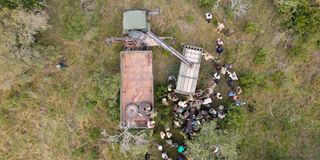
“The past three years have also seen historic wildlife movements and veterinary interventions. More than 3,600 animals have been translocated nationwide to restore ecological balance and reduce pressure on farmlands. The largest of these involved 53 elephants moved from Mwea National Reserve to the Aberdare ecosystem,” it says.
“In a world-first conservation milestone, 10 mountain bongos were released into the Mawingu Sanctuary in Mt. Kenya, while 43 black rhinos were translocated to Loisaba and Segera conservancies,” adds the review.