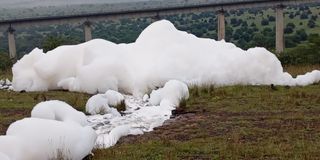
Foul, foamy water has been observed flowing into Nairobi National Park from the upper Mlolongo drainage corridor, prompting the Kenya Wildlife Service to raise the alarm over a suspected chemical discharge that threatens one of the country's most iconic protected areas.
The KWS said on Thursday it was "assessing a suspected chemical discharge incident reported on the morning of April 30 2026, in the Mlolongo Athi Dam ecosystem, raising serious environmental and public health concerns."
"Officers on patrol observed abnormal inflows entering the park, characterised by white, effervescent bubbles, continuous flow and unnatural colouration consistent with possible chemical contamination," the wildlife protection agency said.
Preliminary investigations suggest the runoff may have interacted with nearby industrial zones, with KWS pointing to "areas near Orbit Chemical Industries Ltd" as a possible source, though it stressed that investigations are ongoing to confirm the source.
KWS is investigating suspected chemical discharge into the Mlolongo-Athi Dam ecosystem after officers detected foamy, discoloured water flowing from the upper drainage corridor.
Photo credit: Pool
Orbit Chemical Industries, founded in 1972 and based along the Mombasa-Athi River Road corridor, is one of East Africa's pioneer manufacturers of sulphonic acid, sulphuric acid, and sodium lauryl ether sulphate, among other industrial and household chemical products.
The timing of the incident couldn't be worse from an ecological standpoint. Athi Dam, situated in the southern section of Nairobi National Park near the Athi River, is the largest and most ecologically significant dam in the reserve. It is home to hippos and crocodiles, and serves as a convergence point for hartebeests, rhinos, waterbucks, lions, and cheetahs, particularly during the dry season when other water sources diminish. Preserving and rehabilitating water bodies like Athi Dam is considered essential for maintaining biodiversity within the park.
The threat does not stop at the park's boundaries. KWS said the affected drainage system feeds into the Mbagathi and Athi Rivers, placing downstream communities, agriculture, and livestock at risk as well. The Athi River has for years been flagged by parliamentarians and scientists as one of Kenya's most polluted water bodies, carrying industrial and human waste from Nairobi into downstream counties. Thursday's incident adds a fresh dimension to a crisis that conservationists have long warned about.
In response, KWS has activated what it described as a multi-agency intervention.
"We are conducting water sampling and laboratory analysis in collaboration with the National Environment Management Authority (NEMA) and the Water Resources Authority (WRA). Officers are also tracing upstream discharge points and evaluating containment measures to prevent further contamination," KWS statement said.
The public has been warned to stay away from the affected water bodies and advised people to "refrain from fishing in or using water from impacted sections, and report any unusual water conditions or wildlife distress. Game wardens and wildlife veterinarians will be monitoring animals in the vicinity of Athi Dam closely in the coming days, given how heavily dependent the park's wildlife is on that water source," KWS added.
Nairobi National Park, established in 1946 as Kenya's first national park and the only national park located within a capital city in the world, covers approximately 117 square kilometres. It serves as a critical ecological buffer, maintaining important ecosystem services such as water regulation, carbon sequestration, and biodiversity conservation, and draws tens of thousands of tourists annually.
Industries operating within the catchment area have been warned that discharging untreated waste or hazardous substances into protected ecosystems is illegal and will attract strict enforcement action, including prosecution, fines, facility closures, and liability for environmental restoration.
It is a warning that has been issued before. MPs and environmental watchdogs have repeatedly called for stronger enforcement against industries discharging into rivers that flow into Kenya's protected areas, with NEMA described in parliament as having been rendered largely toothless due to understaffing and inadequate funding.