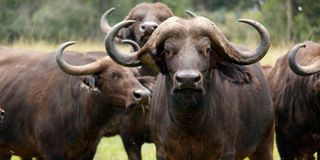
The country’s tourism industry recorded a positive revenue trajectory in 2024, posting Sh460 billion, with wildlife recognized as a major revenue artery.
This comes at a time when the Kenya Wildlife Service (KWS) is pushing for 10 percent of the total revenue to be reverted to local communities.
The Kenya Wildlife Service (KWS) Director General Dr Erustus Kanga said the total income marks an increase from approximately Sh352.5 billion collected in 2023.
Dr Kanga said 75 percent of the total revenue was accrued from wildlife, which remains a major attraction for both local and international tourists.
“Most tourists who visit the country come to see our national heritage — wildlife. Out of the total Sh460 billion tourism revenue, Sh345 billion was generated from tourists who visit to observe or watch wildlife,” said Dr Kanga.
Dr Kanga spoke at Isara, Kajiado East Sub-county, on Monday during the issuance of Human-Wildlife Conflict (HWC) compensation cheques worth Sh64 million to a handful of victims who had waited for several years.
The event was also graced by Principal Secretary, State Department for Wildlife, Ms Silvia Museiya, local leaders, and dozens of residents who coexist with wildlife.
Dr Kanga further said KWS, in collaboration with the Ministry of Tourism and Wildlife, is advocating for a revenue-sharing formula where local communities will receive 10 percent of total tourism earnings to boost wildlife conservation.
“We are rooting for a formula for local communities to get 10 percent of the total revenue. We will make this money the locals’ ‘cow’ to milk — through bursaries, water pans, and fencing off wildlife migration corridors,” he added.
PS Museiya said the Ministry of Tourism and Wildlife has launched a month-long nationwide campaign that will culminate in the launch of the National Compensation Fund, to be presided over by President William Ruto in Meru County on May 26.
“The integrated campaign will educate communities on Human-Wildlife Conflict (HWC) mitigation and compensation processes, including the implementation of new digital claims systems. It will also highlight wildlife economy opportunities — such as wildlife species allowed for farming, beekeeping, and eco-tourism enterprises — to reduce dependency on compensation payouts,” said PS Museiya.
Kajiado leaders challenged KWS to ensure unborn infants, in cases where expectant mothers are killed by wild animals, are considered as separate victims, and urged that delayed livestock compensation be based on current market rates.
“We want two lives to be compensated for any expectant woman killed by animals. It’s not fair to compensate a cow that was killed 10 years ago at the rates of that time,” said Kajiado South MP Samuel Parashina.
Kajiado East MP Kakuta Mai Mai urged the Ministry of Tourism and Wildlife to partner with legislators from the 10 counties most affected by human-wildlife conflict to lobby for more resources.
“We want more resources allocated to compensation. We have seen the government allocate money for coffee, miraa, and tea farmers. We want our people to be considered as well,” said Mr Kakuta.
Similar sentiments were echoed by nominated Senator Peris Tobiko, who urged KWS to build a better rapport with residents coexisting with wild animals to help minimize HWC cases.
Meanwhile, the Oloirien wildlife migratory corridor — linking Kajiado and Makueni counties to Chyulu National Park and Tsavo West — took center stage during the meeting. The corridor has been blocked by human settlement, and local elders demanded its immediate reopening to prevent animals from straying into residential areas.
However, Dr Kanga explained that the occupants of the corridor obtained a court order in 2019 barring KWS from evicting them.
“By the time the individuals obtained the court order, they had occupied 10,000 acres of the corridor and were eyeing an extra 54,000 acres. The court stopped them from advancing further, but we have noted they are still building more houses even as HWC in Kajiado and Makueni escalates,” Dr Kanga told the agitated locals. “We have cited them in court for contempt. Let locals from both counties maintain peace until the court rules on the matter.”
In a ruling dated February 22, 2019, and delivered in Machakos by Justice O. Angote, a permanent injunction was issued restraining KWS and the Makueni County Government from evicting ranchers in Mikululo.
Justice Angote barred the eviction of the plaintiffs (Mikululo Ranch) and their members, families, servants, and/or agents from the disputed land.