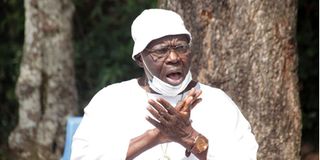
In its May 11, 2011 issue, the Catholic World Report painted his church and the Legio Maria as 'unclassifiable sects', describing him as a man of imposing stature with a flamboyant, witty and theatrical manner.
Yet he carried an unmistakable aura of authority that silenced even his critics. For decades, Father John Pesa I remained an enigma wrapped in mystery.
Rarely did he appear without a group of dedicated followers, private security officers clad in black suits hovering around him and armed police officers standing vigil as though guarding a monarch.
Father John Pesa: Nyanza's most untameable priest
His mere presence stirred curiosity, fear, devotion and fascination in equal measure.
The controversial founder of the Holy Ghost Coptic Church of Africa commanded attention wherever he went.
Whether he spoke in hushed tones, strode through crowded streets, or stood before congregations to preach, Father Pesa carried himself with the gravity of a man convinced he had been touched by divinity.
And so, when news filtered through on Thursday morning that he had died, a heavy cloud of disbelief descended upon his faithful followers.
Men and women who revered him almost as a deity wandered silently through corridors of grief with their voices reduced to whispers.
At the Kwee Funeral Home within the Jaramogi Oginga Odinga Teaching and Referral Hospital sorrow hung thick in the air.
His followers huddled quietly in corners, secluded from the world and struggling to come to terms with the fall of a man they believed was not only larger than life, but near immortal.
His body is said to have been brought to the mortuary around 10am by senior officials of the church after he had already died.
The body of the clergyman was initially taken to the main hospital mortuary before being transferred to the prestigious Kwee Funeral Home within the facility.
The church, through Reverend Kennedy Otieno, however, declined to comment on the passing of their leader, saying that given Father Pesa’s stature, a comprehensive statement regarding his death would be released in due course.
Father Pesa remained a towering figure in the religious landscape of Nyanza, with many knowing him for the controversies that seemed to follow him wherever he went.
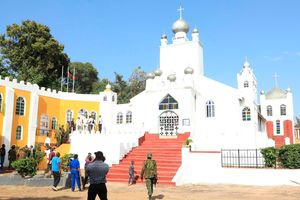
He was excommunicated from the Catholic Church in 1971, a move that led to the establishment of his own church, whose headquarters is located around Mamboleo along the Kisumu-Kakamega Road.
Father John Pesa's Holy Ghost Coptic Church in Kisumu.
Photo credit: Nation Media Group
Father Pesa frequently sparked controversy through claims that he possessed powers to spiritually cleanse people with mental illnesses, some of whom were chained within the church premises, a practice that repeatedly placed him on a collision course with the public and human rights activists.
His defence was always that only violent individuals were restrained to prevent them from harming others or injuring themselves.
A Nation exposé unearthed disturbing allegations of human rights abuses, where vulnerable individuals were reportedly chained, denied meals and held in solitary confinement, seeing sunlight only once a week.
The individuals were allegedly locked in separate rooms, denied access to basic healthcare and other essential human needs, while their freedom of expression and movement was curtailed in what critics described as deeply dehumanising conditions.
In January 2023, he was charged in court for allegedly harbouring 23 persons of unsound mind in inhumane conditions. He, however, emerged victorious after a court dismissed a petition seeking the demolition of his church over allegations of detaining people in deplorable conditions.
Following the court verdict, he dismissed the case as a witch-hunt, insisting that the church did not hold anyone against their will. According to him, guardians, parents and relatives signed consent forms allowing their loved ones to remain in the church for prayers.
In 2023, the controversial clergyman once again came under scrutiny after an ad hoc committee investigating the proliferation of religious organisations turned its attention to the Coptic Church amid a broader crackdown on questionable religious institutions.
When members of the committee visited the church, they encountered deplorable living conditions within structures inhabited by individuals said to be mentally ill and awaiting prayers.
Describing the facility as “a small Shakahola”, the committee rescued at least eight people believed to have been detained within the church.
Father Pesa rarely left the church compound and whenever he stepped outside the walled premises, he attracted immense attention, something he appeared to relish.
On one occasion, he walked from his church to the heart of Kisumu Town, causing a major traffic snarl-up in a town that rarely experiences heavy congestion.
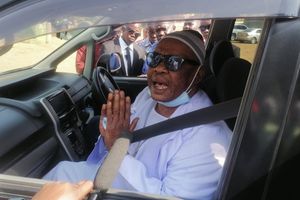
Holy Ghost Coptic church Head Father John Pesa I arrives at the church in Kisumu on June 24, 2023.
Photo credit: File | Nation Media Group
He was often criticised over claims that each of his processions was followed by accidents near the roundabout close to his church. The most recent tragedy involved the AIC Naki High School bus carrying mourners from Sigoti Clan, which overturned at the notorious black spot, killing 29 people.
However, he later appeared somewhat vindicated after investigations pointed to poor road design as a major contributor to the accidents.
The Kenya National Highways Authority subsequently announced plans to permanently redesign the notorious Coptic Roundabout, replacing it with dual carriageways separated by a median.
The decision followed a mysterious excavation of the roundabout island by unknown individuals on August 15.
The proposed redesign and reconstruction, estimated to cost Sh20 million, came amid complaints from motorists and residents who argued that heavy commercial vehicles struggled to navigate the bend at the roundabout, often resulting in accidents.
KeNHA, however, maintained that completely removing that section of the road was not an option, warning that a longer free flow could pose dangers to oncoming vehicles and other road users.
While many clergymen from Nyanza traditionally aligned themselves with opposition politics and often gravitated towards the late Raila Odinga, Father Pesa consistently chose to work with the government of the day.
And on his famous notice board hung photographs of him alongside the late presidents Jomo Kenyatta, Daniel Moi and Mwai Kibaki, as well as Uhuru Kenyatta and William Ruto.
His sense of humour often surfaced whenever he addressed congregants, held press conferences or spoke at political gatherings.
Perhaps his most famous gaffe, which attracted widespread laughter and ridicule on social media, was when he claimed that it was King Solomon and not David, who killed Goliath in the Bible. For journalists who frequently visited his church for interviews, he had a trademark gesture: presenting them with a 500 millilitre bottle of soda accompanied by a broad smile.
To Father Pesa, publicity, whether positive or negative, appeared to be an ally rather than a burden. Newspaper cuttings about him were pinned across a notice board in his office like trophies of notoriety.
He often boasted of enjoying the goodwill of every president who had served Kenya and frequently differed with other religious leaders both before and after general elections.