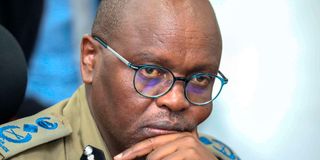
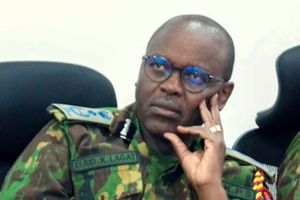
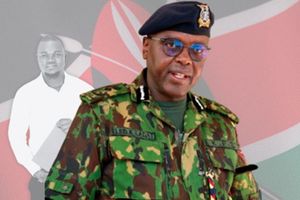
It was a low-key and brief day for Deputy Inspector-General (DIG) Eliud Lagat, who reported back to work on Monday after nearly three weeks away from office.
The Nation has established that Mr Lagat arrived at Vigilance House shortly before 9am, driving himself without the official chase cars that usually accompany him.
Teacher Albert Ojwang who mysteriously died in a police cell.
Photo credit: Pool | Nation
Upon arrival, he held a brief meeting in his office with his principal deputy Patrick Tito, who updated him on pressing matters requiring his attention.
Mr Lagat spent about an hour and a half at Vigilance House before heading to the National Police Service Headquarters at Jogoo House where he met his boss, Inspector-General (IG) Douglas Kanja, in a closed-door session.
Sources familiar with his schedule said Mr Lagat did not return to Vigilance House even after officially resuming duties. Yesterday, Interior Cabinet Secretary Kipchumba Murkomen declined to address the matter directly, stating only that “tomorrow at noon, I will respond to matters security and it will be at the ministry’s premises.”
He spoke at Kasarani Stadium, where he had gone to assess security preparedness for the upcoming African Nations Championship (Chan) tournament in August.
“We are in court over the matter,” LSK Vice Chairperson Mwaura Kabata said. Ojwang’s father Meshack said, “Even if I were to comment on Mr Lagat’s return, I do not have any powers to remove or return him to office… Mr Lagat was the complainant, that I’ll say even with my last breath. He is the police boss. Those who were detained and arraigned were working under the orders of a higher authority.”
Meshack Ojwang, father of Albert Ojwang, speaks to journalists outside Nairobi Funeral Home on June 8, 2025.
Photo credit: Lucy Wanjiru | Nation Media Group
Justice Chacha Mwita turned down the application by activist Eliud Karanja Matindi, who filed the petition earlier this month questioning Mr Lagat's continued stay in office despite announcing that he had stepped aside.
Justice Chacha Mwita.
Photo credit: File | Nation Media Group
When the petition came up for directions, Mr Matindi requested interim conservatory orders prohibiting Mr Lagat from performing any duties of his office, as outlined in Section 23 of the National Police Service Act. He also applied for an additional interim order prohibiting Mr Lagat's principal assistant, Mr Tito, from acting as the DIG, Kenya Police Service, pursuant to instructions allegedly given by Mr Lagat on June 16, 2025, when he stepped aside to allow investigations into the teacher’s death.
Mr Matindi asked the court to issue conservatory orders barring both officers from exercising those roles until the case is heard and determined.
However, Justice Mwita declined to grant the orders and instead directed all parties—including Mr Lagat, Mr Tito, Attorney-General Dorcas Oduor and the National Police Service Commission (NPSC)—to file their responses within seven days.
The LSK and Katiba Institute, who are listed as interested parties, were also directed to respond. The judge ruled that the application would only be considered after all parties had submitted their responses.
The matter is scheduled for mention on July 23, 2025, for further directions. Through his lawyer Cecil Miller, Mr Lagat opposed the application and requested time to file a response to the petition and accompanying application before any interim orders could be granted.
Section 23 of the National Police Service Act outlines 13 core responsibilities of the DIG, including supervision of the Kenya Police Service, overseeing daily operations and administration, implementing NPS policies, budgeting and managing police infrastructure across counties.
The DIG is also responsible for establishing public complaint mechanisms, evaluating police performance, training officers and building relationships between the police and the community.
Mr Lagat stepped aside from his position on June 16, 2025, following public pressure over the murder of Ojwang at Nairobi’s Central Police Station. The killing followed a complaint Mr Lagat filed over alleged online defamation. In the petition, Mr Matindi argues that, by stepping aside, Mr Lagat conceded he was no longer fit to serve as DIG.
He wants the court to declare that the move constituted a de facto resignation under Section 12 of the National Police Service Act and that the position of DIG should now be considered vacant. He further accuses the NPSC of breaching the Constitution by allowing Mr Lagat to “step aside” instead of vacating office entirely. Also under scrutiny is the legality of Mr Lagat’s appointment of Mr Tito as acting DIG.
Mr Matindi contends that the move was unconstitutional, created confusion within the police service, and should be declared null and void.
He argues that Mr Tito’s appointment has effectively created two DIGs for the Kenya Police Service—one substantive and one acting, a situation not contemplated by the Constitution.