The dust had yet to settle on the ugly scenes in Homa Bay, where the Linda Mwananchi team was attacked in August, when similar, if not worse, violent scenes were witnessed in Nembure, Embu County, about three weeks later.
In the same month Wiper leader Kalonzo Musyoka and his anti-government supporters ran into trouble in Garissa.
But while the incidents have unfolded in different parts of the country and may appear isolated, experts who spoke to the Daily Nation said they follow an all-too-familiar pattern.
Unable to load interactive map. Please check your connection or try again later.
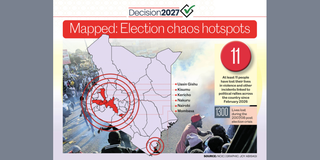
At least 11 people have lost their lives in violence and other incidents linked to political rallies across the country since February, turning gatherings meant to mobilise voters into increasingly dangerous encounters as Kenya heads towards the August 10, 2027 General Election.
And the renewed insecurity along the Turkana–West Pokot border, Isiolo County, recent political violence in Embu County, and inflammatory political rhetoric across the country raise grave concerns of the right to life and security, the Kenya National Commission on Human Rights (KNCHR) says.
“Fundamental freedoms must be protected before they are violated, not after,” the commission said, beseeching the mandated government agencies to investigate all reported violence.
The National Cohesion and Integration Commission (NCIC) has, in an all too familiar song, warned politicians to watch their tongues and stop recruiting youths to attack opponents during rallies and campaigns.
Some of the vehicles which were set ablaze when chaos erupted during a meeting presided over by Deputy President Kithure Kindiki in Nembure, Embu County, on September12, 2026.
Photo credit: George Munene | Nation Media Group
Those warnings were issued after Linda Mwananchi leaders and their supporters were attacked in Homa Bay on August 16, and again after violence erupted during a September 12 meeting held by Deputy President Kithure Kindiki in Embu.
A week after the Embu violence, NCIC said it has been doing civic education in schools and communities where political tension triggers violence.
The commission has also been conducting audits covering ethnic composition of State institutions, noting that imbalance in sharing of national resources and opportunities has become a political weapon, especially during election seasons.
The NCIC notes that Kenya has made significant strides since the 2007/08 post-election crisis that claimed approximately 1 ,300 lives and displaced over 650,000 people.
However, the commission observed, the recurring threat of electoral violence remains a deeply rooted pattern of Kenyan politics, “fueled by a winner-takes-all electoral system, ethnic patronage, institutional weaknesses, and the persistent manipulation of historical grievances by political elites”.
NCIC is working with other agencies and non-state actors to identify potential conflict hotspots as part of an early warning system.
In the run up to 2022, the commission had identified Nairobi, Nakuru, Kericho, Kisumu, Uasin Gishu and Mombasa as potential hotspots.
“We implore you (political actors) not to use young people as instruments of violence. Young people should be given genuine opportunities to participate in democracy, not recruited, financed or deployed to attack opponents,” NCIC chairperson Kepha Nyamweya Omae said on September 21.
In Nairobi, the National Police Service (NPS) touted the Linda Mwananchi rally of September 13 as a largely “peaceful political rally”. But records at the Nairobi Funeral Home indicate that three bodies, initially unidentified, were brought in by police to the facility following the rally which began in the city centre and ended at Jacaranda Grounds.
“What was witnessed on Sunday is precisely what the National Police Service has consistently advocated: that we can exercise our constitutional freedoms peacefully and within the law,” the NPS spokesperson Muchiri Nyaga said, adding it “demonstrates that political expression can take place without violence or disruption of public order”.
But for more than three decades, Kenya’s election violence has followed geographical fault lines, they argue, with some areas repeatedly emerging as flashpoints.
The hotspots have always remained largely unchanged since the return of multiparty politics, says security expert George Musamali.
“And if you look at the pattern of events that have been happening, the hotspots have always remained the same. No new hotspots ever come up, depending on the outcome of the elections,” he explains.
Residents scamper for safety after tear gas canisters were lobbed at Witima ACK Church in Nyeri County during a Sunday service that was attended by Rigathi Gachagua on January 25, 2026.
Photo credit: Pool
Mr Musamali, who traces part of the problem to the way Kenya has conducted its politics since 1992, says the question, therefore, is not simply why violence happens, but why particular places keep finding themselves at the centre of it.
“If you look closely, what has been happening in this country from 1992 is that we've tribalised our politics,” he argues, adding that political incitement as elections approach has repeatedly sharpened these fault lines.
Another warning sign, he says, is the emergence of political gangs, especially during electioneering periods. That is a worrying sign, he argues.
“You'll get that there's a lot of incitement from the politicians, especially as we head to the elections,” he added. “We now have this culture of goons coming up, whereby each political actor has his own group of goons that will attack their opponents.”
He points to Nyanza, parts of Western and Trans Nzoia, where he says the phenomenon has already been visible.
“All these actions by goons and then incitement by politicians, especially from those areas that have been identified as hotspots, is an indicator that we are not going to have a peaceful election in those areas,” he explained.
Mr Musamali’s current watch list includes Nairobi, parts of the Rift Valley, Mombasa, Homa Bay, Migori and Kisii. He also identifies Kiambu as vulnerable to spillover from Nairobi. His assessment is consistent with previous attempts to map election-related risks.
Ahead of the 2022 General Election, the National Cohesion and Integration Commission identified Nairobi, Nakuru, Kericho, Kisumu, Uasin Gishu and Mombasa as areas at high risk of electoral violence. Nairobi had the highest risk rating at 79.85 per cent and was viewed as a likely epicentre of political contestation.
However, the pattern is not new. The Institute for Security Studies observed in its 2023 postmortem of the 2022 election that, except for 2002, every general election since Kenya returned to multiparty politics had been marred by some form of violence.
Much of it, the institute said, was perpetrated by ethnic militias and organised criminal gangs.
The gangs, ISS said, have been employed by politicians to assassinate opponents or election officials, destroy voting materials, disrupt campaign rallies and contest results through violent post-poll demonstrations. They were also largely responsible for the approximately 1,500 deaths during and after the 2007/08 post-election violence.
The violence does not, however, always follow a simple ethnic line, according to some experts.
Some, like the Kenya Human Rights Commission’s Ernest Cornel, say it is important to distinguish between inter-community and intra-community violence. The former involves different ethnic communities, while the latter occurs within the same ethnic group.
For inter-community violence, he says, political alliances are an important variable when trying to map possible election flashpoints.
“One of the variables that you need to check to probably scientifically map out where possible violence would occur in the context of election, it is the alliances that are forming. Let's take the case of the 2007 election. You saw the formation of the Pentagon, brought together Luos and Kalenjins,” he explained.
In such circumstances, Mr Cornel argues, communities living on opposing political sides can become vulnerable depending on the local demographics.
The other layer is intra-community conflict, which can involve land, border and historical grievances.
“Those are usually about mountain grievances, border issues, land issues… So, when chaos is created through politics, it's an opportunity for you to strike back,” he argued.
But perhaps the more worrying possibility is that violence can be targeted, observes Mr Cornel, who views political goonism as a strategy that can disrupt an opponent’s ability to organise and campaign and eventually affect whether their supporters turn out to vote.
“Because if you create a condition where it is very chaotic for people to organize, it means that they will not have enough space and time to campaign,” he said.
The same conditions, he argued, can extend to voting day, suppressing turnout in particular areas.
One of the vehicles torched by goons during attacks on the Linda Mwananchi convoy in Homa Bay County on August 16, 2026.
Photo credit: Alex Odhiambo | Nation Media Group
But more than that, data shows that it is not always simply about where violence has happened before. It is where political alliances, local grievances, organised groups and rising tensions could converge to create new flashpoints or reignite old ones.
As with previous elections, the warning signs were already visible even in the 2017 election period.
A Kenya National Commission on Human Rights report noted that the stakes had been heightened by competition for the expanded seats created by devolution.
“Some politicians dared to play the ethnic card that is a great threat to peaceful election,” the commission said.
It’s monitoring recorded campaign-period violence in Bungoma, Kakamega, Kisumu, Migori, Nairobi, Nandi and Marsabit, among other counties.
Kajiado’s Kitengela town on the outskirts of Nairobi was among the first in this electioneering period to witness political violence. And when appearing on Citizen TV sometime this month, Kajiado Governor Joseph Ole Lenku offered another explanation for why the cycle persists. In his view, Kenya barely gets time to breathe between elections.
“We finish elections and begin campaigning the next day,” he argued, adding that the country still has “a lot of ground to cover” in removing violence from politics.
“And until we do that, we continue to suffer such shameful circumstances where people feel like this is my domain, don’t come in. And that undermines our democracy,” he said.
Two days after the Homa Bay violence, former Chief Justice David Maraga wrote to President William Ruto demanding implementation of a police taskforce report he had handed him. He warned that “a partisan police force was a root cause of the slaughter of 2007/2008”, saying such partisanship could plunge the country into further chaos.
For human rights advocate Fredrick Kipkulei, Kenya has seen these warning signs before. Talk of political violence, shrinking civic space, repression of dissent and, more recently, young people increasingly demanding a place in public and political life — he argued in his article on Amnesty International — are all things Kenya has seen before.
And now the question, he says, is “whether Kenya will once again learn the cost of ignoring the warning signs.”