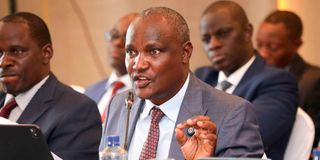
Treasury Cabinet Secretary John Mbadi has defended the government’s plan to borrow Sh1 trillion from local banks to finance the 2026/2027 budget, saying domestic lenders possess sufficient financial muscle to support the economy without crowding out the private sector.
Mr Mbadi said internal borrowing would not disadvantage businesses that also rely on local banks for credit, assuring the private sector that access to financing would remain intact.
The National Treasury is already gearing up for the budget-making process, a key component of which involves identifying viable sources of funding. Among these, the government has singled out commercial banks as a major avenue for raising funds for the upcoming budget.
The Treasury requires up to Sh1 trillion to meet its budget projections, with Mr Mbadi attributing the deficit to reduced revenue inflows and rising expenditure.
“We will have a deficit of Sh1.1 trillion if you compare what we plan to spend against what we have collected. We will borrow from domestic lenders after negotiating with multilaterals, who have already indicated how much they can offer in financial support,” he said.
Concerns have, however, been raised that banks may prioritise lending to the government - drawn by guaranteed repayment and steady returns - at the expense of the private sector. Critics warn that such a shift could deny small and medium enterprises the credit they need for growth and expansion.
Mr Mbadi dismissed these fears, insisting that banks would continue to support businesses alongside government borrowing.
“Kenya has a robust financial sector. We are the strongest in the region, with a stable financial system,” the Cabinet Secretary said.
He added that domestic borrowing would help improve the country’s credit rating, noting that Kenya has relied heavily on external borrowing, which comes with high repayment obligations.
According to Mr Mbadi, one of the major challenges of external loans is fluctuating interest rates, often influenced by the strength of the US dollar.
“When the value of the Kenyan shilling falls against the dollar, our repayment burden increases. All countries run budget deficits and must borrow to bridge the gap,” he explained.
He said borrowing locally would reduce dependence on institutions such as the World Bank and the African Development Bank, arguing that domestic banks and other financial institutions offer a viable alternative.
“Our banks have a lot of money. The same applies to pension funds and insurance firms. We cannot leave all this money solely to the private sector,” Mr Mbadi said.
The Cabinet Secretary, however, cautioned that the Treasury would not borrow recklessly, warning that excessive borrowing could drive up interest rates.
He noted that interest rates had fallen to below eight per cent in 2024, from 15.6 per cent previously, while average bank lending rates had declined to 14.7 percent from 17.2 percent a year earlier.
“Credit uptake by the private sector has increased. The main challenge in the past was the high interest rate charged by the government,” he said.
He added that delayed payment of pending bills by businesses had previously strained liquidity, making banks reluctant to lend.
“Many businesses were struggling to clear pending bills, which reduced liquidity. As a result, banks were hesitant to extend credit,” he said.