The government’s projected Sh1 trillion borrowing from the local market in the 2026/27 financial year is bad news for the private sector, as small businesses and ordinary borrowers will struggle to secure credit.
This is because lenders, including commercial banks, will opt to loan to the government — which seeks to plug a Sh1.11 trillion budget gap — given guaranteed repayment and higher consistent returns.
The restricted access to credit will be a disadvantage to businesses and other borrowers who are already struggling due to the tough economic times.
According to experts, as the current financial year draws to a close, the credit given to small businesses reduced sharply to less than one per cent as government loans doubled— a situation that is set to worsen for the private sector.
A draft 2026 Budget Policy Statement indicates that the 2026/27 fiscal deficit “will be financed through external borrowing” of Sh99.5 billion, which is about 0.5 per cent of the Gross Domestic Product (GDP), and domestic financing of Sh1.01 trillion, 4.8 per cent of the GDP.
“Based on the projected revenue and expenditure framework, the fiscal deficit, including grants, is expected to reach Sh1.11 trillion,” reads the draft Budget Policy Statement.
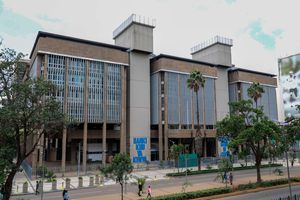
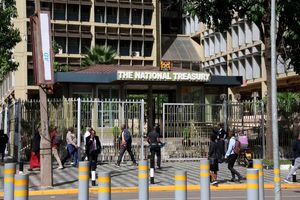
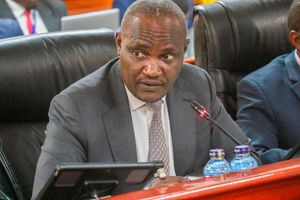
National Treasury Cabinet Secretary John Mbadi.
Photo credit: Billy Ogada | Nation Media Group
The Parliamentary Budget Office documents reveal that local financial institutions prefer lending to the government as growth in total credit to the economy declined from 8.1 per cent in March 2024 to 5.7 per cent in March 2025.
The drop in credit to the economy, the Parliamentary Budget Office says, is largely attributed to the declining credit to the private sector — the Micro, Small and Medium-sized Enterprises (MSMEs), which are critical for a country’s economic growth, innovation and job creation.
The Parliamentary Budget Office, in its Budget Watch report for 2025/26 period, notes that as credit to MSMEs plummeted from 7.9 per cent to 0.2 per cent, credit to the government doubled from 8.6 per cent to 16.4 per cent during the period in focus.
“The trends in credit growth over 12 months indicate a potential crowding out of the private sector by increased government borrowing from the domestic market,” the Parliamentary Budget Office document reads.
About 7.4 million small and medium-sized enterprises employ approximately 80 to 90 per cent of the country’s labour force. This accounts for about 15 million jobs of the total workforce of about 18 to 20 million, contributing over 40 per cent of Kenya’s GDP.
The 2025 Economic Survey notes that the MSMEs sector employed 17.4 million people in 2024, up from 14 million in 2020.
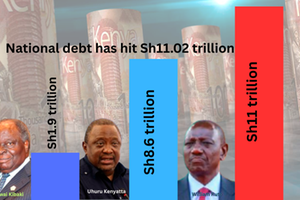
The projected additional Sh1.1 trillion borrowing will add to the country’s growing debt stock that stands at Sh12.1 trillion.
Photo credit: Nation Media Group
This is a debt to GDP ratio of 69 per cent, which is much higher than the International Monetary Fund (IMF) threshold of 50 percent for developing countries.
In 2023, to make more room for borrowing, Kenya changed its statutory public debt ceiling from a fixed nominal cap of Sh10 trillion to a debt anchor of 55 per cent of GDP, but even this is way off the mark.
A Central Bank of Kenya document presented to Parliament shows that President William Ruto’s government has borrowed at least Sh3 trillion over the last three years.
The document presented to the National Assembly Public Debt and Privatization Committee by CBK Governor Dr Kamau Thugge indicates that in the 2021/22 financial year, when President Ruto assumed office, the country’s debt stood at Sh8.7 trillion.
Central Bank of Kenya Governor Kamau Thugge.
Photo credit: Dennis Onsongo | Nation Media Group
“Recent borrowing targets have been quite ambitious as the domestic market continues to support growing budgetary financing requirements,” the CBK document reads.
It adds that the public debt had escalated with a higher reliance on domestic financing, “highlighting rising debt service pressure on the country’s fiscal sustainability.”
However, the CBK document does not show the projects that were financed by the Sh3 trillion borrowed within the first three years of the Kenya Kwanza administration.
The expected increased borrowing from the local market comes as the CBK governor, and Controller of Budget Dr Margaret Nyakang’o raised questions about the possible misapplication of the proceeds from “ambitious borrowing.”
In her National Government Budget Implementation Review for the first three months of the 2025/26 financial year- July, August and September, Dr Nyakang’o advised the government to limit borrowing for development projects.
This is after it emerged that Sh507.98 billion was incurred in debt repayments during the first three months of the current financial year that saw public debt hit Sh12.04 trillion.
Controller of Budget Margaret Nyakang’o.
Photo credit: File | Nation Media Group
“To enhance fiscal impact and ensure debt sustainability, borrowing should be strictly aligned with development projects that have measurable economic and social returns,” says Dr Nyakang’o.
She notes that increased government borrowing to finance the budget for projects that have no economic or social returns, exposes the country.
The 2026 Budget Policy Statement prepared by the National Treasury shows the government expects to spend Sh4.7 trillion in the 2026/27 financial year, with the deficit of Sh1.11 trillion to be financed through local and foreign borrowing as well as from development partners’ grants.
In the document, the Treasury projects that the Kenya Revenue Authority will collect Sh3.5 trillion during the 2026/27 fiscal period. The Budget Policy Statement is a strategic document that outlines a government’s broad economic priorities and financial goals for the upcoming fiscal year and the medium term.
In Kenya, the Budget Policy Statement is prepared by the National Treasury, in accordance with section 25 of the Public Finance Management (PFM) Act, and upon approval by the Cabinet, it is submitted to Parliament by February 15 every year for consideration.
“The financial year 2026/27 budget and the medium-term expenditure framework are anchored on the government’s policy priorities and the macroeconomic strategy,” the draft Budget Policy Statement states.
In the current fiscal period, the National Assembly approved a budget of Sh4.3 trillion. But with expenditures under Article 223 of the Constitution — emergency withdrawals — pending the approval of the House, as well as the expected supplementary budgets, the figure could rise. This will pile more pressure on revenue mobilisation and taxes could be increased.
The 2026/27 expenditure outlook comprises recurrent spending of Sh3.43 trillion, which is 16.4 per cent of GDP and development expenditure of Sh759.1 billion, about 3.6 per cent of GDP.
The transfers to county governments are projected at Sh446.6 billion and an allocation of Sh5 billion to the Contingency Fund.
The expenditure projections for the 2026/27 fiscal period are against estimated revenues inclusive of Appropriation-in-Aid (A in A) of Sh3.5 trillion, about 16.7 per cent of GDP, up from Sh3.32 trillion, which was 17.5 per cent of GDP in the 2025/26 period. The Treasury says that the ordinary revenue is projected at Sh2.9 trillion, compared to the Sh2.8 billion in the current financial year.
“Revenue performance will be supported by the ongoing reforms in tax policy and revenue administration aimed at broadening the tax base and enhancing compliance,” the draft Contingency Fund states.
The draft Budget Policy Statement indicates that in advancing the Bottom-Up Economic Transformation Agenda (Beta), “the government will sustain its growth-supportive fiscal consolidation efforts by restraining expenditures and strengthening revenue mobilisation.”
“This approach is intended to moderate the pace of public debt accumulation while ensuring that delivery of essential public services remains uncompromised,” the statement shows.