A majority of Nairobi residents have backed the proposed partial sale of government shares in Safaricom PLC to raise about Sh204 billion for infrastructure development, but have demanded strict accountability and transparency in the use of the proceeds.
The residents told the National Assembly’s Joint Committees on Finance and National Planning, and Privatisation and Public Debt, that Parliament must enact a law to ensure proceeds from the partial divestiture of 15 per cent government shareholding in Safaricom are ring-fenced and used strictly for their intended purpose.
Appearing before the committees during public participation on Sessional Paper No. 3 on Partial Divestiture of Government Shares in Safaricom PLC, some Nairobi residents proposed that the government offload 11 per cent of its shares to the public and sell four per cent to South African telecommunications firm Vodacom.
Some participants raised concerns over poor public finance management, the risk of misappropriation of proceeds, and a trust deficit in government transactions.
“While I support the proposed sale of 15 per cent of government shares in Safaricom, we need proper oversight to ensure the proceeds are directed towards infrastructure development,” said Eric Ambuche, a participant.
“If the sale goes through, it should prioritise Kenyans so that public shareholding rises to 40 per cent. Vodacom’s shareholding should not exceed 49 per cent,” he added.
Through Sessional Paper No. 3, the government seeks to raise approximately Sh204 billion ($1.57 billion) in gross proceeds from the divestiture, at a premium of 23.6 per cent above the six-month volume-weighted average price ending December 2, 2025.
CS John Mbadi speaks on Ndindi Nyoro, Safaricom and KPC
The government currently owns 35 per cent of Safaricom valued at between Sh280 billion and Sh300 billion. Vodacom holds 40 per cent, while public shareholders own 25 per cent.
If approved, Vodacom’s stake would rise to 55 per cent.
Parliament has 28 days from December 2025 to approve, amend, or reject the Sessional Paper. If it fails to do so, the Paper will automatically take effect on March 26, 2026.
Nairobi Woman Representative Esther Passaris urged the committees to include a clause compelling Vodacom to sell back its shares to the government should it dispose of them in the future.
“We need a clause that ties Vodacom to sell back shares to the government, not to any other investor. The government can then offload those shares to the public through an IPO,” she said.
However, Bunge la Wananchi opposed the sale, citing past corruption scandals.
“We reject the sale of Safaricom shares because of previous corruption. We were told Sh63 billion was lost in the NYS scandal and recently Sh11 billion at the Social Health Authority. We cannot sell Safaricom while losing billions,” said Muumuu wa Bunduki, President of Jacaranda Bunge la Wananchi.
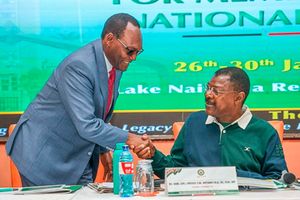
PS Treasury Dr Chris Kiptoo and the National Assembly Speaker Moses Wetangula shake hands during the 2026 Legislative Retreat for Members of the National Assembly, at Lake Naivasha Resort, Nakuru County, on January 29, 2026.
Photo credit: Boniface Mwangi | Nation Media Group
Stephanie Njungo, a student at Cooperative University, said it would be a shame for the government’s stake in Safaricom to fall to 20 per cent.
“Safaricom is a Kenyan brand. Let us sell the shares to Kenyans. There are wealthy Kenyans who can own them,” she said.
University of Nairobi student Ian Emanuel supported the proposed sale but urged MPs to reduce government wastage, involve youth in the transaction process, and guarantee accountability mechanisms.
“We know Treasury must raise money through taxation, borrowing, or privatisation. We support the sale, but only with clear accountability,” he said.
He also called for extended protection of Safaricom workers and dealers beyond the proposed three-year no-redundancy period.
Rachael Oduor from Starehe Sub-county supported the divestiture, saying the country needs investment in roads, water, electricity, and other infrastructure.
“We support the sale for development, but Kenyans with money should be given priority,” said Bishop Nakitare from Roysambu.
Finance and National Planning Committee Chairperson Kuria Kimani who chaired the session said the biggest concern was guaranteeing that proceeds would be used for infrastructure in the absence of a legal framework.
“We are putting the National Treasury on notice. The Eurobond raised Sh270 billion, which went into the Consolidated Fund, and no one can clearly say which projects it financed. If Parliament approves the sale of Safaricom shares, there must be an express law showing where the money will be spent,” Mr Kimani said.
In Machakos, a cloud of mistrust hung over the sale’s public participation forum on the planned partial sale of Kenya’s shares in Safaricom.Most residents who addressed the National Assembly Finance and National Planning Committee opposed the proposed divestiture, arguing that the government could not be trusted to manage the billions of shillings expected from the sale, citing recent Auditor-General’s reports and corruption scandals.
“The other day we lost Sh11 billion at the Social Health Authority, yet the Cabinet secretary has not explained the loss. We are not sure MPs can protect the Sh204 billion expected from the sale of Safaricom shares. We trusted you to protect our resources, but you have failed,” said Emmanuel Kimuyu.
WATCH: MP Ndindi Nyoro's session before MPs looking into Safaricom deal
Residents urged the government to explore alternative revenue sources, including mineral exploitation, revitalising agriculture, and cutting politicians’ salaries and perks. They also called for the sale of struggling parastatals instead of profitable strategic national assets.
“We should start by selling East African Portland Cement Company, which is struggling financially despite sourcing free pozzolana. The land it occupies can earn the government a lot of money,” said Wellington Mbindyo.
Ainamoi MP Benjamin Langat, the vice-chairperson of the Finance and National Planning Committee, which organised the forum, occasionally intervened to defend the proposal.
He said President William Ruto’s administration intends to use proceeds from the Safaricom share sale to unlock economic growth by funding infrastructure, reducing reliance on borrowing, and boosting investor confidence.
“When you face an urgent problem, you sell the fattest bull. But if the problem is not urgent, you sell the emaciated cow,” Mr Langat said.
“The business is not shrinking. What is proposed is a transfer of shareholding, not the business itself. Safaricom may even perform better and employ more people. No foreigner will replace Kenyans working at Safaricom. The government will retain two seats on the Safaricom board to safeguard national interests,” he said—remarks that did little to sway opponents.
Some residents who supported the sale nonetheless expressed reservations about how the funds would be used.
“The shares can be sold, but the money should go into fixing healthcare. If you engage wananchi, you will realise healthcare is where Kenyans are hurting most, not roads. If the purpose was healthcare, the move would enjoy widespread support,” said Ruth Wanza.
Kitui Rural MP Mboni Mwalika, also a member of the committee, appeared to bolster opposition to the sale, arguing that Kenya does not need to borrow to fund development.
“We do not need loans. Of the money allocated for development, about 30 per cent is lost to corruption and wastage. That is nearly Sh800 billion every year—the same amount we borrow annually. We need to fight corruption,” he said.
However, Mr Mwalika strongly opposed proposals to cut politicians’ salaries and allowances to reduce the wage bill.
“MPs are conveyor belts. We may earn a lot, but we end up disbursing it to constituents who come to us with diverse needs,” he said.