Members of Parliament have rejected a proposal to increase the 2027 election budget from Sh43 billion to Sh63 billion.
The Independent Electoral and Boundaries Commission (IEBC) submitted its budget policy statement Tuesday which showed that it requires Sh63 billion to conduct the 2027 polls. A budget breakdown in the report shows the top expenses are wages (Sh12.4 billion), voter registration (Sh6.9 billion) and Kiems kit replacement (Sh6.2 billion).
However, MPs on the National Assembly Justice and Legal Affairs Committee rejected this proposal and insisted that the Sh43 billion assigned by Treasury is enough to conduct polls. Additionally, the MPs told the Commission to cut unnecessary, wasteful expenditure from its budget to save billions of shillings.
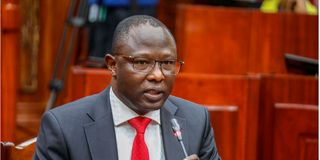
“We all know that elections are vital, but we need to have a realistic budget,” committee chairman George Murugara (Tharaka MP) said.
“We cannot provide the Sh63 billion. You have to find a way of cutting that cost,” MP Mwengi Mutuse, the committee’s vice chairman, said.
In its report, IEBC said most Kiems kits (45,352) will be replaced at a cost of Sh6 billion as they have become obsolete. Only 14,000 kits bought in 2022 will be retained but will require an upgrade at a cost of Sh175,000 per kit, the agency said.
However, MPs moved to halt the planned purchase of new kits and told the agency to submit an expert report proving that they can't be reused.
Commissioner Anne Nderitu failed to convince the committee on the cost variance for upgrading and buying new kits. She asked lawmakers to give the IEBC more time to consult before giving a comprehensive answer.
She tried to explain that the upgrading of the old Kiems kits included putting in new software to conform with new technology.
The electoral agency is now left with a budget hole of Sh22.9 billion. IEBC acting Chief Executive Officer Moses Sunkuli told lawmakers that among the critical areas that will be affected by the budget cuts are the purchase of ballot papers which requires Sh4.6 billion and election materials (Sh2 billion).
Asked by the lawmakers whether the amount can be reduced considering that Kenya’s elections are among the most expensive in the world, Mr Sunkuli said that Sh63 billion is the lowest they can go.
“This is the bare minimum and we cannot go below that. This budget was made after consultation with all stakeholders,” he said.
However, Mr Murugara took issue with the IEBC’s decision to omit critical areas such as the purchase of election materials and ballot papers.
“You know for sure that ballot papers must be printed, but you never allocated money for that. Instead you prioritised the purchase of vehicles and other things,” Mr Murugara said.
“According to the National Treasury, Sh41 billion should be sufficient because it seems that when you get money you don’t allocate it to critical areas.”
The Tharaka MP accused IEBC of deliberately leaving out critical areas because it knows that the government cannot fail to give it money.
“The way you have allocated money is not the way it should be done, maybe that is why our elections are expensive,” he added.
Stakeholders have questioned why a struggling economy like Kenya’s should spend billions of shillings on elections.
In Africa, Ghana has the least expensive election at $0.07 per voter, Rwanda $0.5 per voter, Uganda $4, Tanzania $5.16 and Nigeria $8.6. Lack of trust has been cited as a key reasons for the high cost of elections in Kenya.
Meanwhile, IEBC said it projects that the number of polling stations in Kenya will rise to 55,393 from 46,229 in 2022, an increase of 9,169. Voters per polling station are expected to remain at 700.