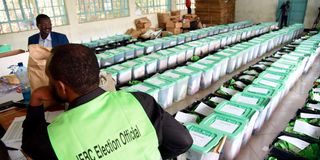
The electoral commission’s announcement that the November 27 by-elections in 24 electoral areas will cost taxpayers Sh1 billion has reignited debate over the high price of running elections in Kenya compared to other democracies.
The Independent Electoral and Boundaries Commission (IEBC) projects that the 2027 General Election will require at least Sh61 billion, with a significant share allocated to procurement of technology, remuneration of temporary poll officials and security personnel, and logistics.
IEBC Chief Executive Officer Marjan Hussein Marjan said the pending by-elections budget of Sh1.046 billion covers “all critical aspects required to deliver free, fair, and credible polls.”
He cited personnel, transport, ballot materials, technology, security, and voter education as the main cost drivers, though the commission did not provide a detailed breakdown.
Kenya’s elections are among the most expensive in Africa and globally. In 2017, the per-voter cost was about Sh2,000, placing Kenya behind only Papua New Guinea, where the cost stood at Sh6,300.
In 2022, IEBC spent Sh44.18 billion to administer the General Election, translating to about Sh2,200 (USD18–20) per registered voter. This figure far exceeded the international Average Cost per Registered Voter Index (ACRVI) benchmark of USD5 (about Sh646).
Democratic Party leader Justin Muturi, a former Attorney-General and Cabinet Secretary in the Ruto administration, argues that Kenya cannot sustain such costs.
“Compared with the cost of the General Election, IEBC’s request for the pending by-elections is exaggerated,” said Mr Muturi, who also served as National Assembly Speaker in the 11th and 12th parliaments.
His concerns echo those raised in a February 2019 report by the Public Accounts Committee (PAC), which found the cost of the 2017 General Election and the repeat presidential poll “highly inflated.”
The committee, then chaired by current Energy Cabinet Secretary Opiyo Wandayi, said taxpayers did not receive value for money and warned that the true scale of financial losses due to procurement manipulation and creative accounting might never be known. It urged investigative agencies to pursue accountability without fear or favour.
Kenya’s elections remain the most expensive in Africa on a per capita basis. By comparison, Ghana’s 2016 elections cost just USD0.07 (Sh9) per voter, the lowest on the continent.
Ballooning electoral costs
Rwanda’s 2017 polls cost USD1.05 (Sh136) per voter, Uganda’s USD4 (Sh517), Tanzania’s USD5.16 (Sh667), and Nigeria’s USD8.61 (Sh1,112). In recent by-elections, the IEBC under former chair Wafula Chebukati spent Sh471.12 million on four contests in Bungoma and Elgeyo Marakwet (Senate) and Kandara and Garissa Township (National Assembly). The polls were necessitated by the appointment of senators Kipchumba Murkomen and Moses Wetang’ula, and MPs Aden Duale and Alice Wahome, to the Cabinet.
Data shows the IEBC spent Sh233.2 million in Bungoma, Sh144 million in Elgeyo Marakwet, Sh49.51 million in Kandara and Sh44.41 million in Garissa Township.
Lawyer and elections expert Koki Muli attributes Kenya’s ballooning electoral costs to a deep trust deficit. “We do not trust IEBC, each other, or the processes. To manage this mistrust, we adopt expensive safeguards,” Ms Muli stated.
Kenya imports its ballot papers, which carry more than ten security features, making them more secure than banknotes. This adds to costs. “We do not reuse leftover materials, we procure everything afresh. Our technology is expensive to buy and maintain, and we rely on foreigners to host our servers, which is risky and costly,” Ms Muli added.
Nairobi-based lawyer David Ochami argues that IEBC has failed to justify “soaring and unconscionable expenditure that defies logic.” He accuses vested interests of inflating procurement budgets for personal gain.
“Much of the election budget goes to the comfort of top poll managers, while police officers and clerks wait months for their allowances,” he said.
However, such a reform would require a shift from the current first-past-the-post system to proportional representation.
Ms Muli adds that the number of polling stations unnecessarily inflates costs. “We insist on fewer than 1,000 voters per station, which means more staff must be hired and paid. IEBC can reduce the number by half and increase voters per station to 2,000 without needing parliamentary approval,” she said. Transport is another challenge.
IEBC relies on private companies due to a lack of inter-agency trust, leading to exorbitant charges. Security officers and temporary poll officials must also be paid allowances in large numbers, further stretching budgets. Delayed disbursement of funds by the National Treasury often forces last-minute procurement at inflated prices.
“The government, politicians, Treasury and Parliament are all to blame. Whatever budget IEBC provides must be rationalised and accountability interrogated,” Ms Muli stressed.
The commission acknowledges the rising cost of elections, attributing it to “over-legislation” driven by mistrust among political actors.
In official reports, IEBC cites technology requirements, the high number of polling stations, reliance on satellite results transmission due to weak 3G coverage, multiple ballot security features, transport and logistics costs, and allowances for temporary officials as the key drivers. “The Commission, having recognised the rising cost of elections, is committed to instituting possible measures to reduce costs without compromising credibility,” IEBC said in one report.
By-elections in 24 electoral areas
While Kenya’s costs are steep, international comparisons provide perspective. In the United States, total spending on the 2024 election reached USD21 billion, up from USD15.1 billion in 2020. With a population of 331 million, this equates to USD63.44 per capita—double Kenya’s level.
The UK spent £147.42 million on the 2019 parliamentary elections with 47.5 million registered electors, a cost of £4.55 per voter. India, with 969 million voters, spent about USD12 billion on the 2024 elections, translating to USD12.38 per voter.
In 2019, Kenya’s Constitution Implementation Oversight Committee (CIOC) visited India to observe its use of the Voter Verifiable Paper Audit Trail (VVPAT) system. The technology allowed electronic voting machines to generate paper slips for each ballot cast, improving transparency. The CIOC said Kenya could learn from India’s experience with technology integration.
The forthcoming by-elections cover 24 electoral areas, including the Baringo Senate seat and National Assembly constituencies of Banissa, Kasipul, Magarini, Malava, Mbeere North, and Ugunja. The Baringo seat fell vacant after the death of Senator William Cheptumo on February 16, 2025.
Banissa’s vacancy arose from the death of MP Hassan Kullow in a road accident on March 29, 2023, while Magarini’s seat was declared vacant after the Supreme Court upheld the nullification of Harrison Kombe’s election on May 31, 2024.
In Ugunja, the appointment of Opiyo Wandayi to the Cabinet on August 8, 2024 triggered a by-election. The Malava seat fell vacant following the death of MP Malulu Injendi on February 17, 2025, while Mbeere North became vacant after Geoffrey Ruku’s appointment to Cabinet on April 17, 2025.
Debate over electoral costs continues to dominate Kenya’s political and governance discourse. Analysts argue that meaningful reform will require addressing mistrust, procurement corruption, over-legislation, and logistical inefficiencies.
Without tackling these challenges, Kenya risks maintaining its position among the world’s most expensive electoral democracies, burdening taxpayers with escalating costs every election cycle.
As Ms Muli observes, “We all share responsibility—politicians, Parliament, Treasury, IEBC and citizens. Unless accountability is enforced and reforms embraced, Kenyan taxpayers will continue footing an unjustifiably high electoral bill.”