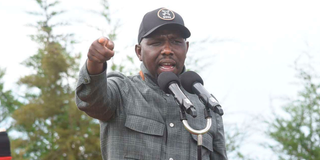
The government has vowed to deal firmly with hooligans and criminal gangs who are seeking to exploit Thursday's planned protests to cause chaos, disrupt businesses, and steal or destroy property.
At the same time, Interior Cabinet Secretary Kipchumba Murkomen said families of victims of the deadly June 25, 2024, protests would be permitted to hold peaceful processions under police escort.
However, State House Road and Uhuru Highway will be out of bounds to protesters, as police officers will be mobilised from across the country and deployed during the planned demonstrations.
CS Murkomen told Citizen TV on Monday night that the country's security apparatus was prepared to deal decisively with goons and criminal gangs intent on exploiting the planned protests.
"We will deal with the goons in accordance with the law. We will be ruthless in dealing with criminals seeking to infiltrate peaceful protests. We must ensure Kenyans are safe and cannot allow the country to slide into anarchy," Mr Murkomen said.
He added that the government was aware that "political scavengers" were looking to use Thursday's protests to gain political mileage and portray the police negatively.
"Families of victims of last year's protests will be accorded proper security. I am happy they have notified the police of their plans to march on Thursday. Their leadership will sit down with the police to plan and facilitate their procession along the routes they have identified," Mr Murkomen stated.
Families of people killed in Gen Z protests march to IG Kanja's office
He said the police would exercise caution and restraint to avoid a repeat of last year's deadly protests, during which youths stormed Parliament.
"State House Road and Uhuru Highway will, however, be no-go zones for protesters due to the security considerations attached to them. State House is a protected security installation, while Uhuru Highway is a major international highway, and it is unlawful to block traffic there through protests," Mr Murkomen said.
At least 62 people were killed last year, while hundreds more were injured or permanently disabled. Property was also destroyed during the protests, which culminated in an attack on Parliament that forced legislators to flee for safety.
The 2024 unrest eventually led to the withdrawal of the Finance Bill after President William Ruto rejected it. He subsequently disbanded his Cabinet and later reconstituted it, bringing in allies of former president Uhuru Kenyatta and former Prime Minister Raila Odinga.
Mr Murkomen, who recently travelled to the United States and the United Kingdom with Nairobi Governor John Sakaja and senior security officials to benchmark metropolitan policing systems, said the government was moving ahead with plans to install CCTV cameras in major cities and urban centres.
He revealed that the procurement process for the supply and installation of the surveillance system, including a national command centre, would be completed within the next two months, with installation expected to take a further six months.
"The cost of installation is expected to be between Sh22 billion and Sh25 billion. We will begin the rollout in Nairobi, Mombasa, Kisumu, Nakuru, Eldoretand Nyeri," Mr Murkomen said.
He noted that footage and data from the CCTV system would assist the Directorate of Criminal Investigations (DCI) in building stronger cases against suspects and help prosecutors secure convictions in court.
According to the CS, the initiative would help reduce crime, identify offenders and dismantle criminal gangs, enabling Kenyans to conduct their daily activities without fear.
He said the government had previously dismantled several organised criminal groups, including Confirm Gang in Nakuru, Jeshi la Mzee, MRC, Mungiki, Gaza, and 42 Brothers, all of which had terrorised residents in various parts of the country.
Mr Murkomen acknowledged that identifying and arresting goons remains challenging because many operate informally and are often loosely associated with politicians and political actors who facilitate their activities.
"Some present themselves as bouncers accompanying politicians to public events. They often do not carry weapons, making it difficult to prosecute them for some of the alleged crimes. However, police have made significant progress using CCTV footage to identify suspects, including those involved in the attack on Senator Geoffrey Osotsi in Kisumu and the church attack in Nairobi," he said.
Vihiga Senator Godfrey Osotsi recuperates at Karen Hospital on Thursday, April 9, a day after he was attacked in Kisumu.
Photo credit: Pool
While picketing and demonstrations are protected under the Constitution, Mr Murkomen said those rights are not absolute and should not provide cover for criminal activity.
"I support the police when they sometimes choose to stand by during protests instead of escalating situations. In many instances, they are outnumbered and their own lives are at risk," he said, noting that some officers have previously been attacked, injured, or killed during demonstrations.
The CS also called on the media to report responsibly on incidents of unrest and avoid exacerbating already fragile situations.