After declaring the National Government- Constituency Development Fund (NG-CDF) unconstitutional with a decree that it be wound down by June 30, 2026, the Judiciary is now appealing to MPs to have part of the fund channelled to support court construction across the country.
The request was made to the MPs on the basis of the national government's “chronic underfunding” of the judiciary, whose budgetary allocation is less than one percent of the national budget, despite currently grappling with a “staggering 257,000 case backlog.”
Documents obtained by the Daily Nation show Judicial Service Commission (JSC) vice chairperson Isaac Ruto, the former Bomet County Governor, making a passionate appeal to the Constitutional Implementation Oversight Committee (CIOC) of the National Assembly.
“The JSC submitted a proposal for parliament to consider allocating part of the NG-CDF to support court construction across the country,” Mr Ruto stated in the JSC document to the CIOC, chaired by Suba South MP Caroli Omondi.
“Such allocation would make it possible for constituencies without courts to finally have them in place,” the JSC vice chairperson adds.
He made the appeal to the MPs well aware of the September 2024 High Court judgment declaring the fund unconstitutional.
“The budgetary allocation is insufficient to meet operational requirements,” stressed Mr Ruto as it emerged that 16 court projects have stalled across the country due to financing difficulties.
JSC is one of the constitutional commissions established under Chapter 15 of the Constitution and the Judicial Service Act.
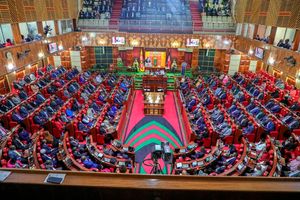
The National Assembly during a past session.
Photo credit: File I Nation Media Group
The commission’s mandate includes, among others, recommending to the President persons for appointment as judges, reviewing and making recommendations on the conditions of service for judges and judicial officers.
The Judicial Service Act empowers JSC to ensure the independence and accountability of the judiciary through merit-based appointments, performance evaluation systems and disciplinary mechanisms.
The commission had appeared before the committee for a status update on the implementation of the constitution.
In the face of the JSC request, the Omondi-led CIOC did not make a determination to have part of the NG-CDF allocation committed towards the construction of the courts across the country.
Nonetheless, the committee recognised that underfunding of the judiciary affects delivery of justice to the people and demanded that the National Treasury ensure adequate budgetary allocation, commensurate with its mandate to safeguard “the constitutionally protected rights to justice and efficient public service.”
“This systemic underfunding directly undermines the delivery of essential public services; the administration of justice and effective public administration as guaranteed by the constitution,” the CIOC notes in its report.
After the courts declared the NG-CDF unconstitutional, the National Assembly filed an appeal that is currently pending with a judgment expected on February 6, 2026.
Other than the appeal, the National Assembly is also pushing for a constitutional amendment through parliamentary initiative to salvage the fund, but faces opposition from the Senate, which is determined to shoot down the proposal.
In its subsequent report to the House, CIOC notes, “the commission’s vice chairperson Isaac Ruto noted that conditional allocation from the NG-CDF could fat-track access to justice, especially in underserved areas.”
The CIOC report captures JSC vice chairperson stating that the judiciary faces underfunding that “significantly limits its ability to discharge its constitutional mandate effectively.”
Inadequate funding, Mr Ruto noted, “particularly” affects infrastructure development across more than 140 court stations, recruitment of judges, magistrates and support staff and technology adoption for e-justice systems.
Construction of 14 courts
“These funding constraints undermine the judiciary’s capacity to deliver timely and accessible justice to citizens,” the JSC vice chairperson stated.
The NG-CDF kitty has previously been used to support the construction of 14 courts across the country, “with three more underway, built using the judiciary-issued prototypes and cost estimates.”
The commission noted that its long-term plan is to ensure every sub-county has a court, “but chronic underfunding remains a major obstacle.”
As of January 2026, there have been at least seven major legal petitions and significant consolidated cases filed against the constitutionality of the Constituency Development Fund (CDF) and its successor, the NG-CDF.
In 2013, two primary petitions that led to a 2015 High Court ruling declaring the Act unconstitutional and later affirmed by the Supreme Court in 2022, were filed and subsequently consolidated by the High Court to challenge the CDF Act of 2013.
The second petition was filed by the Centre for Enhancing Democracy and Good Governance (CEDGG) in Nakuru and later transferred to Nairobi.
Following the 2015 ruling, parliament enacted the NG-CDF Act of 2015 to replace the old law.
However, this triggered new litigation with activist Wanjiru Gikonyo and others in 2016, successfully challenging the 2015 Act and its subsequent amendments.
On September 20, 2024, a three-judge bench declared the NG-CDF Act, as amended in 2022 and 2023, unconstitutional as it ordered the fund to wind down completely by June 30, 2026.
The National Assembly’s proposal to anchor NG-CDF in the constitution through a constitutional amendment has triggered new legal battles.
Mr Paul Mwangi, the former legal advisor to the late Raila Odinga, has challenged the move that has also drawn opposition from the Katiba Institute and city lawyer Suyianka Lempaa.