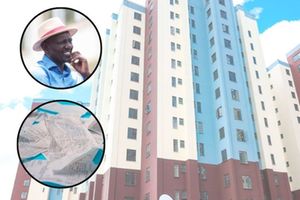
Days after President William Ruto announced plans for changes to the Affordable Housing Levy law, it has emerged that the government seeks to alter the regulations to allow for diversion of the funds to finance the construction of schools, markets, police posts and hospitals.
In his Madaraka Day speech, Dr Ruto said part of the proposed reforms will seek to allow contributors to access affordable home loans.
“I am pleased to announce today that we shall be proposing to Parliament a reform to the law that will allow any contributor to access an affordable home loan of up to Sh5 million at a single-digit interest rate, applicable toward any housing unit in the market,” President Ruto said.
But in the draft regulations currently with Attorney-General Dorcas Oduor, the government seeks to cap the loan at Sh4 million.
“A person may apply to the Board for a loan for the development of a rural affordable housing unit where that person has made voluntary savings and has not been allocated an affordable housing unit,” the draft regulations state.
For individuals with a monthly income of less than Sh20,000, the fund will charge them an interest rate of 3 per cent per year on reducing balance, while for those with a monthly income that does not exceed Sh149,000, an interest rate of 6 per cent per annum will apply. Those earning more than Sh149,000 will pay an interest rate of 9 per cent.
The government is also seeking to divert the funds to finance other projects, a move that has since rattled the Central Organisation of Trade Union (Cotu), led by Secretary-General Francis Atwoli.
The draft obtained by the Nation proposes to have the fund finance the construction of health facilities, early childhood development centres (a devolved function), classrooms in both primary and secondary schools, as well as markets. The proposal further seeks to have the fund used to finance the construction of fire stations, social halls and infrastructure for the management of solid waste.
Deputy President Kithure Kindiki with Bahati MP Irene Njoki and other leaders inspect the construction of Dundori Market in Nakuru County on April 24, 2025.
Photo credit: Boniface Mwangi | Nation Media Group
Other associated physical infrastructure to be financed by the fund includes access roads and parking spaces, storm water drainage, sewer line connectivity, street lighting, internet connectivity, water reticulation services and high mast lighting.
On Tuesday, Mr Atwoli said in a statement that the proposed regulations are likely to open up loopholes for misappropriation of the funds.
He said that, if adopted, the regulations could be exploited by MPs to divert the funds into projects that fall outside the core mandate of providing decent and affordable housing for Kenyan workers.
He said that while the proposed projects are all important public services, they fall outside the scope of what Kenyan workers were promised when the levy was introduced.
“It must be noted that Cotu (K) supported the Affordable Housing Programme in good faith, with the understanding and expectation that our members, who shoulder the burden of this levy, would benefit directly through access to dignified, decent and affordable housing.
“Unfortunately, at no point were the Kenyan workers represented by Cotu (K), who form 90 per cent of the contributors, nor their representative on the board, consulted during the drafting of these regulations,” said Mr Atwoli.
The union called for the immediate halting of the process to allow for proper public participation, demanding redrafting of the regulations to safeguard the purpose and integrity of the Affordable Housing Levy.
“Cotu (K) reiterates its unwavering support for the Affordable Housing Programme, but we will not stand by and watch as our members’ contributions are diverted away from the primary purpose of providing them with homes. We call upon the President to intervene decisively to protect the rights of workers and ensure that the Affordable Housing Fund is used solely and strictly for its intended purpose,” said Mr Atwoli.
Beneficiaries of Mukuru Affordable Housing project inspect the progress of the project on May 10, 2025.
Photo credit: Bonface Bogita | Nation Media Group
Last week, President Ruto raised a storm over possible misuse of the money raised from affordable housing when he disclosed that the fund is also being used to complete construction of markets, some of which were started in the Mwai Kibaki era and which are not part of the low-cost housing programme.
“We are not only using that housing levy kujenga hio affordable housing, we are using it to build markets,” said Dr Ruto. “We now have 260 markets going on in Kenya. We have hostels that are about to begin now. So, our young people in colleges will benefit. Our women and all the other market people will benefit.”
The draft regulations also provide that the affordable housing board may enter into an agreement for off-take financing with an entity established by either the national or county governments to provide loans for the purposes of purchasing affordable housing units, an institution licensed under the Banking Act or a retirement benefit scheme, among other institutions.
The Affordable Housing Act imposes a levy of 1.5 per cent on the gross salary of an employee, which is to be matched by the employer. Self-employed people are charged 1.5 per cent of their gross income derived from their businesses, dividends or other sources.