Nairobi City was transformed into a fortress on Thursday as police sealed off major roads leading into the city, erected roadblocks across key highways and deployed thousands of officers in one of the most extensive security operations seen since the Gen Z-led anti-Finance Bill protests of June 2024.
Long before dawn, security agencies moved to lock down the capital, restricting access to the Central Business District amid intelligence reports that criminal gangs planned to infiltrate demonstrations organised to mark the second anniversary of the protests that culminated in the storming of Parliament.
Public service vehicles were barred from entering the city centre, leaving commuters stranded for hours as major transport corridors turned into scenes of confusion and frustration.
Inspector General of Police Douglas Kanja and his deputy, Gilbert Masengeli (right), speak to security personnel in Kitengela town, Kajiado County, on June 25, 2026, during the second anniversary of the Gen Z protests.
Photo credit: Dennis Onsongo | Nation Media Group
Yet amid the razor wire, armoured vehicles and heavily armed anti-riot police officers, grieving families gathered near Parliament to honour loved ones killed during the 2024 protests, turning the anniversary into a powerful reminder of a movement that altered Kenya’s political landscape.
Inspector General of Police Douglas Kanja defended the extraordinary security measures, saying authorities acted on credible intelligence indicating plans to unleash violence in Nairobi and other protest hotspots.
“The security agencies acted promptly by barricading major roads leading into the capital city to avert planned violence,” Mr Kanja said after touring Nairobi, Mlolongo and Kitengela to assess the security situation.
The commemorations had been organised by Gen Z activists, human rights defenders and families of victims who were killed, injured or otherwise affected during the anti-Finance Bill demonstrations that sparked a nationwide movement demanding accountability and governance reforms.
For many Kenyans, the anniversary was intended as a solemn day of remembrance. For security agencies, however, it represented a significant security challenge.
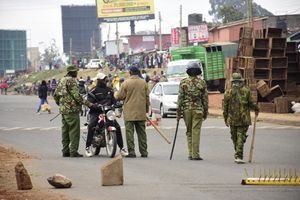
Hours before sunrise, police mounted roadblocks along Thika Road at Kimbo, Ruiru, Githurai and the Eastern Bypass roundabout. Similar checkpoints appeared along Waiyaki Way, Mombasa Road and Namanga Highway.
Thousands of commuters abandoned public transport and continued their journeys on foot after matatus and buses were prevented from proceeding towards the city centre.
Along Thika Road, one of the country’s busiest highways, traffic volumes dropped sharply as heavily armed officers maintained a visible presence throughout the day.
At Kihunguro in Ruiru, traders and boda boda operators organised private security teams to guard businesses against possible attacks.
“We are here to ensure everything remains peaceful. We have seen what happens when demonstrations turn ugly because businesses are destroyed and livelihoods lost,” said one coordinator overseeing the security teams.
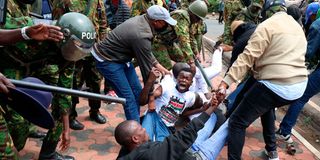
A police officer drops his firearm while running after a protestor at Kencom bus stop in Nairobi on June 25, 2026 during the second commemoration of the 2024 anti-Finance Bill protests.
Photo credit: Evans Habil | Nation Media Group
At Githurai 45, police patrol vehicles dominated the streets as officers dispersed groups of youths gathered along the highway, including some playing football by the roadside.
At some point, police used tear gas to disperse youths who were throwing stones at motorists and security officers, even as more police officers were brought into the area.
For commuters, the disruption was severe.
“I was supposed to report to work as usual, but now I have to walk all the way to Nairobi CBD,” said Maurice Atema as he joined hundreds trekking towards the city.
Along Waiyaki Way, police adopted a preventive approach by blocking potential gathering points at Kangemi and 87, limiting the formation of large crowds. The strategy appeared largely effective, with only isolated confrontations reported.
One brief standoff erupted when a group of youths attempted to attack motorists leaving the city, prompting police to fire teargas before restoring order.
For much of the day, Nairobi existed in a tense state of anticipation.
Residents braced for confrontations that never fully materialised while businesses counted losses from restricted movement and reduced customer traffic.
“Business has been slow, but at least we have not experienced the destruction associated with previous demonstrations,” said Nelson Mbugua, a wholesale trader.
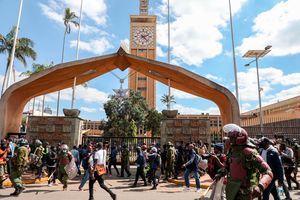
While roadblocks dominated the city’s entrances, the symbolic centre of the anniversary remained Parliament Buildings—the site that became synonymous with the Gen Z uprising after protesters breached its precincts on June 25, 2024.
On Thursday, Parliament stood behind layers of razor wire, barricades and heavily armed anti-riot officers.
Wreaths on razor sharp barbed wire that barricaded Parliament Road in Nairobi on June 25, 2026 as the nation marked the second anniversary of the Gen Z protests.
Photo credit: Francis Nderitu | Nation Media Group
Mounted police units patrolled surrounding streets while water cannons, armoured vehicles and police trucks remained on standby.
Subaru vehicles with obscured registration plates were stationed throughout the CBD as plainclothes officers blended into crowds, some disguised as boda boda riders.
Despite the restrictions, authorities eventually allowed families of victims and opposition leaders to access the area for a wreath-laying ceremony.
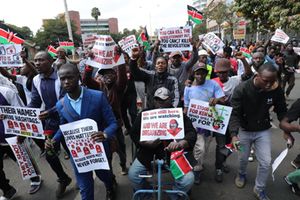
Family members of victims who lost their lives during the 2024 Gen Z anti-Finance Bill protests with activists outside Parliament Buildings in Nairobi on June 25, 2026 during the second anniversary of the protests.
Photo credit: Bonface Bogita | Nation Media Group
Around 11am, opposition leaders Kalonzo Musyoka, Martha Karua, David Maraga, James Orengo and Eugene Wamalwa joined grieving families near Parliament to honour those killed during the 2024 protests.
Families carried photographs of their loved ones and laid wreaths in memory of young Kenyans whose lives were cut short during the demonstrations.
Opposition leaders (from left) Eugene Wamalwa, Kalonzo Musyoka, Martha Karua, and former Chief Justice David Maraga hold wreaths on June 25, 2026 as they headed to Parliament Buildings during demonstrations marking the second anniversary of the 2024 anti-Finance Bill protests.
Photo credit: Bonface Bogita | Nation Media Group
Among them was Gillian Munyao, mother of Rex Masai, widely regarded as the first victim of the June 2024 protests.
Standing near Parliament after laying a wreath, she delivered a simple but powerful message.
“Compensation cannot replace the life we lost. Arrest the killer cops,” she said.
Her words captured the unresolved pain and unanswered questions that continue to haunt families of those who died.
Gillian Munyao, the mother of the late Rex Masai, speaks to the media in Nairobi on June 25, 2026 after laying wreaths at Parliament Buildings in honour of her late son.
Photo credit: Francis Nderitu | Nation Media Group
As commemorations continued, police unveiled a new crowd-control tool that signalled a shift in security tactics.
For the first time during a major protest anniversary, officers deployed a Long Range Acoustic Device (LRAD), a powerful sonic communication system originally developed for military operations.
The device, capable of transmitting commands and warning tones over distances exceeding two kilometres, was used in the CBD when demonstrators attempted to march towards Nairobi Central Police Station demanding the release of arrested activists.
Around 1:30pm, police combined LRAD broadcasts with teargas to disperse the crowd.
Interior Cabinet Secretary Kipchumba Murkomen said 355 people were arrested during demonstrations held across the country on Thursday, even as he praised Kenyans for maintaining peace.
Nairobi County recorded the highest number of arrests at 161, followed by Kajiado with 123 and Kiambu with 36. Other arrests were reported in Murang’a (12), Bungoma (9), Meru (6), Laikipia (5) and Machakos (3). There were no arrests in Nyanza, Coast and North Eastern regions.
Those arrested are expected to face charges including robbery, vandalism, road obstruction and attempted stealing.
The deployment highlighted how crowd-control tactics have evolved since the 2024 protests when police largely relied on teargas, water cannons and physical force.
Police officers on patrol in Kitengela town, Kajiado County on June 25, 2026, during the second anniversary of the Gen Z protests.
Photo credit: Dennis Onsongo | Nation Media Group
Deputy Inspector General Gilbert Masengeli said police remained supportive of peaceful demonstrations.
“I am happy that Kenyans have respected each other’s rights. As police, we have ensured everyone remains safe,” he said.
Beyond Nairobi, the security operation extended to other towns.
In Mlolongo, police erected roadblocks along Mombasa Road and screened motorists before allowing them to proceed. The operation left many travellers stranded.
“A lot of people are stranded here. They are travelling to different places but cannot get there,” said public transport tout Dennis Nyabuto at Cabanas.
In Kitengela, businesses remained closed for most of the morning as traders feared looting and unrest. Police presence was particularly heavy following the arrest of several individuals accused of mobilising demonstrations.
Among those arrested were human rights activist Bob Njagi and Aslam Longton, one of the individuals linked to the widely publicised “Kitengela Three” case.
Yet despite the arrests, roadblocks and unprecedented security deployment, the widespread violence feared by authorities largely failed to materialise.
Reporting by Steve Otieno, Dan Ogetta, Ndubi Moturi, Kevin Cheruiyot, Jurgen Nambeka, Stanley Ngotho