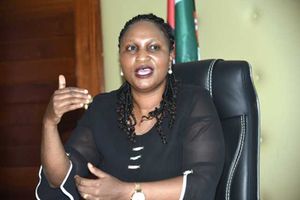
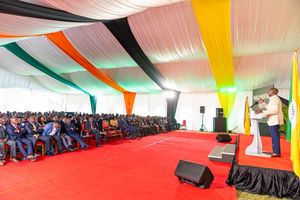
Registrar of Political Parties, John Cox Lorionokou says Kenya currently has 92 fully registered political parties and 27 provisionally registered ones, bringing the total to 119 political vehicles.
The records show that the country’s political landscape is undergoing a quiet but consequential transformation in terms of parties’ registration.
Beyond the rallies, alliances and high-stakes presidential manoeuvres lies a fast-growing industry whose profitability is rarely discussed openly: the business of political parties.
As the country inches toward the 2027 General Election, the registration of new political outfits has accelerated, driven not just by ideology or democratic zeal, but by money, leverage and political survival.
From glossy headquarters in Nairobi to skeletal offices in county towns, political parties are multiplying at a pace that mirrors Kenya’s increasingly fragmented politics.
What was once the preserve of mass movements and ideological platforms has become, for many political actors, a strategic investment — one that offers financial returns, bargaining power and insurance against exclusion.
At the centre of this proliferation is access to public funding. Registered political parties that meet statutory thresholds qualify for allocations from the Political Parties Fund, a taxpayer-supported kitty meant to strengthen democracy by supporting party activities.
In the 2025/26 financial year, President William Ruto ’s United Democratic Alliance (UDA) and the Orange Democratic Movement (ODM) steered by Dr Oburu Oginga, were allocated the largest share of the Political Parties Fund, a total of Sh 1.2 billion.
The office of the Registrar of Political Parties announced that only 47 political parties were eligible for the funding.
UDA was set to pocket the highest allocation at more than Sh789 million as ODM secured more than Sh421 million, leaving other parties to scramble for the rest.
The Jubilee Party for ex-president Uhuru Kenyatta, once the ruling outfit, secured an allocation of Sh184 million, while Kalonzo Musyoka’s Wiper Patriotic Front was earmarked to benefit from Sh98 million.
Eugene Wamalwa’s Democratic Action Party Kenya (DAP-K) was meant to receive Sh43 million, while FORD-Kenya, headed by National Assembly Speaker Moses Wetang’ula, qualified for Sh35 million.
The United Democratic Movement (UDM) secured Sh36 million, and the Kenya African National Union (Kanu), led by Mr Gideon Moi was allocated Sh32 million. The majority of smaller political outfits secured minimal allocations.
The funding imbalance had even triggered protests from minor parties. On September 10, 2025, a coalition of smaller parties filed a petition to Parliament demanding amendments to the Political Parties Act, 2011.
They argued that the funding formula was skewed in favour of dominant parties and undermines their ability to prepare adequately for the 2027 General Election.
National Liberal Party (NLP) leader Augustus Muli criticised the arrangement, saying it had crippled operations for smaller outfits, laying bare the clamour for registration of parties.
“Out of 91 registered political parties, only 47 are funded. This has crippled our ability to operate offices and organise campaigns,” he said then.
The kitty was set to allow parties to maintain offices, hire staff, mobilise supporters and remain operational even outside election periods.
For small parties struggling to survive in a competitive political environment, the fund is often the difference between extinction and relevance.
But public funding is only part of the attraction. Registration also confers the legal authority to field candidates.
Only registered parties can officially nominate contenders for elective office, making party ownership a critical gateway to electoral participation.
Nomination seasons, in particular, have become lucrative moments. Aspiring candidates pay nomination fees — sometimes running into hundreds of thousands of shillings — creating a steady revenue stream for party owners.
In parties with weak internal competition, the leadership effectively controls who gets a ticket, turning nominations into a powerful commercial and political tool.
Further still, some party owners sell the outfits at higher prices, thus turning them into profit-making tools.
ODM, for instance, was acquired from Mr Mugambi Imanyara, who offered the party to the late Raila Odinga following Mr Musyoka’s exit from the camp with the ODM-Kenya.
Lawyer Mugambi Imanyara (left) hands over ODM documents to Raila Odinga.
Photo credit: File| Nation Media Group
Founding ODM officials Henry Kosgei (Chairman) and Prof Anyang'’ Nyong’o (Secretary General) recalled during the party’s 20th anniversary in Mombasa in November last year how ODM-Kenya slipped from Raila Odinga and William Ruto’s camp on the eve of the 2007 elections.
Their recollections reveal how the hijack by Kalonzo Musyoka’s team forced the movement to fall back on an earlier ODM certificate held by lawyer Mugambi Imanyara.
Mr Mugambi Imanyara.
Photo credit: File | Nation Media Group
Speaking at the ODM Founders’ Dinner at Sarova Whitesands Resort in Mombasa, Mr Kosgei gave a recollection of a movement struggling to find its footing after the 2005 referendum victory, only to be ambushed by internal sabotage, state pushback, and ambitions that threatened to scatter Kenya’s most iconic opposition force.
The night also featured a narration from ODM’s pioneering Secretary-General, Prof Anyang’ Nyong’o, who situated ODM’s emergence within a broader national struggle against authoritarianism, political manipulation and betrayal.
Together, the two testimonies painted the fullest picture yet of how ODM survived its most perilous birth pangs.
Coalition politics has further amplified the value of party registration in Kenya. Kenya’s elections are increasingly won through alliances rather than standalone parties, and registered outfits — regardless of size — gain negotiating power during coalition talks.
A party with a handful of seats or regional influence can bargain for Cabinet slots, parliamentary leadership positions or development promises. In an alliance-driven system, numbers matter, but so does symbolism: every registered party adds weight to a coalition’s claim of national reach.
Even without clear presidential ambitions, politicians establish parties early to build structures, recruit members and prepare for future electoral cycles.
The party becomes a long-term asset — a political vehicle that can be activated when the timing is right or traded during coalition negotiations.
Registration has also provided a legal vehicle for regional and issue-based mobilisation. Groups that feel marginalised by dominant national parties — whether along regional, ethnic or ideological lines — find refuge in registering their own outfits.
Some parties are born out of fallout from major political formations, offering disgruntled leaders a new platform to mobilise supporters without defecting into political oblivion.
For emerging leaders and minority interests, owning a party offers protection against political exclusion.
In a system dominated by powerful kingpins and party barons, registration acts as insurance — a way of guaranteeing a seat at the negotiating table, however small. Even politicians with limited electoral prospects find value in controlling a party, which can later be merged, rebranded or absorbed into larger coalitions.
Official records underscore the scale of the phenomenon. According to the Registrar of Political Parties, Mr John Cox Lorionokou, Kenya currently has 92 fully registered political parties and 27 provisionally registered ones.
“I’m not sure about the ‘high clamour’ (for registration) as you put it, because as a country our Constitution provides for multi-party democracy and political rights for all Kenyans,” Mr Lorionokou told Nation.
“There is no capping on the number of political parties we should have. However, increased awareness of political rights and the need for expanded democratic space and voice are contributing factors,” he added.
Yet analysts argue that the surge is less about civic awakening and more about political economics. Political analyst Dismas Mokua describes the trend as unprecedented, driven largely by individuals with political capital and financial resources.
“One, political parties in Kenya hardly practice internal democracy,” Mr Mokua said. “Party primaries cannot be described as free nor fair. Persons who want to run for electoral office but don’t want to present themselves as independent candidates opt to register political parties. Owning a political party immunises politicians from the vagaries of party dictatorship during party primaries as witnessed in big political parties.”
Internal wrangles, chaotic nominations and arbitrary ticket allocations in major parties have pushed ambitious politicians to seek refuge in personal outfits where control is guaranteed. In such setups, the party leader is also the gatekeeper — eliminating the uncertainty that comes with competitive primaries.
But beyond political security lies money. “Political parties are a business with a very high return on investment,” Mr Mokua said. “Having a political party in Kenya creates big revenue opportunities during general elections. Party owners make money when dishing out nomination certificates. Parties that meet the bare minimum in having requisite representation in legislative assemblies access taxpayers’ resources via the Political Parties Fund.”
He notes that many of the bitter internal disputes witnessed in political parties revolve not around ideology, but control of the Political Parties Fund. Leadership battles are often proxy wars over access to state-backed financing, underscoring how parties have morphed into revenue-generating entities.
Owning a political party has also become a status symbol. In Kenya’s political culture, party ownership signals arrival. It elevates politicians into the exclusive club of “principals” — actors recognised as key decision-makers during coalition formation.
“This is how politicians pronounce their arrival in the political space and access political negotiation sanctums,” Mr Mokua said. “Owning a political party elevates one to the role of a principal in coalition formations.
"A principal participates in crafting and sharing power. Politicians without political capital nor political parties hardly participate in power-sharing negotiations.”
In this sense, political parties function as political currencies. Even small parties with limited grassroots support can translate their legal status into influence by aligning with larger coalitions. Some are formed purely as bargaining chips, designed to be traded for positions or protection.
At times, party formation is also deeply personal. Analysts point to instances where politicians establish parties to settle scores, challenge former allies or anchor legal and political fights. The emergence of outfits like the Democracy for the Citizens Party (DCP) has been widely interpreted as strategic moves born out of personal and factional battles rather than ideological differences.
Critics warn that the commercialisation of political parties risks hollowing out democracy. When parties exist primarily as vehicles for profit or personal ambition, ideology takes a back seat.
“Manifestos become generic, membership lists inflated and grassroots structures thin. Voters are left navigating a crowded ballot of parties that often stand for little beyond the ambitions of their founders.”
Yet defenders argue that pluralism, however messy, is preferable to exclusion. They contend that the proliferation of parties reflects Kenya’s vibrant — if chaotic — democracy, offering multiple entry points into political participation. In a country with deep social, regional and economic diversity, they argue, many parties are inevitable.
The challenge, analysts say, lies in regulation and enforcement. Stronger oversight of party financing, stricter thresholds for public funding and enforcement of internal democracy could help distinguish serious parties from briefcase outfits.
Without reforms, they say, the political marketplace risks becoming saturated with parties that exist only on paper — or as profit centres.
As Kenya heads toward another high-stakes election cycle, the booming business of political parties offers a revealing window into how power is organised, traded and monetised.
But behind the lofty language of democracy and representation, analysts say, lies a hard reality that in modern Kenyan politics, a political party is not just a platform, but an asset.